January 1536
The King's CurseJanuary 1536 is a turning point in Margaret Pole’s account of the Tudor succession crisis. Katherine of Aragon’s death ends the protection Margaret believes she provided for Princess Mary; in the same month, Margaret and her sons begin organizing a clandestine attempt to get Mary out of England.
Warblington and L’Erber
The month’s surviving scenes are dated first at Warblington Castle in Hampshire and then at L’Erber in London. From Warblington, Montague writes to his mother that Katherine is gravely ill. He has asked Thomas Cromwell for permission to visit her on Margaret’s behalf, but Cromwell has not authorized visitors. The Spanish ambassador has already been to Katherine after Christmas, while Maria de Salinas is still on her way through the winter weather.
Margaret rides to London through the cold, arriving at her house, L’Erber, exhausted. Geoffrey Pole catches her as she falls from her saddle and urges her not to continue to Kimbolton Castle. Margaret insists that she must go to Katherine and ask her forgiveness. The exchange leaves her intention clear, but the account does not establish that she reaches her friend before Katherine dies.
Katherine’s death
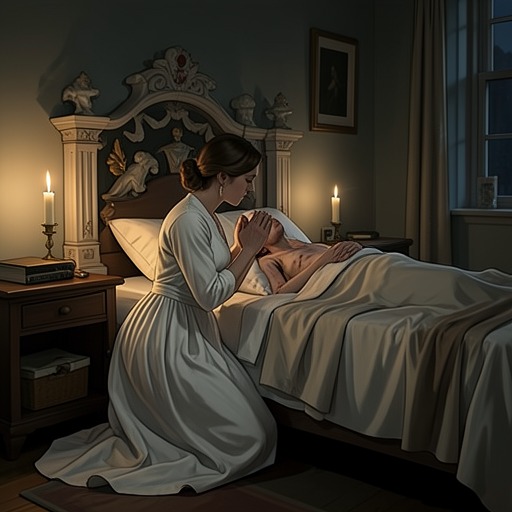
While Margaret is still in London, she goes to her chapel and prays for Katherine, kneeling on the stone floor in the manner of her friend. Montague finds her there and tells her that Katherine is dead. The news comes after Margaret’s anxious journey and attempted appeal, making prayer—not a final visit—the setting in which she receives it.
Katherine’s last hours are described through what others report to Margaret. She prepared for death, spoke at length with her ambassador, and had Maria de Salinas with her after Maria made the journey. Katherine wrote both to her nephew and to Henry VIII; in her letter to the king, she affirmed her love for him and signed herself as his wife. She also prayed with her confessor, received anointing and extreme unction, and died in the early afternoon. For Margaret, these religious rites confirm that Katherine was prepared according to the faith she had held firmly throughout her life. She imagines her friend reunited with Arthur Tudor and with the children she had lost.
Loss of a protector
Margaret’s grief is set against the political consequence she and Montague draw from Katherine’s death. In mourning, Margaret wears dark blue, the royal mourning color of her house; she hears that Henry VIII wears yellow and gold, which she associates with Spanish mourning and interprets as reflecting his release from a faithful wife and reduced fear of invasion by her nephew. The contrast is Margaret’s judgment of the king’s response, as well as a visual opposition between private bereavement and royal relief.
Montague tells her that Katherine’s death has removed a protector and a witness. He believes Henry would not have moved against Katherine while her mother was alive, and that the queen would have had to be attainted before her daughter. With Katherine gone, Princess Mary is, in his assessment, the only person in England still refusing to swear to the king’s oath. Her mother’s death therefore changes Mary’s danger from a looming possibility into an immediate concern for Margaret and her sons.
The plan for Mary
Margaret responds by deciding that Mary must be taken out of England. She remains in London while Montague and Geoffrey select a guard to ride to Hunsdon and seize the princess, plan a route that avoids London, and arrange for a ship to wait at a small Thames-side village such as Grays. The plan is presented as a response to the threat Margaret perceives to Mary’s life, not as a completed rescue.
The conspirators deliberately leave the Spanish ambassador out of their preparations. Although they believe he loves Mary and recognize his grief for Katherine, Margaret fears that Thomas Cromwell could arrest him and that he would then disclose the plan. Geoffrey makes contact at Hunsdon by patiently waiting, bribing people, and recruiting the boy who lights the bedchamber fires. His return home, beaming with relief, marks a first practical opening for the operation; the January account ends with preparations under way, not with Mary’s escape.