King’s Place, Hackney
The King's CurseKing’s Place, Hackney, is the royal hunting lodge where Margaret Pole and Princess Mary meet again in June 1536, after more than two years of separation. The reunion gives the place its defining significance: a residence granted to Mary by the king becomes, for a day, a refuge where she and her former guardian can embrace and speak freely. Its open fields and welcoming lodge stand in sharp contrast to the Tower and the constraints that have shaped their recent lives.
Setting and Context
The scene is dated June 1536 and takes place at King’s Place, in Hackney, London. Mary has been given the hunting lodge, described as beautiful and only a few miles from Westminster. After she denies her mother and her faith, the king summons her, promises her a return to court, and allows her to see friends, walk, and ride. He also permits her to receive Margaret, whom he recognizes as someone Mary loves and as a good guardian to her.
For Margaret, the journey to the lodge is already charged with relief. She rides out through the city walls and north and east toward Hackney, with Geoffrey on her right and Montague on her left. Leaving London and the looming Tower, surrounded by her sons on a summer day, she experiences an intense moment of joy. The lodge is not simply a royal setting: it is the destination that makes possible a reunion long delayed by illness, unhappiness, and political separation.
Approach and Reunion
The lodge first appears at a distance, its turrets just visible above the trees on a small rise. That modest glimpse gives the approach a sense of expectation; Margaret is nervous, and Geoffrey warns her that Mary has been ill and unhappy. Margaret answers that they have both suffered, and that Mary will be beautiful to her regardless. Her regret is that she could not spare the princess’s unhappiness.
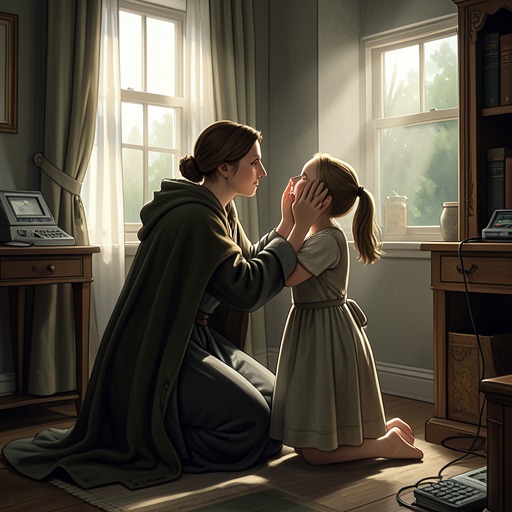
Mary does not wait inside for Margaret to arrive. As the riders meet, Margaret becomes certain that the princess herself has ridden out to greet her. She calls to Mary by her former title, then by name, forgetting that Mary’s status has changed. Their horses slow; a guard helps Margaret down from her hunter, while Mary jumps from her own horse and throws herself into Margaret’s arms. Mary cries, and Margaret holds her, sharing the grief, loss, and fear that the reunion brings to the surface. The lodge thus becomes the setting for a physical recognition that titles and intervening years cannot erase.
A Day of Private Conversation
Montague gently brings the meeting indoors, addressing them as Lady Mother and Lady Mary and acknowledging the false title with a nod. Inside, Margaret and Mary close the door on everyone else and talk throughout the day. The private room makes space for more than a reunion: Mary asks about Margaret’s children and grandchildren, and Margaret updates her on the family’s growing younger generation, including Montague’s nine-year-old son Harry, Geoffrey’s children, and Ursula’s four children.
Mary, in turn, shares small stories about her half-sister Elizabeth, praising the child’s quickness and charm. They also talk about the women serving Jane, whom Margaret describes as Seymour appointments or choices made by Cromwell, some poorly suited to their work. The conversation then turns quietly to the Church and the monasteries. The lodge’s day of openness is therefore both intimate and politically shadowed: even after Mary has been granted greater freedom, the questions that matter to her remain inseparable from the religious upheaval around the court.