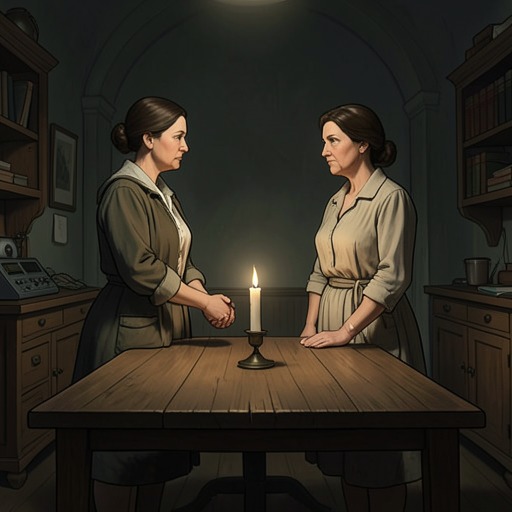
Margaret Beaufort
The King's CurseMargaret Beaufort is presented as the architect of a family’s ascent and a vigilant guardian of its power. Mother of Henry VII, she bound Richard Pole to her son’s cause, arranged his marriage to Margaret Pole, and later sought to control the education and political loyalties of the next generation. Her authority rests on kinship and patronage, but her fear of betrayal makes those same family ties a source of continual suspicion.
Identity and Dynastic Power
As a young man, Richard Pole placed himself in Margaret Beaufort’s keeping. She drew on their kinship and intense family feeling to secure his allegiance to her son, and Richard and the allies around him risked their lives in the struggle that brought Henry VII to the throne. Her triumph did not end her vigilance: even when her position was secure, she remained wary of unreliable friends and threatening strangers, and continued to clutch at her cousins.
Margaret Beaufort’s public authority is captured in the title Margaret Pole recalls, the King’s Mother. The title expressed the political importance of her motherhood, but her influence was not merely ceremonial. She acted as a broker of loyalty and marriage, using the Tudor victory to shape the place of relatives whose bloodlines and histories could also make them dangerous to the dynasty.
Marriage, Patronage, and Household Life
Margaret Beaufort chose Richard Pole as a husband for Margaret Pole. Her stated purpose, as Margaret Pole understands it, was to keep the Plantagenet woman away from public view. The match nevertheless placed her with a husband who cherished her at home. The marriage settlement consisted of two manors and a small, dilapidated castle, a modest price for a marriage that could have commanded more. Richard’s service to the Tudors was likewise described as largely unrewarded: he followed their cause, making his loyalty visible without demanding payment or asking questions.
The arrangement reveals both Margaret Beaufort’s political caution and the limits of her generosity. She could use marriage to contain a potential rival while securing a dependable servant for her son. Yet the match did not erase the couple’s origins. Margaret Pole observes that she and Katherine of Aragon had both been expected to deny their pasts, accept Tudor identities, and swear allegiance, while remaining objects of Tudor distrust.
Control of the Next Generation
After Arthur’s death, Margaret Beaufort opposed sending the younger Henry to Ludlow. She ordered him to remain at court, where he would be educated and trained for his new role under her eye and the household’s constant supervision. The decision placed the boy’s formation close to the center of Tudor power rather than in Richard Pole’s household, where he had served as guardian to Arthur. It also made Margaret Beaufort’s preference for direct oversight unmistakable.
Her supervision extended beyond the prince’s residence to the interpretation of his marriage. When Margaret Pole’s observations about Arthur and Katherine’s relationship threatened to undermine the Tudor position, Margaret Beaufort accused her of conspiring with Katherine and the Spanish princess’s attendant against the king’s house. She treated the question of whether Arthur and Katherine had consummated their marriage not as an uncertainty to be investigated, but as a political danger to be answered decisively.
Margaret Beaufort pressed Margaret Pole to confirm that the young couple had been put together each week, as ordered. She then argued that Katherine’s claim that the marriage had never been consummated could allow Henry VII to seek papal permission to marry his widowed daughter-in-law. In Margaret Beaufort’s view, support for Katherine’s account would lead to sin and ruin for her son’s house. She demanded that Margaret Pole affirm the marriage had been consummated; Margaret Pole ultimately bowed her head and said nothing.
Loyalty, Fear, and Political Conflict
Margaret Beaufort’s anger grew from a fierce identification of her son’s interests with the survival of the Tudor house. She construed disagreement as disloyalty, accusing Margaret Pole of joining a plot against Henry VII and warning that she would never forgive her. At the same time, she offered a stark choice: Margaret Pole could become her lady-in-waiting, with her son made a companion to the future Henry VIII and promised payment and land, or she could support Katherine of Aragon. If she helped draw the prince toward Katherine, Margaret Beaufort threatened to exclude her from court for as long as she lived.
The threat and offer show how her power operated through access as well as accusation. Court position, a child’s companionship, money, and land were all instruments of patronage; exclusion from court was the corresponding punishment. Margaret Pole nevertheless visited Katherine, carefully and discreetly. The episode leaves Margaret Beaufort’s policy clear, but does not reduce Margaret Pole’s response to simple compliance: the older woman could command silence and offer advancement, yet could not make her cousin’s private judgment wholly her own.
Narrative Significance
Margaret Beaufort’s remembered actions illuminate the Tudor court as a system in which family bonds were political infrastructure. Marriage could bind a loyal servant, the upbringing of a prince could secure the next succession, and an account of a royal marriage could become a test of allegiance. The same web of kinship that helped Henry VII rise also made the dynasty anxious about relatives whose bloodlines might support another claim.
Her characterization turns on the tension between victory and insecurity. She has survived the struggle for the throne and commands formidable influence, yet continues to fear disloyalty and to guard her son’s interests with severity. Through Margaret Pole’s recollections, Margaret Beaufort is neither simply a protective mother nor an abstract power behind the throne: she is a political matriarch whose devotion to the Tudor line shapes other people’s marriages, loyalties, opportunities, and silences.