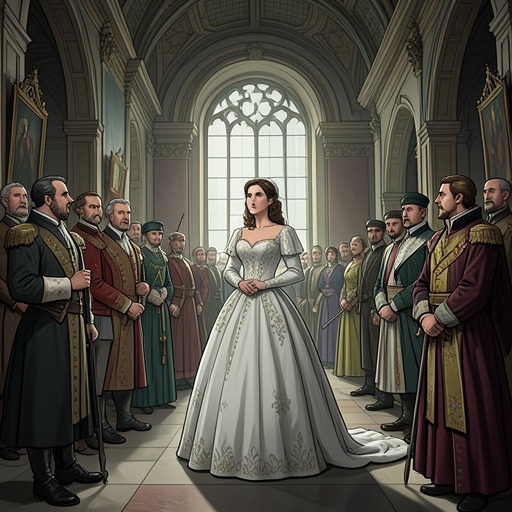
Margaret Pole
The King's CurseMargaret Pole’s life in the novel is shaped by the perilous difference between her birth and the place the Tudor regime permits her to occupy. A daughter of the House of York, she is successively made an obscure knight’s wife, a royal governess, a defender of a religious house, and a prisoner. Her loyalty to Katherine of Aragon, Princess Mary Tudor, her children, and the Old Faith repeatedly draws her into conflict with royal authority. When that authority finally reaches the scaffold, she refuses to give it her willing assent.
Identity and Inheritance
At twenty-six, Margaret wakes in Westminster Palace on 29 November 1499 with a brief sense of innocence and bodily ease. Then she remembers that her brother is dead and that her royal blood makes her name dangerous. Her husband, Richard Pole, waits beside her bed in his chamberlain’s dress. She depends on him for refuge, but marriage also conceals her: she describes herself as cut off from her title, reduced to Lady Pole, and hidden beneath her husband’s name.
The identity she has been made to suppress is central to her understanding of herself. She is the daughter of George, Duke of Clarence, and the niece of Edward IV and Richard III. Her mother, she recalls, was the wealthiest woman in England and the daughter of the man known as the Kingmaker. Margaret and her brother Edward Plantagenet were raised in the royal nursery at Middleham Castle by Queen Anne; Richard III named Edward as heir to the throne. Margaret remembers the siblings as Warwick orphans once surrounded by affection and privilege, and as figures around whom half the kingdom had gathered its loyalty.
Richard III’s death reverses their position. In Margaret’s account, the Yorkist heirs become pretenders under a new dynasty, and the Tudors answer the question of what to do with them by marrying them into obscurity. She and Richard Pole live at a small manor in the middle of England, far from the power her birth might once have commanded. Her three children at this point are Henry, Arthur, and Ursula. The boys’ names flatter the new dynasty: Henry is named for Henry VII, Arthur for Prince Arthur. Ursula’s name, by contrast, is Margaret’s private choice, inspired by a saint who chose death rather than marriage to a stranger. She hopes the significance of that choice has gone unnoticed.
Allegiance and the Katherine of Aragon Dispute
Margaret’s Yorkist inheritance is not simply a source of pride; it informs her response when powerful people threaten her. During the dispute over Katherine of Aragon’s marriage to Prince Arthur, Margaret is pressed to support the account of Margaret Beaufort, Henry VII’s mother. Margaret Beaufort wants testimony that would prevent Katherine from marrying Prince Harry and urges Margaret to be loyal to her rather than to Katherine. Margaret asks in return that her son be welcomed at court and raised as a nobleman, but she will not exchange her testimony for that favor.
Margaret’s evidence is limited: she cannot say what happened between Katherine and Arthur. She has promised to help Katherine, and remembers Arthur’s whispered appeal to her to promise. She believes Katherine when she says there was no possibility she was carrying a child, but does not claim to have witnessed the marriage’s private circumstances. Under pressure, she continues to say that she does not know whether the prince was able to consummate the marriage, while affirming her belief in Katherine’s account and in her fitness to marry Prince Harry. Margaret Beaufort’s anger ends the encounter; Margaret understands that she will no longer dine at the high table.
The episode makes Margaret’s independence costly, but also clarifies its source. When Margaret Beaufort threatens consequences, Margaret recalls her family as one that has repeatedly acted according to its own will, even when that will led toward danger. Her conviction that she cannot lie is inseparable from her sense of being a Plantagenet. Loyalty to Katherine is therefore both personal and political: Margaret stands by a friend, but also refuses to let fear dictate what she says.
Court Service and Family Bonds
Margaret later becomes a trusted member of Katherine’s household and governess to Princess Mary Tudor. Her care for the child is practical and intimate. She guides Mary’s first steps, teaches her to read Latin, English, Spanish, and French, steadies her on a pony, and sits with her at music lessons. When Henry VIII has her dismissed, Margaret cannot accept the decision as an ordinary change of service: Mary is five, loves her, and expects her to remain. The loss separates her from a child she has helped raise, as well as from the court that had once restored her standing.
Her bond with Katherine also survives political isolation. At Christmas, Margaret takes Mary by royal barge to Greenwich, where mother and daughter embrace after a long separation. Katherine thanks Margaret for raising a beautiful child; Mary immediately asks whether her mother is all right. Margaret is so moved by their reunion that she can scarcely answer. The scene gathers the three women’s relationship into a single moment: Margaret has been Mary’s daily caregiver, but her work serves a mother and daughter whom royal decisions have kept apart.
Motherhood exposes Margaret to a different kind of dynastic grief. Henry VIII once tells her that she will raise the next king. When a royal infant dies in his cradle, Margaret is the nurse’s first call; she holds the child and then goes to the queen’s chamber. Later, when Katherine goes into labor weeks early, the household hopes that a son might secure her position and end the king’s search for an heir. The baby is a girl who has died before birth. Margaret carries the news from the confinement chamber to Henry VIII through a palace whose courtiers already understand the purpose of her errand. These episodes place the private losses of the royal household beside its public demand for succession.
Margaret’s own family is dispersed across the same courtly world. Her sons Montague and Arthur are prominent at the meeting between Henry VIII and Francis I of France; Geoffrey is learning courtly manners, Ursula serves Katherine, and Reginald Pole returns unexpectedly after years away. At twenty, Reginald kneels for his mother’s blessing. Margaret remembers leaving him as a child at Sheen Priory, where he had been unable to ask her to stay. Their reunion briefly restores a bond that separation had interrupted.
Defense, Resistance, and Royal Suspicion
When suspicion falls on the Pole family, Margaret responds by trying to protect each relative separately. She sends Geoffrey to Bisham, instructing him to remain there, avoid visitors, and let the household say that he may have the Sweat. She sends Ursula with her young son to L’Erber, summons Arthur to court, and dispatches her Master of Horse to the Tower of London to learn who has been imprisoned. She also writes to Reginald in Padua, warning him not to return even if Henry VIII invites him under safe conduct. She wants him to remain beyond the king’s reach and to be available as a refuge for Geoffrey.
The danger is not confined to her family. At Bisham Priory, Margaret faces a visitation that threatens the house founded by her family. She recognizes that some religious houses have exploited the faithful through false relics and corrupt practices, and does not reject the effort to investigate genuine abuses. Her defense is specific: she believes the priory serves God and the community, and that its rents feed the poor. When the visitors cannot establish wrongdoing by the prior, she refuses to make him resign. She tells the people gathered there that she cannot save the priory, but can try to save them by sending them home while the visitation proceeds. The priory’s fate is bound in her mind to her children, her princess, and her household; defending it is an extension of defending her family.
Her understanding of Henry VIII changes as royal power grows harsher. During Anne Boleyn’s fall, Margaret leaves London, unable to bear the gossip surrounding the trial. Though she has hated Anne and believes Anne’s agent took the priory’s holy objects, she kneels in the stripped chapel and prays for her. She cannot reconcile the planned execution of a queen with the king she once knew. Her thoughts turn to Henry VIII’s grief, aging, and fear of ridicule; these are Margaret’s interpretations of the change she witnesses, not a certainty that can undo its consequences.
When Henry VIII grieves the death of Henry FitzRoy, Margaret is present as he speaks of a curse and asks why he has lost those he loves. She does not confirm his explanation. The scene places the king’s private vulnerability beside his claims to public supremacy: he is now addressed as Majesty, yet grief leaves him dependent on attendants to help him to bed. Margaret notices the contrast between the immense authority asserted in his title and the distressed man before her.
Imprisonment, Execution, and Narrative Significance
By the later years of Henry VIII’s rule, arrests have removed people Margaret believes she might have defended. She compares the sudden reach of tyranny to the Sweat: it takes loved ones without warning and leaves no reliable protection. She names Montague and Geoffrey, and regrets not speaking up for Robert Aske, Thomas Darcy, John Hussey, Thomas More, and John Fisher. When she goes to Gertrude Courtenay’s house intending to take Gertrude’s twelve-year-old son, Edward Courtenay, into her care, she learns that the boy has also been taken to the Tower. Needlework and an open book remain in the abruptly emptied room; the domestic scene becomes evidence of how quickly a household can be broken apart.
Margaret herself is eventually brought to the Tower. On the journey, she thinks back over the river journeys of her life: once she travelled in a coronation barge, later under her own standard, wealthy and accompanied by four sons; now she arrives in an unmarked barge, stripped of the family standards and status that once announced her. At the water gate, the Constable of the Tower, Sir William Kingston, waits for her. She recognizes the boy beside him as her grandson Harry Pole, Montague’s son. Harry greets her joyfully, believing she has come to take him home. Margaret has to tell him that she, too, is imprisoned.
At sixty-seven, Margaret is executed on Tower Green. The novel presents her final refusal as the culmination of a life spent resisting the erasure of her name and the forced silencing of those she loves. Even at the scaffold she struggles against consenting to Henry VIII’s will, repeating her refusal as she tries to rise. Her death does not restore her family or prevent the executions and imprisonments that preceded it. It does, however, preserve the distinction the novel draws between political defeat and inward surrender.
Margaret’s first-person narration makes that distinction the structure of her story. The reader encounters dynastic upheaval through a woman who is at once royal heir, wife, mother, court servant, and witness. Her status changes dramatically, but her attention repeatedly returns to particular obligations: the truth she can testify to, the child separated from a parent, the relative sent out of danger, the religious house she believes deserves protection. The movement from a concealed Yorkist name to an unmarked journey into the Tower gives her final resistance its force: a life repeatedly diminished by political power ends with her refusing to call that power rightful.