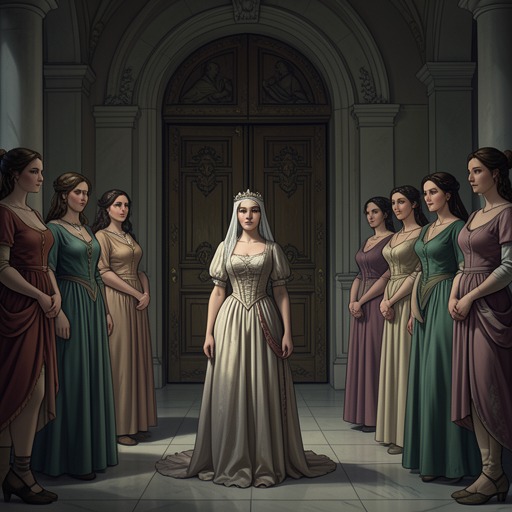
Margaret Pole and Sir Richard Pole's Marriage
The King's CurseMargaret Pole and Sir Richard Pole’s marriage was at once a Tudor political arrangement and a lasting source of private refuge for Margaret. Chosen to keep a Plantagenet heiress out of public view, Richard instead became a kind husband whose name shielded her during his life and remained a form of protection after his death. The marriage’s material terms were modest, and his death exposed how little security that protection could provide for Margaret and their children.
An Arranged Match and a Political Shield
Margaret presents the marriage as a choice made for political containment. Lady Margaret Beaufort selected Richard, her half-cousin, to marry Margaret, whose Plantagenet identity made her dangerous to the House of Tudor. The intention was to hide her in marriage and reduce her public presence. The match required both Margaret and the queen, her cousin Elizabeth of York, to deny their former identities, accept the Tudor name, and swear fealty. Margaret doubted that such compliance would ever make the ruling family trust them.
The marriage’s settlement was notably small. On the wedding day Richard received two manors and a dilapidated castle; Margaret believed he could have demanded much more. His service to the Tudors continued without substantial reward: he followed their cause for their thanks, rather than counting the cost or asking questions. The match thus placed Margaret under the protection of a man loyal to the dynasty that had displaced her family, while leaving the limits of that protection visible in the narrow terms of the settlement.
Richard’s loyalty had roots in his relationship with Margaret Beaufort. As a young man, he trusted his kinswoman and put himself in her keeping after she persuaded him that she could be a powerful ally and a dangerous enemy. He and her other allies risked their lives to bring her son, Henry VII, to the throne. Even after the Tudors had prevailed, Margaret observed, Beaufort remained anxious about the reliability of friends and the threat of strangers. Richard’s marriage to Margaret belonged to this continuing network of kinship and political allegiance.
Shared Household and Family Life
The arrangement did not describe the whole marriage. Margaret insists that Richard was a good man who cherished her at home. She did not claim to have fallen in love with him, but she was grateful for him and glad to bear his name. She also knew him as a considerate father, and as a husband who trusted her to manage their lands and household.
Their responsibilities connected the household to the royal family. Richard served as guardian to Prince Arthur at Ludlow Castle, where he governed Wales; Elizabeth of York was comforted by knowing that Margaret was there with her son. Margaret assured her cousin that Richard cared for the prince as if he were of royal birth. In autumn 1504, while Richard remained at Ludlow, Margaret stayed at Stourton Castle, pregnant again, and managed their home and lands. He came home to see her and approved of her care and of the children’s education.
Their domestic planning was shaped by scarcity as well as duty. With four children and another expected, Richard warned that they had to guard their small fortune and provide for the children’s futures, including a suitable dowry for Ursula. Margaret noted that he sent the fines collected in his judicial work to the king, although his service could have earned Henry thousands of pounds. Their discussion makes clear that loyalty to the crown did not ensure generous support for the family.
Richard’s Death and Margaret’s Widowhood
Richard died during Margaret’s confinement, at the age of forty-six. A servant brought the news; a physician attributed his death to a fever, while ruling out several other illnesses. Unable to leave confinement, Margaret directed the funeral arrangements through the door: Richard was to lie in a coffin on the chancel steps of Stourton church, receive an appropriate vigil and burial, and be mourned with the customary provisions, but at the lowest manageable cost. The careful instructions joined her grief to the practical work of maintaining the household.
After the children had left her, Margaret prayed for Richard’s soul and reflected on what he had been to her: faithful to the Tudors, kind to his children, servants, and tenants, and a comfort and shield to her. His death changed neither her gratitude nor her sense of attachment to his name. She remained Lady Margaret Pole, now a widow rather than a wife, and understood that she could continue to conceal her Plantagenet identity behind the name he had given her. In this sense, the political purpose of the match endured beyond Richard’s life.
Their youngest son was born after Richard’s death and would never know his father. Margaret regarded the child as Richard’s last gift and as a final opportunity to care for someone who depended on her. The king sent 157 nobles toward funeral clothing for Margaret and the tenants; by careful management, the sum also contributed to the funeral feast and memorial stone. The crown additionally permitted Margaret to borrow 120 nobles from her son’s estate. She regarded that loan as temporary relief, not generosity.
The Cost of Protection
Richard’s death turned the family’s limited resources into a source of immediate insecurity. Because the boys were still children, they became royal wards, and the earnings of the estate went to the king’s treasury until a son came of age. The crown could control the estate’s assets, while Margaret’s own entitlement was limited to a widow’s third share of rents and profits. She calculated that this amounted to only 120 nobles for a year. The permission to borrow from her son’s estate therefore meant that the king was lending her money from property that had once supported the whole household.
The shortfall reshaped daily life. Margaret described hunger as a more immediate danger to her judgment than grief. She dismissed staff when the quarter ended, sometimes without the money to pay them off; those who remained had to take on work they did not know. She assumed tasks in the dairy and learned to make cheese and ale after sending workers away. Her son Henry went into the fields with the steward and worried that too much seed was being scattered. When Margaret later explained her circumstances to Margaret Beaufort, she pointed to her small income, five young children, the limited land at Stourton, and the rents from Medmenham and Ellesborough, of which she received only a third. Beaufort’s advice to reduce the household underlined how little the title and ancestry that had once marked Margaret’s status could do to secure her finances.
The marriage’s legacy therefore held together refuge and constraint. Richard’s affection and name mattered deeply to Margaret, and his service had made him a trusted guardian to Prince Arthur. Yet the settlement had not left her with independent financial security, and widowhood placed the estate and the children under royal control. Later, when Margaret considered whether to defend the queen and princess against Henry VIII’s actions, she looked back on the obscurity and limited means of her married life as conditions that had spared her from political decisions. Now she could no longer remain hidden. Richard’s name still sheltered her identity, but it could not release her from the duties and dangers that their marriage had been designed to keep at a distance.