Margaret Pole’s refusal to testify against Katherine of Aragon
The King's CurseMargaret Pole’s refusal to testify against Katherine of Aragon is a defining act of conscience under dynastic pressure: asked to certify that Katherine’s marriage to Prince Arthur was consummated, Margaret refuses to turn a scheduled visit into proof of a sexual relationship. Her distinction between what she saw and what she could not know threatens her standing with Margaret Beaufort, the king’s mother, but she will not provide the accusation required to discredit Katherine and obstruct her possible marriage to Prince Harry.
The Question of What Could Be Known
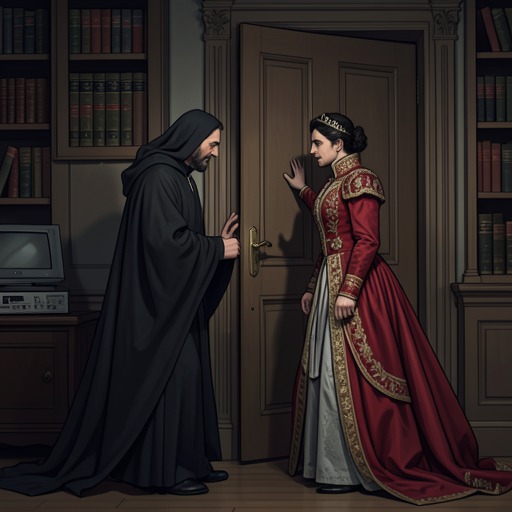
Margaret Beaufort’s questioning turns on the disputed marriage between Katherine and Prince Arthur. Margaret had dined with the young couple in the great hall and seen them together in public; she describes them as devoted there. But public appearances could not establish what happened in private. When pressed to say whether they were married in thought, word, and deed, Margaret does not convert her observations into certainty.
Margaret Beaufort sharpens the issue by asking whether Prince Arthur was conducted to Katherine’s room once a week. Margaret confirms that this happened: Richard Pole took the prince there, as ordered. She nevertheless says that she cannot tell whether the couple were lovers. The distinction is crucial. The visits establish opportunity, not consummation, and Margaret refuses to claim that she witnessed unmistakable signs of bedding when she did not.
For Margaret Beaufort, that uncertainty is itself a betrayal. She accuses Margaret of helping Katherine and her supporters manufacture a story to ruin the family and Prince Arthur. She insists that Katherine’s account is a lie, emphasizing that Katherine did not complain during the marriage or speak of the alleged incapacity at the time. Margaret, however, has promised Katherine her help. She remembers Prince Arthur asking for a promise and remains bound to it, even while kneeling before the woman demanding that she withdraw her support.
Pressure, Patronage, and the Cost of Refusal
The interrogation is not an abstract dispute about evidence. Margaret Beaufort holds power over Margaret’s access to court and her son’s future. Margaret seeks a return to court and asks that her son be allowed to join Prince Harry at Eltham Palace, where he might be raised as a nobleman. Margaret Beaufort offers to help on condition that Margaret tells her what she wants to hear, warning her to fear the consequences and to be loyal to the king’s mother rather than to Katherine.
Margaret considers the material danger plainly. She fears losing her position as a lady-in-waiting and her son losing his education. Yet the threat produces defiance rather than the requested confession. Margaret identifies herself with the House of York and recalls a family history of following its own will in the face of danger. She answers that she does not know whether Prince Arthur was able to have relations with his wife, saw no signs, and believed Katherine when she said they had not been lovers. She also believes Katherine arrived in England a virgin and could marry a suitable prince, including Prince Harry.
Margaret Beaufort’s response makes the immediate consequence unmistakable. She dismisses Margaret from favor and pointedly leaves her to manage on her widow’s jointure. Margaret asks again for her son, stressing his kinship to Margaret Beaufort through his father, Richard Pole, but receives no answer. As Margaret Beaufort and her ladies depart, Margaret understands that her moment of pride has ended in defeat: she has spoken according to her conscience, but cannot yet see how she and her child will manage.
A Widow’s Vulnerability
The stakes of the threat are reinforced by Margaret’s precarious finances. After Richard Pole’s death, their sons are royal wards because they are still children. The king controls the estate’s earnings until an heir comes of age, while Margaret’s widow’s share is only a third of the rents and profits. Permission to borrow 120 nobles from her son’s estate offers help only through Christmastide, not security; the loan comes from wealth that had once supported the whole family.
Margaret’s poverty is practical as well as political. She dismisses household servants when she cannot pay them, takes on dairy work and brewing, and worries that the household will not have enough grain to make bread the following winter. She later tells Margaret Beaufort that the small income from Stourton and the rents from Medmenham and Ellesborough cannot cover her bills or sustain her household. Margaret Beaufort’s instruction to reduce her household is also a reminder that Margaret no longer enjoys the protection implied by her Plantagenet birth.
These pressures clarify what Margaret risks by refusing. A court position might have mattered not only as honor but as a route to education and support for her son; her independent income could not readily replace royal favor. Even so, the refusal does not arise from security. It is made in the knowledge that the person demanding testimony can affect both Margaret’s livelihood and her family’s prospects.
From Testimony to Conscience
Margaret is challenged on the question again in private, after Margaret Beaufort takes her into guarded rooms. Asked what she believes, Margaret fears that no answer will satisfy a woman who insists on a particular conclusion. She finally says that she believes Katherine. The answer is not a claim to have witnessed the marriage bed; it is a deliberate choice to stand by Katherine despite the personal consequences.
The episode anticipates a wider conflict over who has authority to declare a contested truth. Years later, at Westminster Palace, Margaret is summoned with the peers to hear Thomas Cromwell administer the oath of succession. The Pope has publicly ruled that the marriage of Katherine and Henry VIII is valid, while the king asserts that his own declarations determine what is true in England. Margaret recognizes the gulf between the two claims and the danger of defying royal power. Her earlier refusal had concerned the limits of her own knowledge; the oath crisis makes the same problem national, testing whether a person may affirm what power commands against conscience and judgment.
Margaret also remembers that Thomas More refused the oath in a qualified form, willing to accept a revised statement but unable to sign the one presented. Henry VIII had promised not to test his friend on the matter, yet broke that promise. For Margaret, this later betrayal confirms the peril of speaking honestly under the king’s rule. Her refusal to testify for Margaret Beaufort is therefore not an isolated act of loyalty to Katherine: it marks an enduring conflict between political obedience and the responsibility not to claim as fact what one cannot know.