Margaret Pole's Execution
The King's CurseMargaret Pole’s Execution is the culmination of the novel’s portrayal of a woman punished without charge or trial, and of a royal power that leaves her almost no time to comprehend or contest its decision. At Tower of London, Margaret is given an hour and a half to prepare for death. The scene first stages execution as an abrupt sentence imposed on a noblewoman of the royal family; it then turns on her refusal to submit, making her final moments an act of resistance as well as the end of her life.
Sentence Without a Trial
The news comes from Mr. Philips, who can barely bring himself to deliver it: Margaret is to be executed. She cannot reconcile the announcement with what she understands a noblewoman’s position to require. In her view, even the execution of Anne Boleyn had been preceded by a trial, while she has been given no charge and no opportunity to answer one. Her disbelief is sharpened when she learns that there will be no scaffold, only a block set on the grass. The man who accused her has himself died under an accusation of treason, leaving no living accuser to confront.
The sentence is not accompanied by the ordinary signs of a public proceeding. Margaret is told that the execution will take place at seven, only an hour and a half away. She interprets the haste as possible evidence that Henry VIII has made his decision very late and that nobody has had time to dissuade him. The narrative presents this as her suspicion, not as an established account of how the order was made. What is certain within the scene is the absence of trial, the lack of notice, and the speed with which the sentence is to be carried out.
The Brief Interval
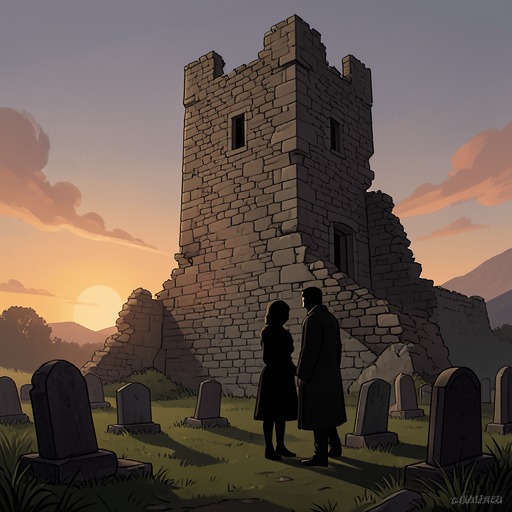
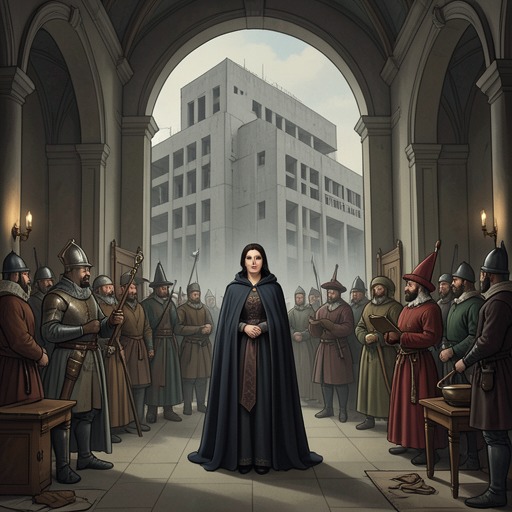
Margaret asks the chaplain to hear her confession and sends him to her sons with her blessing and love. She also asks that they stay away from the windows facing the green and the block. The request makes the family cost of the execution immediate: while Margaret is being prepared for death, she is trying to shield her sons from witnessing it. Only a few people have gathered, including someone bearing the chain of the Lord Mayor of London. The small crowd and unprepared setting distinguish the scene from a fully staged public execution.
As Margaret is escorted downstairs by her lady-in-waiting, she deliberately takes her time. She hopes that a royal messenger may arrive with a pardon, imagining that Henry VIII might first condemn and then spare her in a display of his power and mercy. That expectation shapes the descent: delay remains, for a short while, a possible form of hope. But at the Tower’s door there is no messenger. The path ends at an improvised wooden block, with a young headsman standing beside it. Margaret has pennies ready for him, and the chaplain accompanies her across the short distance.
At the Block
On the way, Margaret thinks of relatives who have walked out of the Tower before her, including her brother, whom she remembers as innocent except for his name. She connects their fates to her own through their family identity: in her understanding, they have been imprisoned not for what they did but for who they were. The scene thus places her sentence within a continuing pattern of danger to her family, rather than treating it as an isolated punishment.
Before the execution, Margaret affirms her loyalty to the king and urges obedience to him, while privately recognizing the contradiction between loyalty and a ruler whose wishes may change from moment to moment. She sends blessings to Prince Edward and Princess Mary Tudor, remembering to address Mary by the reduced title Lady Mary. Her words are cut short because she is not allowed to speak for long. The formal gestures of obedience and farewell therefore remain constrained even as they reveal her continuing attachments: she offers loyalty in public, but her blessings also recall people she has loved and hopes to protect.
Margaret follows the headsman’s instruction and lowers herself toward the block. At the final moment, a sudden desire to live overtakes her, and she refuses to proceed. The headsman has already begun the execution, but Margaret rises and continues to resist. The account describes her repeated refusals and struggle without presenting them as a change of political allegiance: her resistance is directed against being made to accept the king’s decision meekly. She dies still resisting, and the scene makes that refusal the decisive turn from expected submission to defiance.
Aftermath and Significance
The novel’s account gives Margaret no legal defense or meaningful interval to prepare. Its small crowd, improvised block, and abruptly announced hour expose the distance between royal power and the procedures she expects to protect her. Her hope for a pardon also underlines the imbalance: even at the place of execution, she imagines that survival depends on the king’s unannounced change of mind, not on a hearing in which she might answer the case against her.
The author’s note identifies Margaret as sixty-seven at her death and describes the execution as clumsy, offering two possible explanations: an incompetent executioner or Margaret’s refusal to put her head down. The novel chooses to portray her as dying in resistance to what it calls Tudor tyranny, while acknowledging that the precise historical course of the execution is uncertain. Margaret was beatified in 1886 as a martyr for the faith, and the Church honors her as Blessed Margaret Pole on 28 May. That later commemoration gives the scene a legacy beyond the Tower: the execution meant to end her life becomes, in the novel’s framing, an enduring testimony to the injustice done to her and her family.