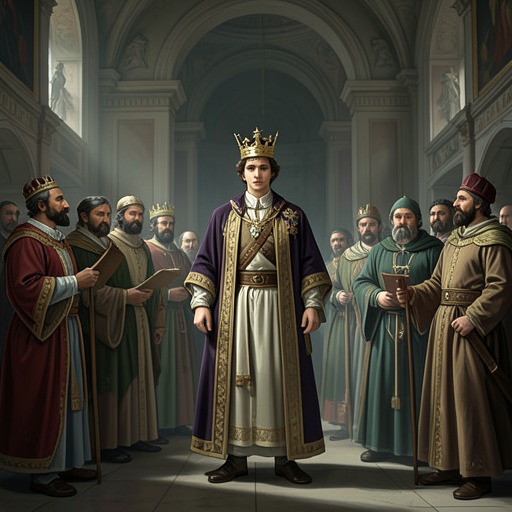
Proposal to marry Mary Tudor to Henry FitzRoy
The King's CurseThe proposed marriage between Princess Mary Tudor and Henry FitzRoy was a dynastic solution to Henry VIII’s succession problem—and a threat to the queen and her daughter. The scheme would place Mary on the throne beside her illegitimate half-brother, using marriage to reconcile the king’s desire for a male heir with the claim of his legitimate child. Its political logic was stark: a marriage could make Henry FitzRoy’s succession more acceptable, but only at the cost of a union that Margaret Pole and her allies regarded as intolerable.
The Proposal and Its Dynastic Purpose
The plan reaches Margaret through Maria de Salinas during a riverside regatta staged at the king’s command. The contrast between courtly spectacle and political danger is sharp: watermen win the races while Henry VIII’s laughing courtiers struggle at their oars, and then Maria tells Margaret that Princess Mary Tudor may be made to marry the Duke of Richmond. The proposal is no joke. Thomas Wolsey had first encouraged the idea, Maria reports, and the king had begun to consider it as well.
The intended outcome was not simply a marriage. In the scheme as Maria explains it, Mary would become Queen of England, while Henry FitzRoy would stand beside her as her husband and, in effect, gain a route to the throne without the king first disinheriting his daughter. The arrangement sought to preserve the Tudor line by combining Mary’s legitimate royal status with the king’s acknowledged son. It treated marriage as an instrument for solving a political problem of inheritance.
Legitimacy, Kinship, and the Queen’s Opposition
The plan depends on a dispensation from the Pope, because Mary and Henry FitzRoy are half-siblings. Margaret’s immediate horror at that prospect is set against the king’s willingness to seek a dispensation if it advances his dynastic aims. The question is therefore not only whether the match is acceptable, but who has the authority to make it acceptable: the king presses toward a solution, while the queen’s consent and the Church’s judgment remain decisive obstacles.
Maria identifies the queen’s likely refusal as the gravest danger. Katherine of Aragon would rather die than see her daughter shamed, and would resist her husband’s command. Margaret understands that such resistance could be treated as treason. The proposal thus threatens to turn a mother’s defense of her daughter into political defiance, exposing the unequal stakes of a royal marriage when the king also controls the language of obedience and disloyalty.
A Court Where Rank Is Being Rewritten
The scheme emerges amid visible changes in the court’s hierarchy. At a masque for Princess Mary Tudor, the princess is at first the center of attention, appearing with seven ladies and dancing with eight costumed knights. Yet the evening’s more unsettling display comes when Anne Boleyn does not join the queen’s departing train. Margaret nearly steps in to guide her, assuming that Anne has simply missed the customary signal; then she sees Anne remain among the courtiers while Henry VIII permits it. The breach of precedence makes a change in favor unmistakable. Against that shifting court order, the proposed marriage is one more sign that Mary’s position can be altered to serve the king’s plans.
The threat also lands on a family network already vulnerable to suspicion. Margaret sees the House of Plantagenet as a far-reaching web of cousins and in-laws, with shared blood, marriages, lands, and loyalties. Her daughter Ursula is married to the duke’s son; Margaret’s sons were raised in the household of George Neville, whose daughter is married to Montague. These bonds can sustain cooperation, but Margaret recognizes that an unfriendly observer could redescribe the same interdependence as faction or conspiracy. The proposal therefore sharpens the danger facing both the queen’s allies and the Plantagenet kin who might support her.
Resistance and the Limits of the Scheme
Margaret’s sons respond to the prospect of Mary’s displacement by proposing action in the queen’s defense. Montague plans to take Geoffrey Pole with him to Calais, where Geoffrey could carry information to Reginald Pole, a message to the Pope, and a letter for the queen to her nephew, Charles V. Their hope is that a forceful papal ruling against Henry VIII would compel him to take Katherine of Aragon back. Montague argues that the family must act together as the White Rose of York, while Margaret recalls that Henry was once a child she taught to walk and that she had promised to protect his family. Her loyalty to the king does not erase her duty to the queen and Princess Mary Tudor; instead, it deepens her sense that the proposed settlement could destroy the inheritance it claims to protect.
The evidence presents the match as a contemplated scheme, not as a marriage that takes place. In the same discussion, Maria says that the king plans to marry Mary to France and judges that course less dangerous than the FitzRoy proposal, which could provoke the queen’s open resistance. Later, during the Christmas progress of 1536, London crowds acclaim Mary as a princess despite her altered official status. She rides beneath the Tudor rose and her mother’s pomegranate standard, while Margaret sees her dressed and equipped as a princess should be. That public welcome does not establish what became of the earlier marriage proposal, but it underscores the continuing contest over Mary’s identity: royal standing is disputed at court, yet affirmed by the people who gather to greet her.