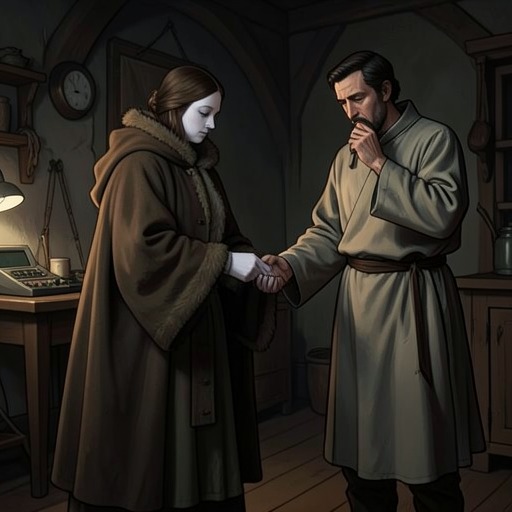
Sweating sickness epidemic of 1528
The King's CurseThe sweating sickness epidemic of 1528 is presented as both a public-health crisis and a threat to family continuity: while Henry VIII and his household withdrew from London, Margaret Pole attempted to protect her relatives at Bisham Manor, yet the disease reached her family and killed her son Arthur Pole. The account emphasizes the limits of contemporary medical knowledge, the burdens of household care, and the political meanings people attached to recurring outbreaks.
Background and the return of the Sweat
The sickness arrives in the summer of 1528, after an earlier London outbreak in 1517 had already prompted royal flight. On that occasion, Margaret Tudor traveled north toward Scotland, while Henry VIII ordered his court to leave London for Richmond. The later epidemic repeats this pattern of danger and withdrawal: the summer heat brings the Sweat, and the royal household again seeks distance from the capital as the country suffers.
The disease is feared partly because of its reported speed and indiscriminate reach. In an earlier episode, Margaret worries that sick children may have contracted the Sweat, and a messenger describes the terror it inspires: people believe a healthy person can die within a day. The narrative does not provide a dependable cause or cure. Margaret recognizes that responsibility for sickness extends beyond her immediate family, but practical responses—food for affected cottages, visits from priests, payment for burial, and, if necessary, plague pits—do not amount to an understanding of the illness itself. That uncertainty shapes the 1528 crisis as well: fear is immediate, while effective medical explanation remains unavailable.
London and the court’s withdrawal
When the disease reaches London in 1528, news arrives of men dying in the streets and collapsing in gutters as they try to get home. Katherine of Aragon summons Princess Mary to join her and Henry VIII as they travel away from London. The royal family intends to live privately in the countryside while the wider population endures the outbreak. The move offers distance from the city, but it also makes the contrast between royal flight and ordinary exposure plain.
The court’s retreat belongs to a recurring response to epidemic danger in the novel. In 1517 the king’s household moved to Richmond; in 1528 the king and queen again summon Mary away from the capital. The pattern makes sickness a force that alters royal movement and family arrangements, rather than a calamity confined to individual sickrooms. Yet escape from London does not mean immunity. Margaret and her relatives shelter behind the walls of her estate, but the disease reaches the Pole family at Broadhurst.
Bisham Manor as a place of refuge
At Bisham Manor in the summer of 1528, Margaret receives Geoffrey Pole and his wife, Constance. Arthur Pole also sends his children, Henry and Margaret, together with their wet nurse. His message explains that the Sweat has reached Broadhurst and that both he and his wife, Jane Pole, are ill; he asks his mother to care for the children as if they were her own. The children arrive as dependants whose safety now rests on Margaret’s household, while their parents face the illness elsewhere.
Margaret’s welcome is shaped by fear as much as by affection. She gathers the two children to her and tries to offer reassurance she does not feel. The epidemic has turned a great estate into a refuge, but its high walls cannot resolve the danger outside them or guarantee the safety of those within. The household is also part of a wider network of responsibility: Margaret must respond not only to her children and grandchildren, but to the consequences of illness on lands and among people under her care.
Arthur Pole’s death and its consequences
Geoffrey eventually brings Margaret the news that Arthur has died. Jane is also gravely ill and is being cared for by only one woman in her private rooms; because of her condition, she has not been told that her husband is dead. The steward, terrified of infection, has shut himself away, leaving the household without someone to maintain its ordinary order. The epidemic therefore produces more than a death: it disables the domestic structures on which care, communication, and the management of the estate depend.
Montague takes charge of the immediate arrangements. He orders Arthur’s body removed from the disordered household and brought to the family priory, where it is laid in the chapel. Margaret’s concern then turns to what Arthur’s death may mean for his children and their inheritance. She insists that his lands must not be allowed to go to waste, because they were intended to provide a legacy for his son. The loss is consequently both personal and material: an illness has taken a family member and threatens the arrangements through which the next generation would inherit his gains.
Subsidence and the meaning of the epidemic
Margaret and Montague spend weeks putting the house and land back in order. Even while the sickness is present, estate work cannot simply stop: Montague directs the bailiff to assemble a haymaking gang, arguing that the animals must have winter forage if they are to survive. This practical labor runs alongside bereavement, showing how the household must continue to meet seasonal obligations amid the epidemic. News from London eventually reports that the illness appears to have burned out. Thomas Wolsey has contracted it but survived, and Jane Pole also recovers.
The survival of Wolsey and Jane, alongside Arthur’s death, gives the epidemic no simple moral pattern. Margaret hears people interpret the Sweat as a sign foretold with the arrival of the Tudor line, and as evidence that the king cannot produce a son or that the country cannot prosper. Such claims express political and religious fears, not a proven explanation of disease. Elsewhere, Henry VIII himself later speaks of a curse when confronted by losses in his family; the novel thus shows how outbreaks and deaths become entangled with anxieties about succession and dynastic fortune. In the 1528 episode, that larger atmosphere is grounded in specific consequences: a royal flight from London, a household divided by illness, a son’s death, and the difficult work of restoring family and estate after the sickness recedes.