The King's Pardon to the Pilgrims
The King's CurseThe King's Pardon to the Pilgrims was Henry VIII’s public promise of clemency to participants in the Pilgrimage of Grace. Presented as the settlement that would let the northern rebels return to their homes, it briefly persuaded them that their demands had prevailed; the arrests and trials that followed turned the pardon into a stark measure of the gulf between royal assurances and royal power.
Background and Presentation
The pardon followed a crisis in which the king had been pressed to reach agreement with the pilgrims. News reaching Margaret Pole suggested that Henry VIII could not govern England, much less the North, without an accord: the pilgrims demanded the return of the Church to Rome and the restoration of older noble advisers. The king consented, and Thomas Howard rode north through snow carrying the pardon.
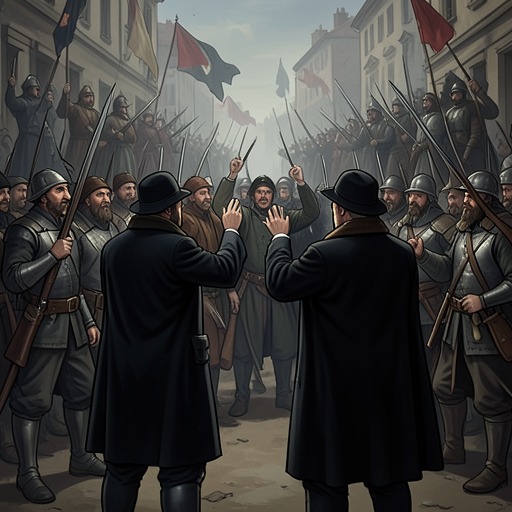
Outside Doncaster, Thomas Howard had to wait in the cold while the Lancaster herald offered the king’s pardon to thousands of northerners assembled in silent ranks. This public presentation made clemency part of the settlement’s ceremony: the Crown’s promise was announced before the gathered movement, rather than conveyed only through private assurances.
Reception and Signs of Submission
Robert Aske treated the agreement as a victory. Before the assembled pilgrims, he asked to be released from his position as captain. He tore off the Badge of the Five Wounds and promised that the pilgrims would wear no badge but the king’s. The gesture marked a visible turn from collective religious protest toward renewed allegiance to Henry VIII.
Margaret Pole also took the pardon as a sign that the conflict had ended. She put away the badge Thomas Darcy had given her, no longer needing it as a hidden reminder of her loyalty, and believed that the pilgrimage was over and that her sons would return home. In London, the news was received with public celebration: church bells rang, and Margaret’s household watched the court’s Christmas progress. For a time, the pardon seemed to have restored both political peace and the possibility of religious recovery.
The Promise Under Pressure
The settlement soon looked less secure. Reports emerged that some pardoned pilgrims had broken the terms of the truce and taken up arms again. Thomas Howard arrested several men and sent their names to Thomas Cromwell. Northern lords and gentlemen raised their concerns with Howard, while Aske insisted that the movement was not rebelling against the king. He pointed to the pardon and wore Robert Aske's Scarlet Satin Jacket as visible evidence of royal favor, arguing that isolated lawbreakers did not invalidate the peace or the pardon.
The arrests of Sir Thomas Percy and Sir Ingram Percy, who had marched beneath the pilgrims’ banner, sharpened the contradiction. They were summoned to court, arrested on arrival in London, and sent to the Tower. Geoffrey Pole dismissed their case as distinct from that of the pilgrims, but the episode showed how quickly a royal guarantee could coexist with coercive action against people associated with the movement.
Failure and Significance
By February, nine men charged with treason in York had been sentenced to be hanged. More arrests followed, and Robert Aske himself was taken to the Tower. Although he held a full royal pardon for leading the Pilgrimage of Grace, he was kept without money, a change of clothes, or adequate food. The narrative stresses that, after returning north, he had tried to persuade others to accept the pardon and trust the king’s word; he had neither led nor encouraged the later uprisings.
Thomas Cromwell supplied a way to treat Aske’s conduct as treason: because Aske had believed there would be a northern Parliament and had sworn that the monasteries would be restored, Cromwell argued that he had assured people the pilgrimage had achieved its aims. The pardon thus failed not simply as protection for an individual but as a dependable boundary on royal retaliation. Its public ceremony had invited submission and dispersed the pilgrims; later, the government could recast the very hopes associated with the settlement as evidence against them.