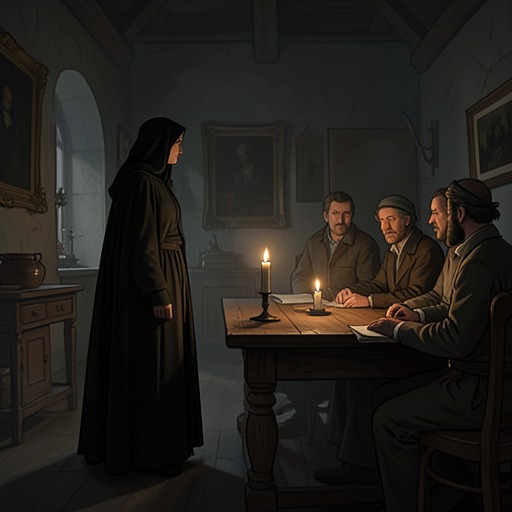
Tudor rule by fear and surveillance
The King's CurseTudor rule by fear and surveillance describes a form of government in which the threat of being watched, penalized, or accused reaches beyond the court and into family life. Under Henry VII, hidden observation and financial extraction turn apparent royal favor into a source of danger; under Henry VIII, arrests and suspicion further pressure the Plantagenet family to govern its own speech and conduct. The system’s force lies not only in punishment, but in the uncertainty that makes people anticipate punishment before it arrives.
Courtly Affability and Hidden Observation
Henry VII’s public manner obscures the scrutiny operating around him. At a royal gathering he smiles at his Plantagenet relatives, displays affection, proposes games, and encourages dancing. Margaret Pole is nevertheless wary of remaining at court: while the king entertains his company, spies search her rooms. She reflects that she has nothing to conceal, yet still does not want to be watched. The contrast makes the court’s sociability difficult to trust. A festive performance does not signal safety when observation continues in the galleries and streets beyond it.
The danger is sharpened by the example of Edmund de la Pole. Although Edmund has served Henry VII loyally and belongs to the king’s inner circle, news of his arrest makes Margaret fear for the wider family. His position had seemed to show that a Plantagenet could serve a Tudor and embody their coexistence. Once even such a loyal kinsman is vulnerable, proximity to the king offers no reliable protection. The uncertainty itself becomes a means of control: Margaret fears that an ordinary visit or an innocent private space may attract attention.
Fines, Revenue, and Conditional Security
Surveillance is joined to financial pressure. Margaret Beaufort’s rooms fill with people seeking relief from fines imposed for minor offenses. She and her son work on the royal accounts, and the proceeds of penalties help supply the treasure needed to keep an army available against feared rebellion. Petitioners seeking mercy may leave with less money and no remedy. Royal finance is therefore experienced not as distant administration but as a repeated pressure on people who must approach the king’s mother for help.
Richard Pole’s household feels the same imbalance. He serves the king and sends the fines collected through his court to the royal treasury, yet receives little in return and does not seek payment directly from the king. Margaret describes a broader pattern: lands granted early in Henry VII’s reign are reclaimed, a traitor’s family may lose its home, and even small offenses can bring heavy demands. Taxes reach ordinary goods, including salt and ale. Wealth moves toward the crown while the household must protect the limited resources needed for its children, including a dowry for Ursula Pole.
For some subjects, payment becomes the price of continued safety rather than a conclusion to a legal matter. After the arrest of George Neville, he returns free but impoverished, with his freedom burdened by severe financial obligations. He must pay half his income each quarter, and twenty-six friends stand as guarantors for his fines. Though no charge has been proved against him, he is barred from returning to several counties and becomes an exile within England. His case shows how penalties can extend control beyond imprisonment: a released man remains tied to the crown through debt, guarantors, and restrictions on where he may live.
Kinship Recast as Political Suspicion
The Plantagenet family’s extensive network of blood and marriage offers mutual support, but also exposes its members to collective suspicion. Margaret understands the relatives as a closely connected family spread across England. The same connections that join households, lands, and obligations can be read by a fearful government as evidence of faction or conspiracy. When her children’s marriages and guardianships bring them into contact with other powerful relatives, kinship becomes politically legible in two opposing ways: as family solidarity to those within it, and as a potential threat to the crown.
The arrests of Margaret’s cousins make that danger immediate. At Syon Abbey, she fears for her sons, Henry and Arthur, who are in George Neville’s care, but hesitates to summon them lest the attempt draw the attention of the Tudor spy system. Other family members are scattered across constrained or concealed lives: Reginald Pole is kept in silence at Sheen, while Margaret and Ursula Pole’s devotional life places them at Syon. Geoffrey Pole remains with Margaret because she fears that the king will discover him if he is sent out into the world. The family’s choices are shaped by the possibility that ordinary movement may expose a relative.
Later, Margaret’s close intermarriage with the Courtenays and Nevilles is described as a structure of shared resources and power. It can also be construed by observers as a conspiracy. This does not mean the family’s connections prove a coordinated plot; rather, the narrative shows how a suspicious political climate changes the meaning attached to them. Bonds that had sustained a great family become evidence that might be used against it.
Self-Censorship and the Reach of Fear
The system’s reach is clearest in what its targets do to protect themselves. Margaret does not dare to bring her sons away from the household of an arrested guardian, because drawing attention to them could make their position more dangerous. When letters arrive from Arthur and Henry, she reads them and burns them. The boys, only sixteen and fourteen, already understand that members of their family must hold their tongues. Even affectionate correspondence cannot safely be kept. Surveillance thus operates through anticipation: the possibility of discovery alters behavior even when no spy is visibly present.
Fear also shapes Margaret’s movements and loyalties at court. Margaret Beaufort offers her a place as a lady-in-waiting, generous pay, gifts, and land if she will serve her interests; if Margaret supports Katherine of Aragon, she will be excluded from court. Margaret chooses to visit Katherine anyway, going after dusk with a lady, a manservant, and a steward carrying a cudgel. She keeps her hood over her distinctive hair and looks for signs that she is being followed. Meanwhile, she sees beggars in London whose poverty she connects to increased rents, unpaid fines, and royal taxes; some may be her own tenants. Political pressure is therefore visible both in guarded elite encounters and in the insecurity of people driven from their homes.
Royal Insecurity and Dynastic Stakes
The narrative connects these practices to the monarchy’s fear of rebellion and uncertain succession without treating royal power as invulnerable. The Tudor rulers’ attention to money and military readiness accompanies anxiety about challenges to their hold on England. For Henry VIII, the question of a male heir intensifies the stakes of his marriage and court politics. Margaret’s account of a possible son for Katherine shows how the birth would alter the queen’s standing against rivals and shift the balance of influence at court. The succession problem is a private family concern with public consequences: a child’s survival or loss changes expectations about the future ruler.
Henry VIII’s own grief later exposes the vulnerable person beneath his claim to sovereign authority. After the death of Henry FitzRoy, he asks Margaret whether a curse accounts for losing those he loves and for his unhappiness. Yet the court increasingly addresses him as Majesty, a title that marks a heightened claim to status even as he is overcome by grief and must be helped to bed. The scene does not erase the coercive power exercised over others; it places that power beside the king’s dependence on a fragile human body and a line of succession vulnerable to loss. In this account, fear belongs to the political order as a whole, but its costs fall unevenly: the king’s anxiety becomes a reason for subjects to watch themselves, their families, and even their words.