Tudor tyranny
The King's CurseTudor tyranny in the novel is not simply harsh rule: it is the conversion of royal preference into public truth, backed by fear and increasingly unchecked punishment. Henry VIII’s claim to govern the Church and define legitimate marriage and succession alters the rules by which his subjects must live. The costs emerge in a repeated pattern: people who cannot accept those claims are pressed to comply, isolated, or removed, while the failure of others to defend them helps make further abuses possible.
Authority and the remaking of truth
The theme first becomes visible in conflicts over marriage and inheritance. Margaret Pole is ordered to confirm that Arthur Tudor and Katherine of Aragon had been married and that their union had been consummated. Her testimony matters because the king’s proposed marriage to Katherine depends on the claim that her first marriage did not prevent it. Margaret’s account of what she witnessed is thus pulled into a struggle in which family loyalty, observation, and political necessity are made to serve competing versions of the truth. The pressure placed on her shows how a private fact can become a test of allegiance when royal power has a dynastic stake in its interpretation.
The conflict widens from marriage to the governing authority of the Church. Lord Montague tells Princess Mary Tudor that the Church has yielded to Henry and that the Pope’s authority in England is to be disregarded. Mary recognizes the consequence as more than a change in religious administration: the king is claiming the Church’s wealth, laws, and courts as part of his own dominion. The novel presents this transfer as a concentration of power, in which an institution that might stand apart from the Crown is brought under it.
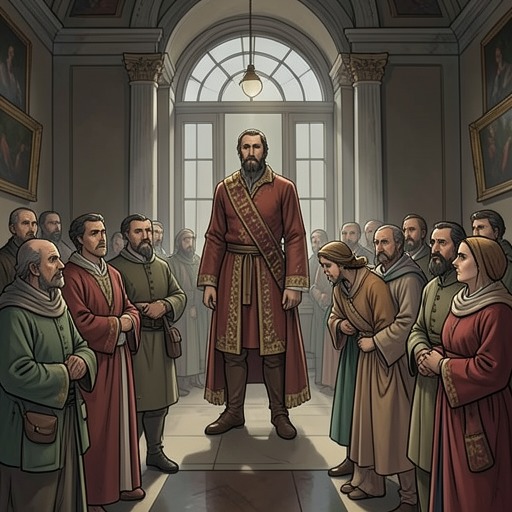
At the 1534 oath of succession, the conflict becomes a demand made directly upon the nobility. Thomas Cromwell administers the oath to peers, although the Pope has ruled Henry and Katherine’s marriage valid. The peers must decide how to act when the judgment of the distant religious authority conflicts with the king’s command. The oath therefore tests not only loyalty but the possibility of recognizing a truth the Crown rejects. Margaret sees the king’s declaration operating as if declaration itself could make a disputed claim real.
Coercion, silence, and complicity
The novel depicts coercion as a system that gains force when opposition is isolated. Thomas More refuses the oath as it stands, explaining that he cannot sign it for the sake of his conscience, while leaving room for a revised version he could accept. Henry had promised More that he would not be put to this test, but breaks that promise. Margaret’s regret at not standing beside More makes the episode personal as well as political: the damage lies both in the king’s betrayal and in the loneliness of those forced to resist him.
Fear extends beyond public declarations. Geoffrey Pole’s arrest follows the discovery of messages between members of the Pole family and Reginald Pole. Margaret is told that Hugh Holland’s disclosures appear to have come under torture, and that Geoffrey has been arrested. The evidence does not present an open contest in which the accused can freely answer the Crown; it shows communication between relatives becoming dangerous and the methods used to obtain it widening the reach of suspicion.
In Margaret’s reckoning, such episodes accumulate into a pattern of failures to defend the threatened. She remembers Robert Aske, Thomas Darcy, John Hussey, More, and John Fisher alongside her own sons. The arrests of Geoffrey and Margaret’s household extend the danger to younger relatives as well: even a twelve-year-old boy is taken to the Tower. Her comparison of political terror to the Sweat gives this pattern its governing image. Like the disease, tyranny arrives abruptly, takes people without warning, and seems impossible to ward off once it has entered a household.
The king’s body and the machinery of rule
Henry’s authority is repeatedly set against his physical and emotional vulnerability. When Henry FitzRoy dies, Henry interprets the loss as evidence of a curse and asks why he has been deprived of those he loves. The scene reveals a bereaved father, but it also complicates the image of an all-powerful ruler: the king who commands the country cannot command death or secure his own happiness. The novel links dynastic anxiety to this vulnerability, since the deaths of children threaten both private attachment and the succession on which royal rule depends.
Yet the king’s grief takes place within a hierarchy that continues to magnify his status. After he assumes control over the Church, he is styled Majesty rather than Your Grace, a title presented as an imperial claim. At the same time, he is so overcome by grief that attendants must lift him into bed. The contrast between the elevated title and the dependent, suffering man exposes the tension between the political body Henry claims and the mortal person who cannot master loss. His vulnerability does not restrain his authority; in the novel’s account, the machinery of obedience persists around him even when he is incapacitated by sorrow.
Resistance and the meaning of the ending
The retrospective account of Henry’s reign describes a ruler moving from one adviser to another as his moods worsen and executions become instruments of terror. It argues that his power grows in a political climate where effective opposition fails to protect people already under threat. The novel also emphasizes the Crown’s response to the northern pilgrims: Henry attacks people who sought justice and believed they had received a pardon. The betrayal of that expectation makes royal power especially destructive, because the promise of protection itself becomes part of the trap.
Margaret’s execution brings the theme to its starkest personal conclusion. As she faces death, she refuses to accept the king’s will, and the narrative makes that refusal an act of resistance even as she is killed. Her death does not undo the power that has condemned her; its significance lies in preserving a distinction between submission and consent. The novel’s final image of Margaret resisting connects individual conscience to a wider history of people left undefended, and turns her last refusal into testimony against a government that has made obedience appear inevitable.