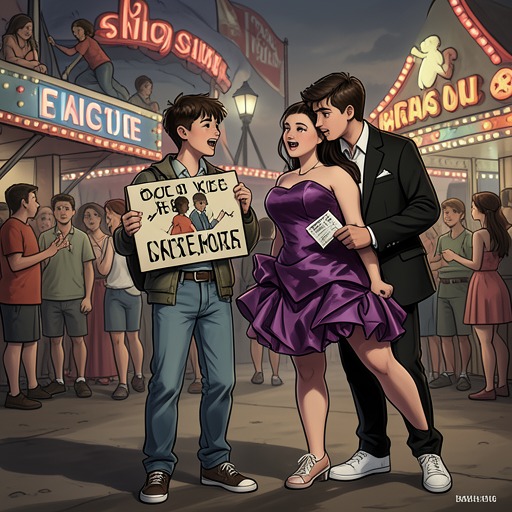
Lee Flynn
The Kissing BoothLee Flynn is Elle Evans’s lifelong best friend and Noah Flynn’s brother. When Elle and Noah begin a secret relationship, Lee becomes more than a bystander to their romance: he is the friend whose trust they risk, the brother drawn into their conflict, and ultimately the person who must decide whether supporting Elle requires approving of her choices. His anger at their concealment is intense, but it does not end his devotion to her.
Identity and Early Friendship
Lee and Elle have been best friends since birth. Their mothers knew each other from college, Elle lives only a ten-minute walk away, and both friends were born on the same day. They grow up together so closely that Elle considers them nearly twins. Their bond is presented as enduring rather than effortless: she regards Lee as her best friend always, even while acknowledging that he can annoy her.
The small domestic familiarity between them gives that history its texture. In Lee’s bedroom, Elle sprawls onto his bed and enjoys its bounce; the room is otherwise recognizably untidy, with clothes, socks, a half-eaten sandwich, and empty cans scattered around. Later, while the two are looking at a computer screen, they independently spot the idea of a kissing booth, say it at the same time, and celebrate with a high five. The shared impulse captures how naturally they collaborate: their closeness is not simply asserted but shown in synchronized reactions and ordinary comfort.
The Friend Between Elle and Noah
Lee’s place in Elle’s life shapes how she understands Noah Flynn’s interference in her romantic choices. When she asks what Noah has done to discourage boys from approaching her, Lee explains that Noah warned them he would have to answer for it if they hurt her. Elle recognizes the protective intention but resents the effect: she is nearly seventeen, has never been kissed, dated, or had a boyfriend, and wants the freedom to discover romance for herself. Lee is the person who can explain Noah’s behavior, while Elle’s frustration shows how protection can become control even when its stated purpose is care.
After the carnival, Lee asks Elle whether she wants to be with Noah and admits that he thought she was over him. Her uncertain answer does not give Lee a simple resolution. He says he cannot really understand her feelings, both because Noah is his brother and because he is a guy. The exchange establishes the limits of his perspective without making him indifferent: he asks because the choice matters to her, even though he cannot experience the attraction from her point of view.
That friendship is also part of what makes Elle hesitate before committing herself to Noah. She enjoys being close to him but fears that a relationship could hurt Lee or damage the friendship she values most. She tells Noah that she will not risk that bond merely to become another girl he sleeps with and does not call back. Even before Lee knows about the romance, his importance has become one of its central constraints. Elle worries about what he would think, and later, when she wakes beside Noah, her first concern is whether Lee might see her leaving.
Discovery and Fracture
When Lee discovers Elle and Noah together, his first response is desperate disbelief. He looks to Elle for an explanation and asks her to tell him that what he thinks he sees is not true. His distress makes clear that the revelation is not only about the romance: he has been excluded from a truth involving the two people closest to him.
The confrontation soon turns from shock to anger over the months of concealment. Lee says Elle should have told him from the beginning. He then accuses Noah of hypocrisy: Noah had warned other boys not to hurt Elle, yet Lee believes Noah has treated her carelessly and allowed her to lie to him. The accusation exposes a painful gap between Noah’s protective reputation and the secrecy surrounding his own relationship with her.
Noah responds by grabbing Lee’s shirt collar and slamming him against a wall, demanding to know whether Lee truly thinks he has no respect for Elle. Lee answers that she had been lying to him for months. When Noah says that was her choice, Lee looks past him to Elle; she recognizes that the choice to conceal the relationship had indeed been hers. The moment refuses an easy division between a guilty couple and an innocent friend: Lee has been betrayed, but Elle also acknowledges her own part in the deception.
The brothers’ argument continues after this confrontation, and Noah leaves after a major fight with Lee. Elle learns from her father that Noah has packed a bag, has not said where he is going or how long he will be gone, and is not answering his phone; Matthew is out trying to find him. Lee’s conflict with Noah thus extends beyond the discovery itself, and the consequences reach the wider Flynn family.
Anger, Loyalty, and Reconciliation
After the discovery, Elle asks Lee directly whether he hates her because she cannot bear his silence. Lee says he does not hate her, but admits that he does not like her very much at that moment. He is especially hurt that both Elle and Noah kept the relationship from him, despite the old assumption that the brothers could scarcely share a room without arguing. His response preserves the difference between anger and the end of love: he cannot forgive the concealment immediately, but neither does he withdraw the friendship altogether.
Lee’s later support is not the same as approving of the relationship. When Elle tells him she may have fallen for Noah, Lee responds that her feelings seemed obvious once she agreed to go to the dance with him. He had been waiting for her to say so. His lack of surprise contrasts with Elle’s belated admission and suggests that he can recognize her attachment even while remaining wary of what it may bring.
When Elle later considers being with Noah again, Lee tells her that he disagrees. He believes Noah has hurt her badly and doubts the relationship will end well. Yet he promises to be there to pick up the pieces if that is what she truly wants. The assurance is a significant change in their relationship after the breach: Lee no longer treats the possibility of romance as a reason to abandon Elle, even though his concern remains explicit.
Narrative Role and Significance
Lee’s importance lies in the way his relationships connect the story’s central romance to friendship and family. As Elle’s childhood companion and Noah’s brother, he is implicated in the couple’s choices before he knows about them and directly wounded by their secrecy once he does. The triangle is not simply a rivalry over affection; it is a test of whether Elle and Noah can pursue one another without damaging the bonds that have shaped their lives.
His responses remain complex rather than settling into uncomplicated approval or rejection. He is protective of Elle, angry at being deceived, and prepared to confront Noah; later, he can accept that Elle may choose a relationship he distrusts and still promise his support. That combination makes his friendship a continuing source of both pressure and stability. Lee cannot remove the consequences of the secret, but his eventual willingness to remain present gives Elle a connection that survives the rupture.