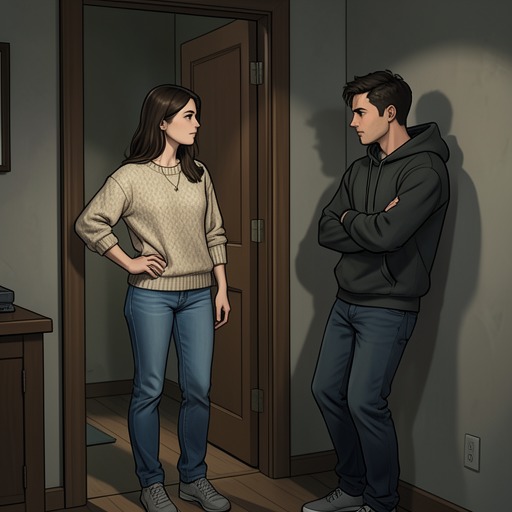
Noah’s ban on boys pursuing or hurting Elle
The Kissing BoothNoah Flynn’s ban on boys pursuing or hurting Elle is an informal rule enforced through warnings to other boys, not an agreement Elle makes or a boundary she knows about at first. It begins as Noah’s claimed protection of someone he considers vulnerable, but its hidden cost becomes a conflict over whether care gives him the right to restrict her choices.
What the Ban Requires
Noah tells boys to back off from Elle and warns that if any of them do anything to hurt her, they will have him to deal with. The rule therefore combines two related demands: boys should not pursue her, and anyone who does approach her must reckon with Noah if he causes harm. Its reach is broader than responding to a particular reported injury; Noah is trying to prevent possible hurt by intervening before Elle can choose whether to date someone.
The warnings operate privately, through Noah’s reputation and the threat of his involvement, rather than through any arrangement Elle has accepted. When she later asks Lee Flynn about the matter, Lee confirms that Noah has warned boys away and that the warning is widely known. Lee’s matter-of-fact response shows how the rule has become ordinary knowledge among others while remaining concealed from the person whose dating life it shapes.
A Protection Kept Secret
Elle first hears the explanation from other girls, who tell her that Noah has been warning boys to stay away and threatening consequences if they hurt her. Her surprise is not simply that Noah has intervened: she had not realized that her lack of dates might be connected to anything he had done. She had understood herself as someone who spent so much time with Lee that boys might see her as one of the group, not as someone they would ask out.
When Elle raises the subject with Lee, he says that everyone knows except her. He had assumed she would have worked it out over the years and points to the fact that boys have never asked her on a date. That explanation turns what Elle had taken in stride into a consequence of someone else’s intervention. Her absence of romantic experience is not presented as proof that the rule caused every missed opportunity, but the characters connect the warnings to boys being kept away.
Lee defends the intention behind Noah’s conduct. He describes Elle as too trusting and suggests she could fall for someone who would hurt her. From that perspective, the ban is a precaution aimed at a risk Lee believes she may not recognize. Elle, however, sees the mismatch between good intentions and the result: she is about to turn seventeen, has never been kissed, has never had a boyfriend, and has never been on a date. She can appreciate that Noah wants to look out for her while still regarding his interference as unfair.
Noah’s Rationale and Elle’s Objection
When Elle confronts Noah, she connects the warnings directly to her lifelong lack of dates and demands to know why he has acted on her behalf without her knowledge. Noah answers that she trusts people too easily. In his view, a boy could claim to love her and quickly take advantage of that trust. The ban rests on his expectation of danger and on his judgment that Elle may not be able to recognize it in time.
That reasoning does not persuade her that he should control the decision. Noah generalizes about boys, while Elle challenges the implication that she has no judgment or personality of her own. The disagreement is not only about whether some boys might behave badly; it is about whether Noah can treat that possibility as permission to prevent her from dating altogether. When their argument escalates, he punches the kitchen door. The gesture makes his anger visible but does not resolve the question she has raised.
The conflict returns later when Noah objects to what boys have been saying about Elle and worries that someone may try something at a party. Elle tells him she can look after herself and rejects his attempts to dictate what she wears, whom she dates, or whom she talks to. Noah insists that he is trying to stop her from getting hurt. His concern is genuine within the exchange, but the form it takes remains controlling: he casts himself as the person who must interpret the danger and manage her response to it.
Noah further argues that Elle’s ordinary joking and friendliness may be mistaken for flirting, even when she has no such intention. He believes other boys may misread her and that she could be hurt as a result. Elle denies that she is leading anyone on and objects to Noah making every move for her. The episode clarifies the rule’s underlying assumption: because he thinks other people may misinterpret her, he treats her own freedom of action as something that needs his supervision.
Recurrence and Meaning
The ban also sits beside Noah’s reputation as a player, a status he appears proud of even though others do not see him paying girls much attention. The contrast complicates his protective role. He positions himself as a judge of the risks posed by other boys while carrying a reputation that itself shapes how people read his relationships with girls. The text does not make that reputation a full explanation for the ban, but it places his authority over Elle’s romantic choices within a broader atmosphere of masculine status and control.
Elsewhere, Noah’s history of getting into fights is connected to what he has learned about looking after himself. That detail helps explain why threats and force are available to him as methods of protection, without making them equivalent to the private warnings themselves. His stated concern is that Elle might be hurt; the repeated conflict is that he responds by trying to decide what risks she may take. The story allows the protective impulse and its restrictive effect to remain visible at the same time.
Consequences and Limits
For Elle, discovering the ban changes the meaning of an experience she had not previously questioned: having no dates now appears partly linked to a rule everyone else seemed to know about. She does not accept that Noah’s affection, or Lee’s confidence that she is trusting, settles the matter. Her objection insists that being cared for cannot substitute for being consulted, and that she must be allowed to make her own choices even when Noah fears the outcome.
The later evidence shows the argument recurring in the context of their relationship, but it does not establish a precise moment when Noah formally withdraws the rule or a final resolution to every disagreement it creates. His later apology acknowledges that taking Elle to the dance was an attempt to say he was sorry and that she deserved better than him; it does not explicitly identify this ban as the subject of that apology. The rule’s significance therefore lies less in a stated policy change than in the conflict it exposes: Noah’s protection can express care while also denying Elle the autonomy that care ought to respect.