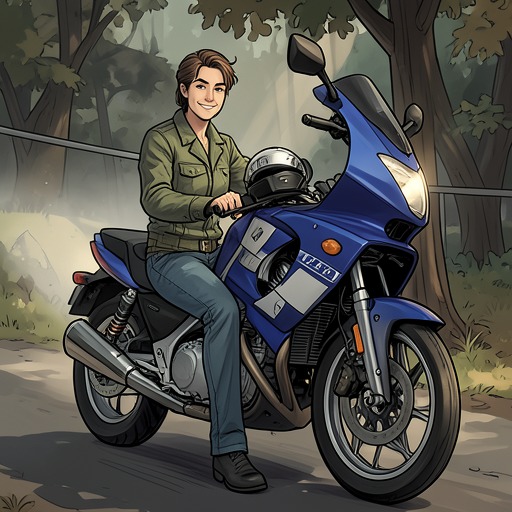
Noah’s motorcycle
The Kissing BoothNoah’s motorcycle is more than a means of transport in Elle’s relationship with Noah Flynn: it repeatedly shapes what she is willing to do, making her apprehension physical and immediate. Its presence outside the Starbucks on the edge of town prompts her to consider how she will get home, and a later ride becomes an awkward test of trust that she endures rather than embraces. Noah treats the bike as useful and worth a second chance; Elle’s lasting refusal to ride it marks a small but clear boundary between them.
Appearance and First Refusal
At the Starbucks on the edge of town, which Elle and Lee Flynn reach shortly after eight, she spots Noah’s motorcycle parked outside. Before going in, she makes a mental note to call Lee to collect her before accepting a ride back from Noah, if he offers one. The bike’s mere visibility changes her plans: she has not yet spoken to Noah, but is already considering how to avoid being dependent on his transport. Lee offers to come get her by text and reassures her as they enter. In this uneasy meeting, the motorcycle is part of Elle’s anticipation of what might happen after the conversation, not just a vehicle waiting in the car park.
When the possibility of leaving with Noah arises, Elle states that she will not ride his bike again because the previous experience was bad enough. Noah counters lightly, asking her to give the bike a second chance just as she gave him one. His appeal joins their relationship to the vehicle: in his teasing comparison, accepting the bike becomes a small parallel to allowing him another opportunity. Elle laughs, and her confidence that Noah is not about to end their relationship eases the tension. The exchange does not persuade her to trust the motorcycle; it momentarily lets her laugh despite her worry.
The Ride and Its Physical Effects
In a later scene, Noah prepares Elle for another ride by putting the helmet on her and fastening its clip. The gesture recalls her first time on the bike, but the memory does not make the present ride comfortable. The motorcycle looks even more monstrous and intimidating to her than she remembers. She climbs on cautiously, wraps her arms around Noah’s waist, and notices her sweating palms and pounding heartbeat. Her reluctance is registered through bodily detail before the journey has begun.
Elle considers backing out and starts to say that she has changed her mind. Noah revs the engine; its sudden roar makes her jump and squeak, and she clings tightly to him. Before she can repeat her refusal, he speeds down the street. The bike’s noise and movement carry the scene past her hesitation: she shuts her eyes, while the wind strikes her bare arms and legs. She thinks about the goosebumps she will have when they get off and is relieved that her hair is tucked inside the helmet and will not be completely messy. Even in fear, her attention catches on these practical details, while the motorcycle’s speed leaves little room for her to control the ride.
When they stop, Elle says she thinks she might throw up. Noah laughs and steadies her as she climbs off; her legs feel weak and nearly give way. The journey’s effect is not abstract dislike but nausea and physical instability. Noah then links his fingers through hers and opens the motorcycle seat, taking out a large picnic blanket and tossing it over his shoulder before telling her they do not want to be late. The bike has carried them and stored what they need for the next part of their outing, while Elle is still trying to make sense of the trip and the possibility of a breakup. Its practical role and her anxious interpretation of the day occupy the same moment.
Practical Appeal and Lasting Resistance
Later, Noah keeps trying to persuade Elle to ride with him. He argues that the motorcycle is easier to park than his car and faster, and even wants to teach her to ride it herself. These are practical and aspirational appeals: he presents the bike as convenient transportation and offers Elle the possibility of mastering it rather than remaining a passenger. She remains adamant that she hates it. The repeated refusal shows that the earlier ride did not turn into acceptance, and that Noah’s arguments do not override her experience of fear and discomfort.
The motorcycle’s recurrence gives it a distinct place in their relationship. At first, its presence outside the coffee shop shapes Elle’s plan for getting home; later, its noise, speed, and movement force her through a ride she has tried to refuse; afterward, Noah continues to imagine it as an efficient vehicle she might learn to handle. Elle’s position remains consistent even as her circumstances change: she can laugh with Noah and trust the relationship without liking the bike. In the later passage leading to Noah Flynn’s departure for Boston, she recalls that he still tries to persuade her, while she still refuses. The motorcycle therefore remains a small, concrete limit on their shared ease rather than a problem resolved by romance.