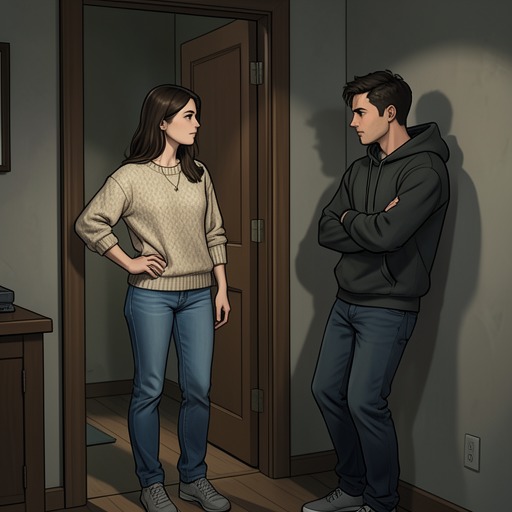
Noah’s overprotectiveness
The Kissing BoothNoah’s overprotectiveness is a recurring tension in his relationships with Elle and Lee: he treats vigilance and physical defense as proof of care, while Elle increasingly insists that protection must leave room for her own judgment. His conduct moves from keeping potential dates at a distance to conflict within their romance, where his stated wish to prevent her from being hurt collides with her demand for autonomy. The pattern helps explain both his appeal as a defender and the damage caused when he assumes that protecting Elle entitles him to decide for her.
Origins and Early Signs
Noah’s protective role takes shape before Elle understands its extent. Although he has a reputation as a player, he is not shown paying much attention to girls, and that reputation sits uneasily beside his focus on keeping other boys away from Elle. When she learns that Noah has warned boys not to hurt her, Lee confirms that everyone already knows about the warnings. He explains that Noah told them they would have to deal with him if they harmed her. The threat is framed as a defense of Elle, but its practical effect is to restrict her opportunities without her knowledge or consent.
That restriction frustrates Elle in concrete ways. She is nearly seventeen, has never been kissed, had a boyfriend, or gone on a date, and resents Noah for interfering in her life even while recognizing that he may be trying to look out for her. She imagines that he sees her as vulnerable and too trusting, but wishes his intervention had a different reason. Her reaction therefore complicates the apparent generosity of his behavior: being protected does not feel like being understood when the protection is imposed from outside.
The pattern also appears in Noah’s readiness to confront people directly. When boys provoke him, he moves toward a fight, and Elle has to stand in front of him to make him pause. Afterward, Noah insists that the boys had no right to speak to her that way. His defense is immediate and personal, but his willingness to answer disrespect with confrontation makes protection difficult to separate from force. He later tells Elle that Lee may have a crush on her, a suggestion that briefly raises the possibility that Noah’s vigilance is not merely brotherly concern, though Elle does not then settle on that explanation.
Protection Meets Elle’s Autonomy
When Elle challenges Noah about the boys he has warned away, the dispute exposes the assumptions behind his conduct. She argues that he has been the reason she has never had a date. Noah answers that she trusts people too easily and believes a boy could persuade her with a declaration of love. He presents his intervention as a response to her vulnerability; she hears it as a judgment that she cannot assess other people or make her own choices. Their disagreement is not simply about whether some boys might hurt her, but about who gets to decide what risks she may take.
That conflict follows them into their romantic relationship. When Noah approaches her, Elle says she will not become another girl he sleeps with and fails to call afterward, and that she will not risk her friendship with Lee for that possibility. Her concern connects Noah’s reputation to the stakes of their relationship: the question is not only whether she trusts him, but whether she can protect her lifelong friendship with Lee while choosing Noah. She does not want his protective attention to turn into another arrangement in which her future is decided by someone else.
Later, Noah’s questions about whether anyone tried anything at a party interrupt the moment between them. Elle tells him that she can look after herself and objects to what she regards as his controlling behavior. She specifically rejects his attempts to dictate what she wears, whom she dates, and whom she talks to. Noah replies that he is trying to stop her getting hurt. The exchange makes the central contradiction explicit: he names his motive as care, but she experiences the repeated intervention as control. Neither position erases the other; the argument arises because his concern is real to him while its consequences limit her freedom.
Conflict Within the Friendship and Family
The strain extends beyond the couple. When Lee confronts them about the secret relationship, he points to the contrast between Noah’s warnings to other boys and Noah’s own involvement with Elle, accusing him of hypocrisy. Noah objects to Lee’s accusation and insists that Lee does not understand how he treats her. In the ensuing confrontation, Noah grabs Lee’s shirt and pushes him against a wall, insisting that he respects Elle. His response reveals how readily his defense of her can become a physical assertion against someone who questions it.
Noah also argues that the secrecy was Elle’s choice. That answer acknowledges her agency in one respect, but it does not resolve Lee’s grievance or undo the concealment that has damaged the friendship. The episode places Noah’s protective claim inside a wider relationship triangle: his bond with Elle cannot be kept separate from Lee, whose trust and history with her are also at stake. Noah’s readiness to speak for Elle and fight over her contrasts with the fact that Elle herself has to bear the consequences of the secret.
After the argument, Noah leaves home without saying where he is going or how long he will be away. The news reaches Elle through her father, who says that June reported Noah had packed a bag and that Noah was not answering his phone; Matthew is searching for him. His departure turns the conflict from a dispute between the brothers into a separation that affects the people around them. Elle, meanwhile, asks Lee whether he hates her. Lee says he does not hate her, but is angry that she and Noah kept the relationship from him. The aftermath makes clear that Noah’s protective choices have not shielded Elle from pain; they have helped produce a crisis in the relationships she values.
Change, Limits, and Significance
Noah’s experience of fighting offers a partial context for his self-image as someone able to protect himself and others. When Elle asks how he knows how to care for an injury, he says that he learned through repeatedly getting into fights. The explanation connects his practical competence to a history of confrontation without proving that violence is necessary or justified. It also sits beside his reputation as a player and his impassive manner, showing how protection belongs to a broader masculine posture built around toughness and physical readiness.
By the time of the dance, Noah describes taking Elle there and similar gestures as attempts to apologize. He admits that saying sorry may not mean much and that Elle deserves better than him, before choosing to express what he has been reluctant to say. This marks a change in how he tries to repair the relationship: alongside gestures, he offers an explanation and emotional acknowledgment. Yet the evidence does not establish that his controlling habits have disappeared. The apology matters precisely because it does not retroactively make the earlier restrictions harmless or settle the tension between care and autonomy.
Across the novel’s conflicts, Noah’s overprotectiveness changes meaning according to who bears its cost. It can appear as loyalty when he steps in against people who mistreat Elle, but as paternalism when he warns potential dates away or tries to regulate her choices. His own declaration that he wants to prevent hurt is tested by the results: secrecy, arguments with Lee, Noah’s departure, and Elle’s repeated need to insist that she can decide for herself. The concept therefore names both an impulse toward care and the boundary that impulse repeatedly crosses.