Brass Ball
The Kite RunnerThe Brass Ball is a small, seemingly insignificant decorative object that becomes the instrument of a pivotal, violent reversal in the novel's climax. Originally one of several walnut-sized brass balls studding the ring where the metallic legs of a coffee table cross in Assef's house, it is retrieved by Sohrab, loaded into his slingshot, and fired into Assef's left eye socket, blinding him and enabling Amir and Sohrab's escape. The object thus transforms from a piece of inert furniture ornamentation into a weapon of poetic justice, echoing the slingshot's earlier role in Hassan's defense of Amir and marking the climactic turning point of the novel's central conflict.
Origin and Material Context
The brass ball originates as a decorative element of a coffee table in the room where Assef interrogates Amir. The table's base is X-shaped, with walnut-sized brass balls studding the ring where the metallic legs cross. When Amir first enters the room, he notices the table and recalls having seen a similar one in a crowded tea shop in Peshawar the night he went for a walk after learning the truth about Hassan. The table holds a bowl of red grapes, and Amir plucks one, unaware it will be the last bit of solid food he will eat for a long time. The brass balls are thus part of the room's ordinary, even luxurious, furnishing—a detail that marks Assef's domestic space as comfortable and well-appointed, in stark contrast to the violence that will unfold there.
Weaponization and the Climactic Confrontation
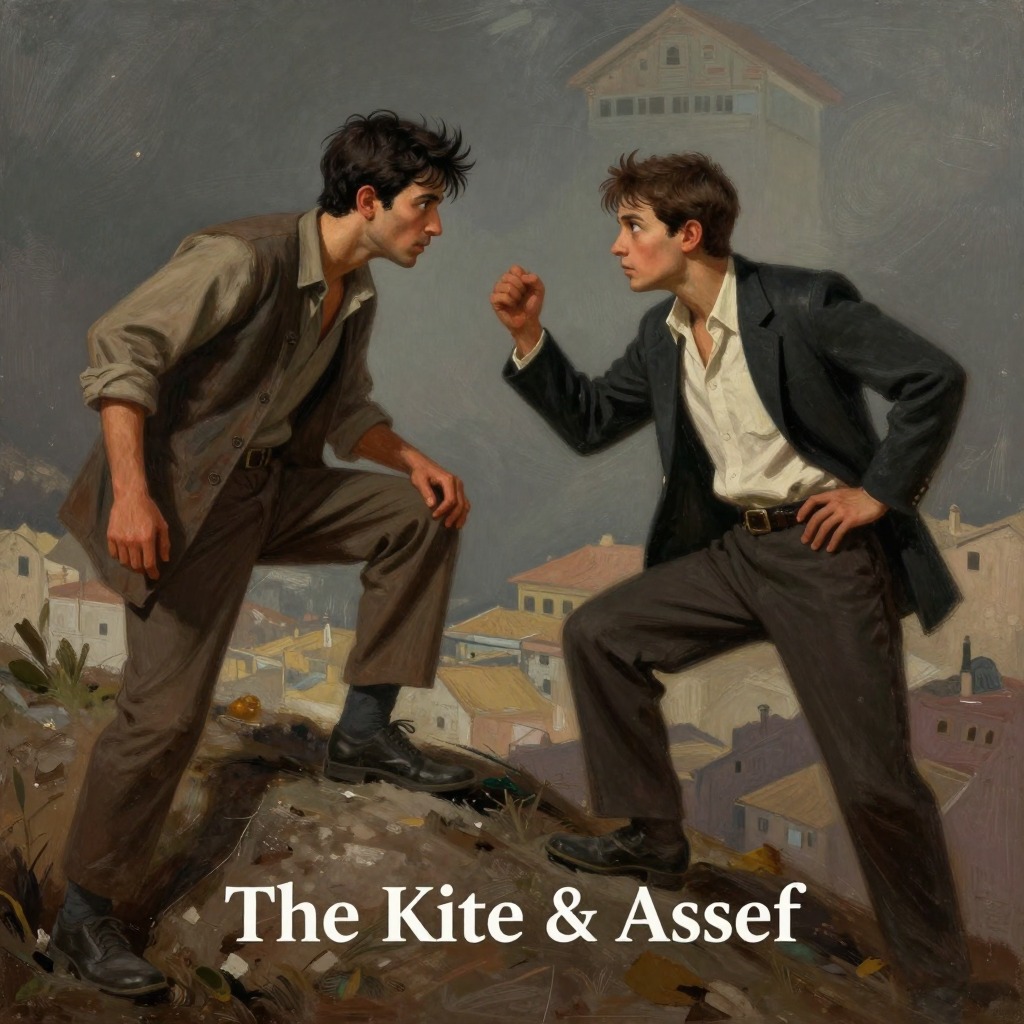
During the fight, Assef shoves Sohrab into the table, knocking it upside down and spilling the grapes. The table's legs, crossing through the ring of brass balls, point to the ceiling. It is at this moment that the brass ball is dislodged from its decorative function and becomes available as a projectile. As Assef straddles Amir, his fist cocked for another blow with his brass knuckles, Sohrab intervenes. The boy has his slingshot cocked, and in the cup is something shiny and yellow: one of the brass balls from the ring in the table base. Sohrab releases the cup, and the slingshot makes a thwiiiiit sound. The brass ball strikes Assef in his left eye, and he screams, putting his hand where his eye had been just a moment ago. Blood oozes between his fingers, along with something white and gel-like—vitreous fluid. The brass ball remains stuck in his empty eye socket, and the guards are later seen huddled over Assef, doing something to his face, trying to remove it.
Narrative and Thematic Significance
The brass ball's transformation from a passive decorative object into an active weapon mirrors the novel's broader theme of objects gaining sudden, violent agency. It is the material counterpart to the slingshot, which Hassan had used years earlier to threaten Assef and protect Amir. Now, Sohrab uses the same weapon—with a brass ball instead of a rock—to save Amir from Assef's murderous assault. The object thus becomes a symbol of inherited loyalty and the cyclical nature of violence and redemption. The brass ball's journey from table ornament to embedded projectile also enacts a kind of poetic justice: Assef, who had tormented Hassan and Amir as children and later became a Taliban official who abused Sohrab, is blinded by a piece of his own furniture, wielded by the boy he had enslaved. The object's materiality—its hardness, its shininess, its perfect size for a slingshot cup—makes it an instrument of fate, a small, dense piece of the world that, when set in motion by a child's hand, alters the course of the story.