Aaron's Death
The Knife of Never Letting GoAaron’s death ends his pursuit of Todd and Viola, but it does not come as a simple victory over a single persecutor. The confrontation follows revelations about the violence that shaped Prentisstown and culminates in a reversal: Todd faces Aaron, yet Viola makes the fatal choice. Aaron falls over the edge beneath the waterfall, and the Noise associated with him stops.
Causes and Background
The confrontation comes after Todd has learned how violence in the New World became organized and justified. Ben explains that hardship had spread across the settlements, with failing crops, sickness, and little prosperity. As conditions worsened, preaching blamed the Spackle; that prejudice grew into a movement and then into war. The imbalance of weapons made the result devastating for the Spackle, though Ben acknowledges that not all of them were killed. He also says the survivors learned to avoid men.
The violence did not end with that war. Todd tells Viola that men in Prentisstown killed the women there, and Ben confirms that many men were swayed by Mayor Prentiss and Aaron’s preaching. Aaron had taught that whatever was hidden must be evil; men killed the women and those who tried to protect them. The disclosure makes Aaron’s role larger than that of a pursuer in the immediate scene: he is also associated with an ideology that converted fear and suspicion into collective violence.
Todd’s account of Prentisstown’s coming-of-age killings further exposes the community’s complicity. Men who had supposedly disappeared were in fact killed by boys on their thirteenth birthdays, as the rest of the men watched. Among the examples Todd recalls are a former schoolteacher made to shoot a man and another man tortured to death by Mr Prentiss Jr. when the Mayor could not use a captured escapee. Todd recognizes the pattern as a system in which one man’s life was assigned to a boy so that the boy could become a man. He sees the town as collectively guilty, while marking himself as an exception. This history informs the moral pressure of his meeting with Aaron, whose language of purification echoes the violence Todd has just come to understand.
The Confrontation
Before Todd can face Aaron, Viola strikes him with a rock, interrupting his advance. Todd lays Viola down gently, then stands to confront Aaron. Aaron urges him toward purification, framing the encounter in terms that invite Todd to treat violence as a way to become clean. Todd apologizes under his breath without knowing precisely to whom or for what, then charges Aaron with his shoulder. The movement is a direct answer to Aaron’s provocation, but it does not settle the encounter.
As Todd is carried toward the edge, he realizes that he will use the Noise. He calls Viola’s name, and she picks up the knife. Todd sees her move toward Aaron while he struggles to keep from going over the ledge. Aaron, trying to rise, directs his remaining attention toward Viola; his Noise conveys anger and fear. The scene shifts the decisive action away from Todd at the moment when Aaron’s invitation to violence has drawn him into the fight.
Aaron’s Death
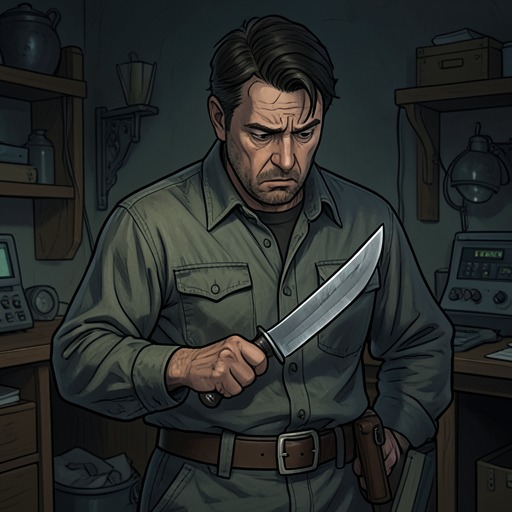
Viola advances and drives the knife into the side of Aaron’s neck. Todd cannot stop her. Aaron’s body slumps away from the pulpit, passes over the edge, and disappears beneath the wall of water, taking the knife with him. The narration presents the fall as the immediate, irreversible consequence of Viola’s action, rather than as a death Todd directly delivers.
The Noise associated with Aaron completely stops. Its cessation gives the death a consequence beyond the removal of an active pursuer: a presence that had accompanied the conflict is suddenly absent. Viola sits down beside Todd, the scene ending not with a declaration of triumph but with the two of them together after the violence. The knife is gone with Aaron, and the immediate danger he posed has ended.
Consequences and Significance
The scene turns on a distinction between resisting Aaron and accepting his account of what resistance requires. Todd does attack him, and briefly appears to enter the violent choice Aaron has been urging. Yet Todd’s words to Viola and his inability to prevent her final action leave the outcome outside his control. Viola, previously threatened and pursued by Aaron, becomes the person who ends that pursuit. The event therefore changes their immediate balance of power while preserving the moral difference between Aaron’s call for purification through violence and the action that actually kills him.
Aaron’s fall also closes the immediate confrontation without erasing the history disclosed beforehand. The war against the Spackle, the murder of Prentisstown’s women, and the coming-of-age killings are not undone by his death. Instead, the revelations make his end part of a wider reckoning with how violence is preached, repeated, and shared. Todd’s recognition that the town’s men were complicit frames the death as an interruption in that system, not proof that its consequences have vanished.