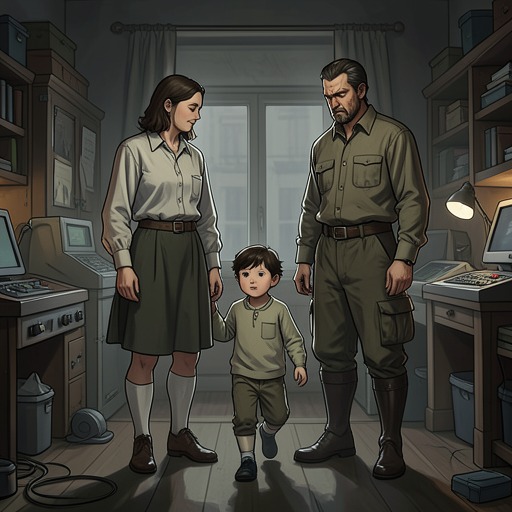
Ben and Cillian: close partners bound by shared care and moral compromise
The Knife of Never Letting GoBen and Cillian’s relationship joins shared care for Todd to a choice neither can call innocent. They take responsibility for him when his mother entrusts him to their protection, but remain in Prentisstown as Mayor Prentiss’s rule and the town’s violence destroy the lives of others. Ben later admits that Cillian wanted to resist and that he stopped him. Their bond is therefore defined both by the care that kept Todd alive and by the cost of preserving that care through inaction.
Shared Care and the Child Entrusted to Them
Ben and Cillian are described as partners in raising Todd, and Todd’s mother gives the very young child to them when escape is no longer possible. She asks them to keep him safe, no matter what. The instruction makes their relationship more than a domestic arrangement: the two men become responsible for a child whose mother cannot protect him herself. Their shared task is set against a town where danger is not hypothetical, and where a decision to leave or resist could place Todd at risk.
The promise of safety is sharply complicated by where they keep him. Todd later asks Ben how remaining in Prentisstown could have protected him. Ben cannot answer with a simple assurance; his Noise is weighted with sadness. The question exposes the difference between preserving a child’s immediate life and giving him a safe world to grow up in. Ben and Cillian keep Todd with them, but the town’s violence continues around the family they have formed.
The narrative first lets Todd recognize Ben’s grief before he knows its full cause. When Todd asks about Cillian, Ben answers through an image in his Noise: Ben running back toward a farmhouse already burning, with Mayor Prentiss’s men inside and Cillian there too. Todd has long suspected what happened, but the image turns suspicion into knowledge. Ben’s grief is not merely a report about a lost partner; it is part of the continuing emotional bond between them, carried in the same unfiltered medium through which Todd comes to understand the past.
Prentisstown’s Violence and Their Position Within It
The catastrophe that shapes their choices grows from a wider pattern of blame and violence. Ben explains that worsening conditions across the New World—failed crops, sickness, and a lack of prosperity—were followed by preaching that blamed the Spackle. That preaching became a movement and then a war. Humans had guns while the Spackle did not, and Ben describes the result as the end of most of them, though not all. The survivors learned to keep away from humans. This history establishes the violence against the Spackle as a prelude to the violence within Prentisstown, not as an isolated conflict.
Ben distinguishes himself and Cillian from men who accepted the claim that women’s silence made them threatening. He says there were good men in Prentisstown, including the two of them, but acknowledges that enough men believed the hostile preaching for it to matter. After the Spackle were killed, many men in Prentisstown killed the women and the men who tried to protect them, swayed by Mayor Prentiss and Aaron. The qualification that not all men participated does not cancel the scale of the violence; it sharpens the question of what those who did not join the killing chose to do instead.
Todd’s mother tries to organize girls and younger boys to flee across the swamp. Before she can leave with the women and the men who have not lost their minds, Mayor Prentiss’s men attack. She is unable to escape and entrusts Todd to Ben and Cillian. Ben remembers her as loving and hopeful about other people’s goodness, but that hope does not spare her from the attack. Her trust gives the two men a responsibility inside a crisis they have not stopped.
The Choice Between Resistance and Protection
Ben’s confession makes clear that Cillian wanted to act against the violence. He says Cillian was prepared to do whatever he could to stop the attackers and would have given his life. Ben, however, would not let him. The difference between them is not that one cared and the other did not: Ben emphasizes Cillian’s willingness to risk himself, while acknowledging that his own decision prevented that resistance. Their shared protection of Todd thus conceals a grave disagreement about what protection demanded.
Viola articulates the bind facing them: they could die fighting for what was right and leave Todd unprotected, or become complicit with what was wrong and keep him alive. Ben does not deny her account. Todd, who does not fully understand the word complicity, understands its central implication: the men acted for him, but their motive does not make the surrounding horror disappear. The relationship holds both truths together. Their care is real, and so is the moral injury of the choice through which they maintained it.
The later account of Prentisstown’s coming-of-age killings makes that compromise part of a wider system. Men who supposedly disappeared were often killed instead: Todd learns that his former schoolteacher was shot by a boy on his thirteenth birthday, while another man who tried to escape was executed after Mayor Prentiss arranged for his son to torture him. When no captured escapee was available, the authorities could take someone they disliked and claim he had disappeared. Boys were made into killers, and men’s deaths were turned into the means of their adulthood. The account does not establish that Ben and Cillian personally carried out these killings; it does show the coercive order within which their failure to resist took place.
Grief, Complicity, and the Meaning of Their Bond
Ben’s memory of the burning farmhouse gives the relationship its unresolved ending. The image places Cillian among the men inside while Ben runs back toward the fire, and Todd sees that Ben is still grieving. The scene connects private loss to the public violence that made their choices possible: Cillian had wanted to intervene, Ben had stopped him, and the violence eventually reached him as well. The evidence does not make Ben’s grief a substitute for accountability. Instead, affection and remorse remain side by side.
When Todd reflects on the men who were killed and on the boys taught to kill them, he concludes that everyone was complicit and everyone guilty, except himself. That stark division belongs to Todd’s reckoning with the town’s history, not to a verdict Ben offers about his relationship with Cillian. Their story complicates it: they did not join the attacks, yet Ben admits that they did not fight or die resisting them. Cillian’s readiness to act and Ben’s refusal mark distinct choices within their partnership. Their care for Todd gives those choices their immediate stakes; their survival, grief, and acknowledged complicity ensure that care cannot be mistaken for innocence.