Crashed Ship in the Swamp
The Knife of Never Letting GoThe Crashed Ship in the Swamp is both a physical wreck and the evidence through which Todd Hewitt begins to understand Viola’s arrival on the New World. Discovered in the dark beside a burned ditch, it first appears as a vast, charred mass of metal; the opened doorway and two bodies make its human cost unmistakable. The scene moves from uncertainty about what the object is to a painful reconstruction: Viola crashed there with her parents, they died, and she survived alone before Aaron found her.
Discovery and Physical Form
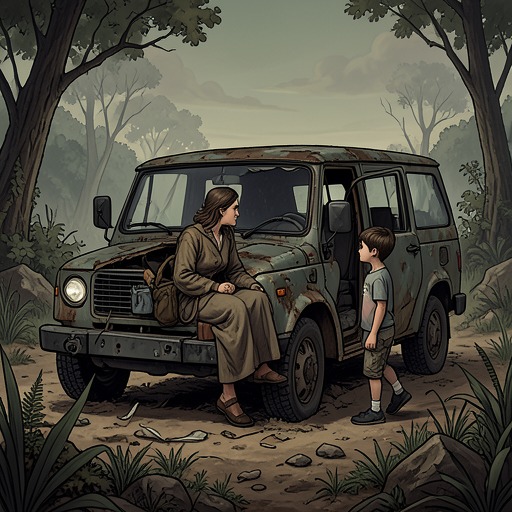
Todd notices the metal while sweeping it with his torch, repeatedly comparing it with the straight line of the ditch and the burned ground on either side. The repeated look does not immediately resolve what he sees. Viola stops waiting and heads toward the metal, and Todd follows her around a large burned log that is still smoking in a few places. The scale is his first clue: the wreckage is much larger than the biggest fissionbike, yet seems to be only part of something larger still.
The object is crumpled and burned across most of its visible surface. Todd cannot know what it looked like before the damage, but recognizes that it is largely wreckage and then identifies it as the remains of a ship. He considers whether it might have been an airship or even a spaceship, possibilities that register the limits of what he can infer from its ruined form. Elsewhere, he can make out features that might be a hull, an engine, and a window, but the damage keeps each recognition tentative. The ship is legible through fragments rather than through any intact design.
A Wreck Connected to Prentisstown
The discovery acquires a local history when Todd recalls that the first homes in Prentisstown were made from the ships in which the original settlers landed. Immediate shelter, as Ben had explained, came from the supplies at hand. Wood and log houses were built later, while the church and petrol station in town still contained parts of metal hulls, holds, and rooms. Settler ships were therefore not simply vehicles that had arrived and been discarded: their metal had been incorporated into the town’s earliest buildings.
That history changes the possible meaning of the swamp wreck. Todd wonders whether it could be an old Prentisstown house that had fallen from the sky on fire. The thought connects the unfamiliar heap before him to the familiar architecture of the town, but remains speculation; he does not establish that it was a house or identify its origin. The ship’s broken material invites comparison with the town’s buildings while leaving the particular vessel’s past unresolved. Todd also cannot tell whether Viola came from somewhere else on the New World or from somewhere altogether different.
The Opened Door and the Dead
Manchee’s calls draw Todd around the wreckage toward the place where Viola has gone. As he runs past, he sees a door opened outward from a metal wall and a light inside. These details distinguish the vessel from an undifferentiated heap: it has an interior, an entrance, and a space in which a light remains visible. They also lead into the discovery that gives the wreck its immediate human significance. Viola is standing beside two long piles of clothes; when Todd shines his torch on them, he realizes that they are bodies.
One is a man. His body and clothing are almost entirely burned away from the chest down, and burns mark his face, though Todd can still recognize him as a man. A wound on his forehead would have killed him even without the burns. The woman lies beside him. Todd identifies them as Viola’s parents, but the scene presents this as his conclusion from what he sees and from her presence, not as an explanation spoken by Viola. Her silence leaves the discovery starkly without confirmation from her.
What the Ship Reveals
Todd brings the wreckage, the burned ditch, and the bodies together into an account of the crash: Viola was there with her mother and father; they died, while she lived. His conclusion shifts the ship from an object of uncertain origin into evidence of a particular loss. Yet the evidence does not answer every question. It establishes neither where the vessel began its journey nor why it crashed, and it does not make the dead parents’ identities independently verifiable within the scene. What Todd can infer is the contrast at the center of the discovery: a vessel and its occupants were destroyed, but Viola survived.
The ending extends that contrast into a new danger. Todd recognizes that, after surviving the crash and being left alone, Viola was found by Aaron. The ship thus marks the beginning of her isolation, while the mention of Aaron connects that past disaster to the threat already facing her. Its wreckage does not merely explain where she came from; it exposes how little protection survival alone has given her. In the darkness, the torch reveals metal, a door, and bodies one fact at a time, and Todd’s understanding follows the same sequence—from an indistinct object to a ship, from a ship to a family’s deaths, and from those deaths to the peril of the survivor.