Davy Prentiss
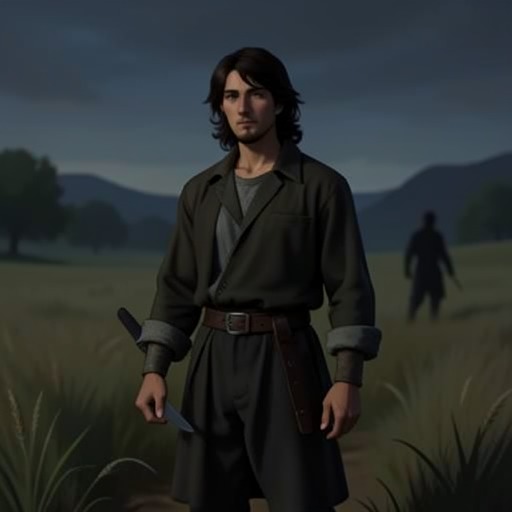
The Knife of Never Letting GoDavy Prentiss, known as Mr Prentiss Jr and Sheriff Prentiss, is the Mayor’s son and an enforcer of Prentisstown’s violent social order. His youth sits uneasily beside the authority he claims: he is barely older than Todd Hewitt, yet the town’s coming-of-age system has already assigned him the status of a man and the office of sheriff. As the story reveals what that status entails, Davy becomes not only a pursuer of Todd but also a participant in the town’s inherited cycle of violence, in which boys are made men through killing and the community shares responsibility for the victims.
Identity and authority
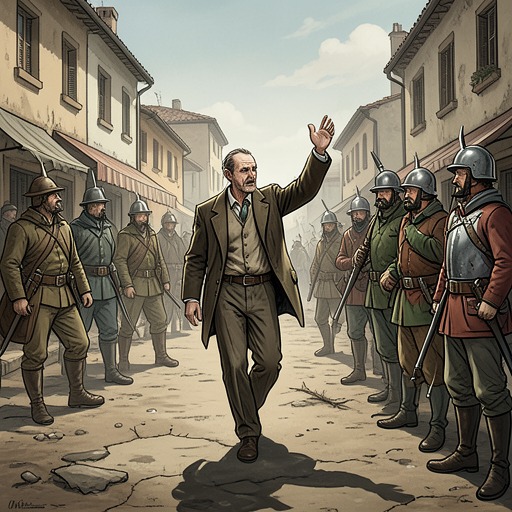
Davy first arrives at Benison Moore and Cillian Boyd’s home looking for Todd. Cillian recognizes him by name, while Todd identifies him as the Mayor’s son and a lawman. Davy addresses the men by their full names and includes Todd, demonstrating that he has traced the group to the house and intends to confront them rather than accept their attempt to hide. When Cillian calls him Davy, he insists on being addressed as Sheriff Prentiss. The title is a claim to official authority, but the scene also makes its foundation visible: Davy is a very young man whose position depends on the town’s peculiar rule that a boy’s thirteenth birthday marks his arrival into manhood.
At the house, Cillian tells Davy to leave the property. Davy persists, and the confrontation becomes physical. Todd, Ben, and Manchee reach the kitchen after hearing a sequence of thuds; the struggle is already over. Davy is on the floor, and Cillian has taken his rifle and is holding it on him. The encounter briefly strips the sheriff of control. Cillian, not Davy, determines what happens on the property, and the young officer is left unable to enforce his demand there.
The town’s violence and Davy’s role
The larger meaning of Davy’s manhood emerges when Ben explains the history behind Prentisstown’s violence. As hardship spread across New World, a poisonous preaching blamed the Spackle for human troubles. That blame grew into a movement and then into war; humans had guns, the Spackle did not, and the violence devastated them. Ben acknowledges that some Spackle survived, but says they learned to avoid coming near humans. The account places Davy inside a culture that turns hardship into blame and blame into organized violence, rather than presenting the town’s crimes as isolated acts.
The violence did not stop with the Spackle. Todd states that the men of Prentisstown killed the town’s women, and Ben confirms that many men were persuaded by Mayor Prentiss and Aaron to do so. They also killed men who tried to protect the women. Todd’s mother was among the victims. This history makes the town’s official order inseparable from its crimes: the authority Davy inherits is part of a social system built through persecution, silencing, and the removal of those who resist.
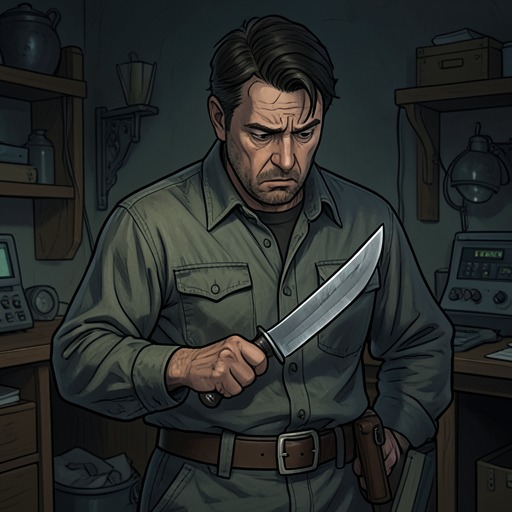
Later, Todd learns what happened to men remembered as having disappeared. Mr Royal, his former schoolteacher, had not shot himself as the town’s story suggested. Seb Mundy shot him on Seb’s thirteenth birthday, with the other men of Prentisstown watching. Mr Gault, whose sheep flock Todd’s family took over, had tried to escape through the swamp. Mayor Prentiss caught him and used the law of New World as justification for executing him; on Mr Prentiss Jr’s thirteenth birthday, Davy was made to torture Mr Gault to death without anyone else’s help. The revelation ties Davy directly to the coming-of-age killing system: he is not merely the mayor’s heir or a sheriff pursuing fugitives, but one of the boys who enacted its violence.
The pattern is larger than either Davy or a single victim. Men known to the community were killed by boys known to one another, and a captured escapee could be kept for a boy’s birthday. If no escapee was available, the men could select someone they disliked and claim that he had disappeared. Each victim’s life was assigned to a boy to end alone. Todd’s conclusion that everyone was complicit and guilty makes Davy part of a collective crime, even as the specific account of Mr Gault’s death identifies his personal responsibility.
Pursuit and conflict with Todd
After the confrontation at the house, Davy is again seen riding alongside his father. Todd observes him through binoculars in a mounted group with several of the Mayor’s men. Davy has a black eye from Cillian’s blow, a visible trace of the earlier clash carried into the next stage of the pursuit. The group examines a large map, and Todd realizes that whatever has happened to Ben and Cillian at the farm is over. Davy’s return with the Mayor’s party signals that the search has continued beyond the initial encounter and that Todd’s guardians can no longer keep him safe in the same way.
Davy is later found alive, untied, and back on his horse. When Ben sees him, Ben decides to stay and says that he can handle Davy. Todd objects that Davy has a gun and Ben does not, but Ben sends Todd on with Viola. Before they part, Ben reminds Todd that his birthday is sixteen days away and tells him that he has already been a man for a long while. He embraces Todd and says that no father could be prouder. Davy’s presence thus helps bring about a painful separation: Ben stays behind to confront him, while Todd and Viola continue without Ben.
The pursuit reaches another crisis when Davy appears on horseback above Todd and the wounded Viola. He taunts Todd about Viola and orders him to get up. Todd is trying to care for her, pressing his shirt against the bullet wound and telling her to hold it there. Davy’s arrival turns that urgent act of protection into a direct confrontation. Todd rises, and when the opportunity comes, strikes Davy across the face. The horse then charges back up the incline with Davy’s foot caught in the stirrup, dragging him away and leaving his pistol in the dust. The reversal is decisive in the immediate encounter: Davy’s mounted authority and weapon do not secure his control over Todd.
Change and narrative significance
Davy’s appearances connect the private danger of Todd’s flight to the public structure of Prentisstown. At first, he is the young sheriff who comes to the door and demands access to Todd. The later revelations show that the title rests on a town where boys’ birthdays can be used to stage killings, where escapees are executed, and where the community conceals those acts by calling victims disappeared. His own thirteenth birthday was marked by the death of Mr Gault at his hands, making the practice’s violence both a public custom and a personal deed.
The book does not give Davy a separate account of remorse or an explanation of his private beliefs. Instead, it establishes him through what he does and the system he serves: he asserts authority over Todd’s protectors, rides with the Mayor’s men, participates in an execution imposed as a rite, and continues pursuing Todd and Viola. His defeat on the road does not undo that history, but it interrupts his immediate power. At the book’s close, the Mayor says that Todd’s presence explains his son’s mysterious whereabouts. The remark confirms that Davy’s disappearance has become a matter of concern to his father, while leaving the consequences of being dragged from the horse unresolved at that point in the narrative.