Farbranch
The Knife of Never Letting GoFarbranch is the settlement Hildy promises to take Todd Hewitt and Viola Eade to for safety, and the refuge Ben had wanted them to find. Its first appearance offers a vision of ordered work and a populated community; that promise is tested almost at once when an army pursuing the fugitives attacks the town. Farbranch matters both as a place of shelter and as the point where the danger facing Todd and Viola expands into danger for everyone who lives there.
Naming and Arrival
Before the settlement comes into view, Hildy gives it a name and a timetable: she will take the children there first thing in the morning. Todd objects that they need to reach it sooner because of the men pursuing them, but Hildy insists she has kept the peace in the area for years and can manage whatever may come. Her confidence makes Farbranch seem within the reach of her local authority, even as Todd’s fear anticipates that their pursuers may not respect it.
The arrival is marked by a change in sound. Todd and Viola begin hearing Noise, and Hildy recognizes what it signals: they are at Farbranch. The road emerges onto the top of a small vale, so the settlement is presented from above before the travelers descend into it. The view gives their destination a clear physical shape: a valley road winding down through orchards toward buildings and a creek at the bottom.
An Ordered Working Landscape
Todd’s first view emphasizes cultivation and maintenance. Rows of well-tended orchard trees follow the road down the hill, with paths and irrigation systems among them. He sees people distributed throughout the landscape, most working in the orchards. Men wear long sleeves and women long skirts; some cut pine-like fruit with machetes, others carry baskets or tend the irrigation pipes. Farbranch is introduced not as an empty outpost but as a settlement whose inhabitants are actively working its land and infrastructure.
The creek at the bottom of the slope appears to run back toward a larger river, though Todd presents that connection as his inference rather than confirmed geography. Together, the valley, road, orchards, buildings, water, and irrigation make the settlement legible as a connected working environment. This view supplies the basis for Farbranch’s initial contrast with the fugitives’ exposed journey: there are people, cultivated land, and a functioning community here. Yet the ordered landscape is not a guarantee of security; the attack will send the workers running back down the hill.
A Refuge with Divided Responsibilities
Hildy describes Farbranch as a refuge for two young fugitives and challenges her sister Francia to say whether the settlement can be anything else. Francia’s concern, however, is not simply the arrival of Todd and Viola. She points to the army following them and asks what trouble they are bringing to the town. The sisters’ exchange makes the central problem explicit: Farbranch can offer shelter to the pursued, but doing so may draw pursuit onto its own inhabitants.
The welcome is also practical rather than a promise that Hildy will remain with the travelers. She has to return to her farm because there is work to do for the good of all, so she entrusts Todd and Viola to Francia’s care for the day and plans to come back that night. The two fugitives suddenly do not want her to leave. Francia, in turn, answers their dependence with a measured assurance that she is not as harsh as Hildy may have made her seem. In these small arrangements, refuge takes the form of shared responsibility: Hildy returns to communal work, while Francia assumes the immediate task of looking after the newcomers.
The Attack on Farbranch
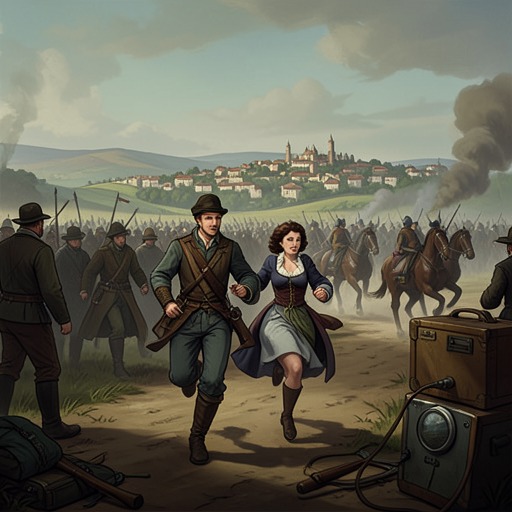
Francia later tells the fugitives that Prentisstown men are attacking the whole town. The pursuing force is no longer merely a threat on the road or a danger directed at Todd and Viola; it has made Farbranch itself its target. Todd and Viola react together with alarm, underscoring how abruptly the place they had reached for safety has become a battlefield.
The attack is seen across the valley beneath the light of the two moons. Farbranch’s buildings and the orchards extending up into the hills are visible in the same illuminated landscape that had first appeared orderly and productive. Now the men and women of the settlement are running back down the hill in retreat. The reversal is concrete: the orchard workers previously seen dispersed among their tasks are moving together away from the assault. The town’s landscape remains recognizable, but its paths and slopes now frame flight rather than routine work.
Farbranch as Turning Point and Recollection
After leaving Farbranch, Todd confirms to Jane that he saw the army there. Her response treats the sighting as confirmation that the danger is real, while Wilf’s reply indicates that he had already insisted it was true. Farbranch therefore becomes evidence that can travel beyond the settlement: what happened there changes a report of an approaching army into something Todd can attest to from direct experience.
Later, when Todd opens his Noise to Ben and recounts what has happened since the beginning of the journey, he includes Farbranch and what happened there among the events he shares. Its place in that account connects the refuge episode to the wider pursuit and to the other encounters Todd has survived. Farbranch’s narrative significance rests on this double role: it is a worked, inhabited community that offers the fugitives shelter, and it is the place where the pursuers’ violence is shown to reach beyond its intended targets and drive the community itself into retreat.