Here-Singing Herd Beasts
The Knife of Never Letting GoThe Here-Singing Herd Beasts are a vast group of animals whose most distinctive feature is not merely their size but their shared song: through Noise, they call Here to one another as they cross a plain and its river. Todd and Viola encounter them while travelling with Manchee and Wilf. Their passage turns the New World’s pervasive communication into something the humans experience not as an invasion of private thought, but as a sound of connection and belonging.
Identity and Appearance
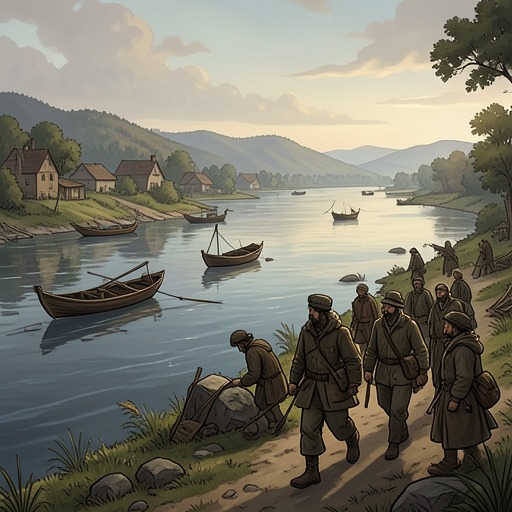
Todd first hears the herd before he can see it. Its Noise crests a hill and rolls toward him and Viola: almost wordless, yet made up of what seems like a thousand voices singing together. Manchee identifies the approaching animals as giant cows, an initial description that catches their scale but not their strangeness. From the hilltop, the travellers see thousands of them spread across the plain, extending from one horizon to the other.
The animals are about four metres tall, with shaggy silver fur, thick fluffed tails, and curved white horns projecting from their brows. Their long necks reach down from broad shoulders to the grass. As they walk over dry ground, their wide lips gather it up; as they cross the river, they drink. The scene presents a moving herd on an immense scale, but its members are not described as isolated figures. Their shared sound binds them as a group while they travel across the landscape.
The Call of Here
The herd’s Noise has many voices and pitches, but Todd perceives a single word running through it. Viola understands that the animals are singing Here, calling it from one to another. The call carries both individual and collective force: it can be heard as one creature answering another, and as the herd declaring its presence together. Todd’s account moves from the many notes to the word that joins them, making the sound itself an expression of connection.
The song is difficult for Todd to compare with anything familiar. He associates it with the scale of planets and moons rather than mountains, imagining different voices beginning at different notes and descending into one another. That comparison conveys the song’s reach and layered quality without making it simply a noise of size or power. Its movement is at once individual and shared: the separate notes remain distinct, yet weave together into a common call.
Crossing the Herd
The river runs through the plain as the animals walk from one side to the other. Todd, Viola, Manchee, and Wilf pass through the herd in their cart. The duration is left uncertain in Todd’s telling: after what might feel like an hour, a week, or a second, the animals begin to thin out and the travellers emerge on the far side. The account’s suspended sense of time belongs to the encounter as Todd experiences it; it does not establish how long the passage actually takes.
Manchee jumps down from the cart once the group is moving slowly enough that he will not be left behind. Todd lets him go, while the cart and its passengers are still among the animals. As the song begins to recede, Viola says that the experience was amazing and that she had forgotten how much her feet hurt. Her response gives the sound a concrete effect on the travellers: for a while, attention to the herd has displaced the discomfort of their journey. Once they are out of it, the song starts to disappear.
Names and Human Understanding
The travellers do not arrive with an agreed name for the species. Wilf mentions Packy Vines, Field Baysts, and Anta Fants as possible names, then explains that he simply calls them things. Viola repeats the casual label, and Todd corrects it to things. This exchange leaves the animals’ naming unsettled: the group has several proposed names, but none is confirmed as a formal or shared designation. The moment also sits beside the careful detail with which Todd describes their bodies and collective call. They are strange to him, but not beyond attention.
The encounter is framed by the novel’s larger soundscape, in which Noise reaches people whether or not they want to hear it. In Prentisstown, Todd has heard the Noise of 146 men as an overwhelming flood. Mayor Prentiss and his deputies attempt to discipline their thoughts through counting and orderly chants. In Farbranch, Doctor Snow explains that music plays to keep men’s thoughts private. Against those human efforts to manage or drown out Noise, the herd’s many voices join without becoming a human-style programme of control. Its sound makes collective presence audible, while the narrative carefully locates its meaning in what Todd and Viola hear.
Belonging Through Sound
Todd experiences the song as something that welcomes its listeners: he associates it with a family whose members belong and care for one another. This is his response to the encounter, not an explanation of the animals’ intentions. The distinction matters. The Herd Beasts are shown feeding, drinking, crossing the plain, and calling Here; the impression of safety and kinship arises as Todd listens to their combined Noise.
That impression gives the scene its significance in the journey. For a brief passage, a vast crowd of unfamiliar animals does not register to Todd as a threat or an unreadable mass. Their voices remain many, but the repeated call makes a shared presence perceptible to the human travellers. The song neither erases difference nor turns the animals into human speakers; instead, it lets Todd hear belonging as something communicated across the herd and felt by those passing through it. As the travellers emerge from among the animals and the song fades, the encounter leaves behind a contrast between Noise as unwanted exposure and sound as a moment of connection.