I AM THE CIRCLE AND THE CIRCLE IS ME
The Knife of Never Letting Go“I AM THE CIRCLE AND THE CIRCLE IS ME” is the central chant in Mayor Prentiss’s attempts to shape Noise into an instrument of order. Heard by Todd Hewitt outside Mayor Prentiss’s House, the phrase belongs to a system of counting, imagined shapes, and group recitation that makes disciplined thought feel less like private reflection than preparation for force.
The Chant and Its Pattern
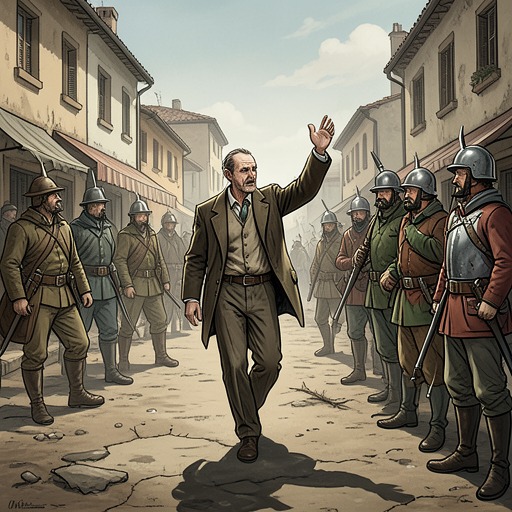
Mayor Prentiss’s Noise is unusually clear to Todd, who describes him as believing Noise can be sorted, harnessed, and put to use. When Todd passes the house, he hears Mayor Prentiss and the men closest to him—his deputies—performing thought exercises, counting, imagining perfect shapes, and repeating orderly chants. The circle formula gives this practice its most memorable verbal form: the speaker’s identity is declared to coincide with a geometric shape, as if thought could be made uniform through repetition.
The chant is embedded in a counted sequence: “1 2 3 4 4 3 2 1,” followed by the circle formula and “IF ONE OF US FALLS WE ALL FALL.” The numbers rise and then reverse, giving the recitation a visibly patterned, controlled shape. The paired slogans extend that pattern from the individual to the group: the first aligns a speaker with the circle, while the second makes each member’s fate depend on the whole.
Order as Threat
The exercise does not reassure Todd. He reads the concentration of Mayor Prentiss and his deputies as the forging of a little army, perhaps even the preparation of a Noise weapon. The weapon is Todd’s interpretation of what he hears, but the effect on him is immediate: the practice feels like a threat and like a world changing without him. As he nears adulthood, he tells himself that men do not run in fear; nevertheless, he urges Manchee onward and takes as wide a curve around the house as possible.
That retreat gives the chant a consequence beyond its stated words. Its promise of order is experienced by the boy outside it as coercive power. Once Todd and Manchee have passed the town, the Noise grows quieter, though it never stops, and both can breathe more easily. The contrast makes the chant part of the town’s oppressive soundscape: it is organized, but not therefore safe.
Voices That Make and Unmake Identity
Elsewhere, Todd encounters a different power in speech. When he and Viola meet Wilf, Viola adopts a voice unlike her own, changing its sound as she speaks until she resembles him. She temporarily names herself Hildy, calls Todd Ben, and says they are from Farbranch. Todd is astonished because he understands her words not merely as a description but as something that makes a new situation seem true for an instant.
Todd’s reflection on lying sharpens the contrast with Mayor Prentiss’s orderly recitations. In a world where Noise exposes thoughts, lies still circulate among other thoughts and truths, and Todd finds it difficult to separate one from the rest. Viola’s performance makes that uncertainty vivid: for a moment, her voice seems to create the identities and origin she claims. The circle chant seeks to stabilize identity through repetition; Viola’s shifting voice shows how readily identity can be altered in the act of speaking.
Revoiced Words
Later, Viola reads from the book in an imitation of Ben’s accent, beginning, “My Dearest Todd,”. Todd recognizes the sound as his mother’s voice speaking through Viola. The scene does not repeat Mayor Prentiss’s chant, but it returns to the entry’s concern with voice and identity: speech can be rehearsed and shaped, yet its effect depends on what it brings into the present. Against a formula designed to bind speakers into a disciplined collective, Viola’s borrowed voice carries a personal connection across absence.