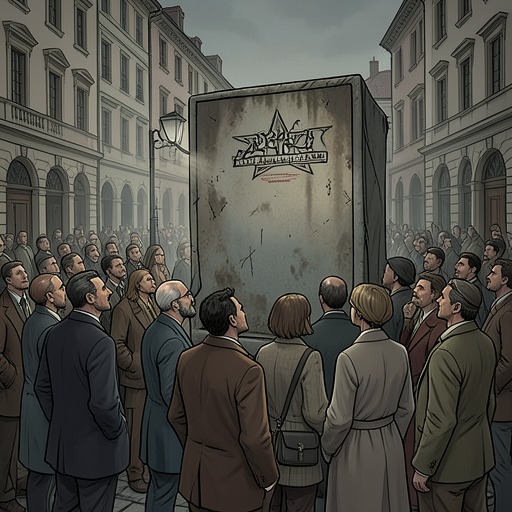
I am Todd Hewitt
The Knife of Never Letting Go“I am Todd Hewitt” is a repeated act of self-identification in Todd’s narration, first introduced as a practical way to quiet his Noise and later returning when fear and moral conflict make him doubt who he is. The phrase does not silence the world around him; it gives him a point of orientation within it. Its recurrence also sets Todd’s effort to name himself against moments when identity seems vulnerable to violence, lies, and other people’s voices.
A name used to steady the Noise
Early in the story, Todd is twelve years and twelve months old and says he will be a man in exactly one month. On the walk back from the swamp toward Prentisstown, the world feels black and grey to him, and the Noise churns until he has to stop and calm himself. He closes his eyes and repeats his name and age. The narration identifies this as a technique Ben taught him: to state as clearly and calmly as possible who he is, because that is what gets lost in the Noise.
The expression is therefore more than a bare introduction. Todd already knows his name; the difficulty is holding on to a stable sense of himself amid the constant, involuntary exposure of thought. The narration insists, “There’s just no such thing as silence.” Against that condition, the deliberate repetition of “I am Todd Hewitt” creates a brief inward structure: a name, an age, a home, and a countdown to adulthood. It does not erase the Noise, but it lets Todd gather his attention and open his eyes again. Manchee murmurs Todd’s name beside him, echoing the act of naming without replacing Todd’s own effort to claim it.
The expression recurs in a different setting when Todd is back at the farm and the day continues to make his Noise no quieter. He thinks of himself as almost a man while describing the work he carries: tending sheep, including feeding, watering, shearing, lambing, castrating, and butchering them. The farm provides meat and wool for Prentisstown, and Todd expects to take on more work as other flocks are absorbed. Here, the self-naming phrase sits beside a concrete, demanding role. His coming adulthood is not merely a date he anticipates; it is tied to labor and responsibility already placed on him.
Repetition under threat and doubt
When Todd encounters the silent girl, his familiar assertion no longer comes easily. Manchee barks at her, Todd holds a knife, and the unfamiliar situation makes the world feel as though it is tipping over. He thinks, “I am Todd Hewitt,” but immediately doubts whether even that can still be true. The repetition exposes a change in the phrase’s function: what had served as a reliable exercise now reveals how little certainty Todd feels when faced with someone and something he cannot understand.
The same tension returns when Todd is unable to bring the knife down to finish a killing. He asks, “Who am I?” and answers with his name, only to condemn himself as a waste of nothing and admit that he cannot do it. The sequence refuses to let the name settle the question. Todd can state who he is, but the words do not make him capable of the action before him; nor does his inability erase the identity he has just asserted. The phrase marks the point where self-definition meets a choice that exposes the limits of Todd’s confidence in himself.
Names, lies, and the making of identity
Todd’s effort to keep hold of his own name gains another dimension when Viola speaks in a borrowed voice. To get past Wilf and the blocked road, she presents herself as Hildy, identifies Todd as Ben, and imitates Wilf’s manner of speaking. Todd is astonished by the performance. He reflects that he knows Viola only through what she says, and that for an instant her words seem not merely to describe a different situation but to make one: they make the two travelers different by naming them so.
This moment sharpens the contrast between Viola’s strategic adoption of identities and Todd’s inward repetition of his own. Todd recognizes that people lie, including to themselves, and that lies mingle with truths in the Noise until it can be difficult to distinguish them. Yet Viola’s performance briefly shows him language acting with unusual force: a name and a convincing voice can alter how a situation appears to others. Against that fluidity, “I am Todd Hewitt” sounds like an attempt to keep a personal truth from being swept into the surrounding current. The phrase is not a guarantee that Todd understands himself completely; it is a claim he returns to when circumstances make that understanding unstable.
A name carried by another voice
Later, Viola reads from the book Todd has taken out, asking whether she can do a Prentisstown voice. She imitates Ben’s accent and reads, “My Dearest Todd,” followed by “My dearest son.” Todd recognizes his mother’s voice in the reading and looks down at the wheat spilled across the ground. The scene places his name inside words of familial address: he is not only a boy trying to steady himself, but also someone addressed as a son by a voice recalled through another person’s performance.
The expression’s recurring force comes from these contrasts. Todd repeats his own name against the noise in his mind; questions it when the encounter with the girl unsettles him; and says it again at the point where he cannot make himself kill. Meanwhile, Viola’s borrowed speech and the remembered voice of Todd’s mother show that names and voices also reach him from outside. The phrase does not resolve these pressures into a fixed, effortless identity. Instead, each recurrence records Todd trying to maintain a coherent self while approaching adulthood, facing violence, and hearing his world narrated through other voices.