Mayor Prentiss's men
The Knife of Never Letting GoMayor Prentiss's men are the armed force and inner circle through which Mayor Prentiss exercises power in Prentisstown. They are associated both with the town's survival and with the violent order that governs it: their military strength helped the settlement endure, while their discipline, pursuit of individuals, and participation in a wider system of coercion make that survival inseparable from the town's abuses.
Identity and Formation
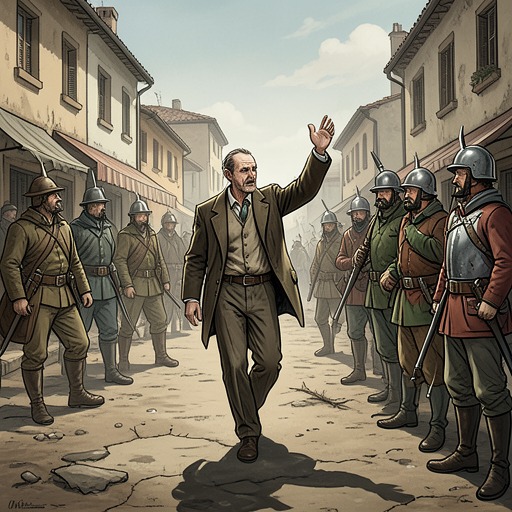
Prentisstown is a dwindling settlement of 147 people: 146 men and Todd Hewitt, who is not yet considered a man. Its isolation follows the war with the Spackle, after which other settlements were wiped out and Prentisstown itself came close to destruction. Ben explains that Mayor Prentiss's military skill was crucial to the town's survival. The men around the Mayor therefore appear first as defenders of a besieged community, a force whose effectiveness residents are told they owe their continued existence to, even while the Mayor himself is described as a nightmare.
That defensive origin does not make the group a neutral institution. The town's population continues to fall, and men who leave or disappear are part of its visible decline. The account of their circumstances later shows that apparent disappearance can conceal coercive enforcement. The men around the Mayor operate within a society where survival, obedience, and political violence have become difficult to separate.
Discipline and Command
The Mayor's House marks the group's distinctive approach to Noise. Mayor Prentiss and the men closest to him practice counting exercises, imagine perfect shapes, and repeat orderly patterns. One recurring chant is the circle formula; another turns the group into a collective whose members are bound by the prospect that if one falls, all fall. These exercises contrast with the uncontrolled, overwhelming Noise Todd hears throughout the town. Rather than treating Noise as an unavoidable condition, the Mayor believes it can be sorted, harnessed, and put to use.
The men performing these exercises are presented as a small, close circle being moulded into shape. Their discipline is more than private training: to Todd, it suggests preparation and a possible weapon made from Noise. The text does not specify the full method or the exact purpose of that preparation, but it makes the group's ordered chants a sign of the Mayor's ambition to turn collective thought into an instrument of power. Their unity is both a bond and a warning: the group's repeated insistence on mutual dependence makes individual resistance appear to threaten everyone.
Military Force and Pursuit
The group also enforces the Mayor's authority beyond the settlement's daily routines. When Mr Prentiss Jr comes to the farm seeking Todd, he says the Mayor wants to speak with him and insists that Todd is not in trouble. Cillian questions why Mr Prentiss Jr is carrying a rifle. The discrepancy between the reassuring explanation and the armed arrival makes the visit a show of pressure, even before its true purpose is clear.
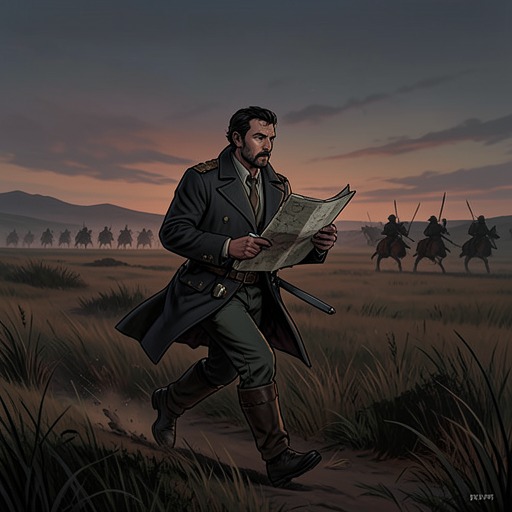
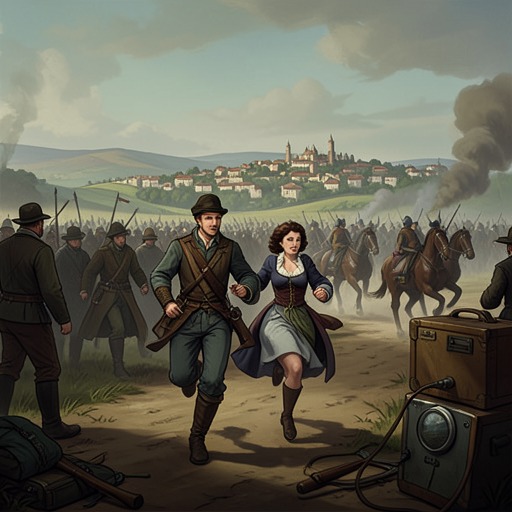
Later, Todd sees Mayor Prentiss riding out of the trees with armed men on horseback. The group includes Mr Collins, Mr MacInerny, Mr O'Hare, and Mr Morgan, alongside Mr Prentiss Jr, who has a visible mark from his earlier encounter with Cillian. The horses are a notable resource on New World: they are difficult to keep alive, and the Mayor protects his personal herd with armed guards. The mounted party's arrival also confirms to Todd that events at the farm involving Ben and Cillian have ended, though he does not know their full outcome at that moment.
Aaron follows behind the riders, bandaged and gesturing as if preaching. His presence connects the Mayor's armed authority to the religious blame and persuasion that accompany it, but the text distinguishes him from the men riding with the Mayor. Together, the scene presents power as a combination of force and ideology: the mounted men can pursue and command, while Aaron's preaching supplies a language that helps make violence seem justified.
Scapegoating and Enforcement
Ben's account traces the political climate in which the group operates to years of hardship across New World: failing crops, sickness, and a lack of prosperity gave way to preaching that assigned blame. The Spackle became the target of that blame, and a movement became a war. Humans had guns while the Spackle did not, and the resulting conflict nearly destroyed them. Ben also makes clear that not all the Spackle died; those who survived learned to keep their distance from humans.
The violence did not end with that war. Todd identifies that the men of Prentisstown killed the town's women after the Spackle were killed, and Ben confirms that many men were swayed by Mayor Prentiss and Aaron's preaching. The men also killed other men who tried to protect the women. The evidence does not reduce every act to a direct order from the Mayor, but it establishes his influence, Aaron's role in shaping belief, and the participation of men within the town's power structure. The group's authority belongs to a wider system in which a community's fear and hardship are redirected toward outsiders and then toward those who resist.
The same system governs the town's coming-of-age killings. Men believed to have disappeared were sometimes killed by boys on their thirteenth birthdays, under the town's rules and before its adult male population. Mr Royal, remembered as a teacher who supposedly died by suicide, had in fact been made the victim of such a ritual. Mr Gault, said to have disappeared, was captured while fleeing through the swamp and later killed by Mr Prentiss Jr on his thirteenth birthday. Other men could be selected if no captured escapee was available, with their disappearance used to conceal what had happened. The Mayor's men are associated with the custody of captured escapees, while the ritual makes a boy's transition into manhood depend on killing another person.
Complicity and Significance
The organization matters not only because it can mobilize armed men, but because it helps sustain a political order that recruits the town into its violence. The exercises at the Mayor's House give that order a language of unity and control; the pursuit parties give it reach; and the town's rituals make violence appear to be a necessary passage into adulthood. The proclaimed bond that all fall together sits beside a system that assigns an individual victim to a boy and asks the rest of the town to watch.
Todd's understanding of Prentisstown changes when he learns what became of the men said to have vanished. Their deaths were not isolated accidents or voluntary departures: they were concealed by a collective practice in which boys, adults, and the authorities all had roles. Todd concludes that everyone was complicit and guilty, except himself. That judgment makes the Mayor's men part of a larger moral structure rather than a self-contained band of soldiers. They protect the Mayor's power, but the town's violence also depends on communal silence, participation, and the lessons by which the next generation is made to inherit it.