Noise
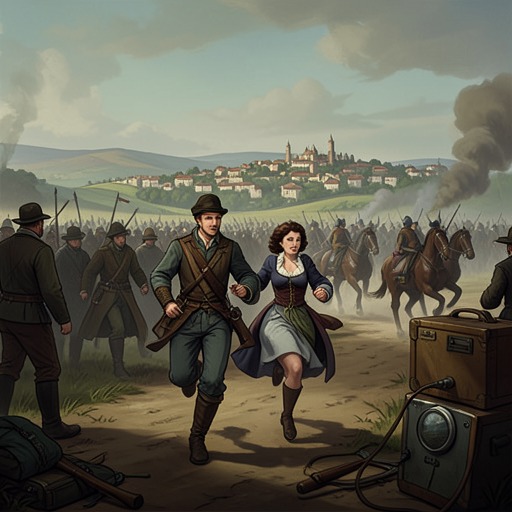
The Knife of Never Letting GoNoise is the New World’s pervasive condition of shared thought: what people think can spill beyond the mind and be heard, seen, or otherwise perceived by others. It is not simply speech or a reliable disclosure of truth. Noise carries memories, fantasies, plans, fears, and contradictions, while the surrounding world participates in a wider flow of information. For Todd Hewitt, it is at once an exhausting atmosphere, a means of exposure, and a force that communities attempt to control. Its meaning changes as he discovers that the account he learned in Prentisstown is false: Noise was not a Spackle weapon, but a natural phenomenon of the planet.
Nature and Origins
Todd initially understands Noise through the history taught in Prentisstown. He believes the Spackle released a Noise germ during the war, killing half the men and all the women, including his mother, and leaving the surviving men’s thoughts no longer private. He connects this catastrophe with another supposed Spackle germ that made animals able to talk. These explanations make Noise part of a story of attack, loss, and human survival, and help sustain the town’s belief that the Spackle were responsible for the disasters that transformed life on the planet.
That account is overturned when Ben explains that the Noise germ was not Spackle warfare. The phenomenon was already present in the air when the colonists landed; within a day, people could hear one another’s thoughts. The colonists’ scientists and doctors could not explain why it happened. Ben describes the early response as chaos and confusion. Some men scattered into remote communities, while others tried to adapt, as they had to the discovery that livestock, pets, and local creatures could communicate too. The revelation changes the origin of Noise from an enemy’s deliberate attack to an enduring condition of the New World.
Ben’s explanation also broadens Noise beyond human thought. On the New World, everything communicates with everything else, producing an unceasing flow of information. The Spackle, Ben says, had evolved to live with this condition, whereas the human colonists were not equipped for it. When the amount of information exceeds what people can manage, it becomes Noise; it does not stop. Noise is therefore both a particular experience of exposed human thought and part of a larger communicative environment that humans struggle to interpret.
What Noise Carries
Noise includes more than words. Todd describes thoughts arriving with pictures: memories, imagined possibilities, secrets, and plans. These impressions do not form a clean record of what a person knows or intends. People can lie within Noise, burying one thought under another or persuading themselves to believe the opposite of what they are hiding. Because a listener receives a rush of mixed material, truth can be present without being easy to distinguish from fantasy, self-deception, or deliberate concealment.
This mixture makes Noise an unstable kind of evidence. Todd hears the thoughts of the two men who run his household, yet recognizes that hearing them does not mean he can make sense of them. He experiences Noise as a jumble of sound, thought, and image in which a person can hold opposing ideas at once. The condition exposes mental activity but does not remove ambiguity: concealment and misunderstanding remain possible even when privacy is compromised.
The burden varies with place and circumstance. Near Prentisstown, the swamp offers Todd a partial respite, not because it is silent, but because its Noise seems to arise from creatures assessing who he is and whether he poses a threat. The town’s noise feels more intrusive: its people already know one another, and the thoughts that circulate among them can be turned into pressure. When Todd looks toward Prentisstown, the thoughts of its 146 remaining men overwhelm him. Their words, images, memories, and plans gather into an experience he compares to a flood, fire, and pursuing monster. The number of men makes the force of the soundscape concrete, while its scale conveys how little refuge he feels he has.
Noise in Farbranch offers a sharp contrast. Todd hears ordinary thoughts about work, singing, repairs, and daily business. Their routine quality makes the settlement’s sound feel safe by comparison with the darker, more oppressive Noise he associates with Prentisstown. Noise itself has not disappeared; its character changes with the community and with Todd’s expectations. The distinction is not simply between loudness and quiet, but between a soundscape experienced as threatening and one that seems absorbed into ordinary life.
Silence, Privacy, and Community
Silence matters because it marks a limit to the shared access Todd takes for granted. Viola’s silence is conspicuous to him, particularly when they are alone, away from a settlement’s surrounding chatter. He experiences it as a powerful presence rather than a blank. It draws him toward the possibility of escaping the constant influx of other minds, even though it also makes Viola’s thoughts inaccessible to him. Her silence is thus both a source of separation and an alternative to the exposure Noise imposes.
The difference affects conversation as well as intimacy. When Viola and Hildy speak together, Todd can catch only occasional words. He understands that people without ordinary Noise can have secrets automatically: distance limits what he can hear instead of making everyone’s thoughts available to him. His assumption that everyone must be Noisy makes this an unfamiliar form of privacy. Silence alters who can communicate with whom, and under what conditions.
Communities respond to Noise by shaping their environments and habits. At Carbonel Downs, continuous music plays day and night. Hildy explains that the music is faint at her house but so prominent in the settlement that people cannot hear themselves think. She says Doctor Snow gave the purpose as keeping men’s thoughts private. The policy does not remove the underlying condition; it places another sound between people and the thoughts they might otherwise perceive. Music consequently functions as a practical screen, while also demonstrating how thoroughly the possibility of private thought has become a matter of communal design.
Control can also be practiced by individuals. Todd remembers Tam as a man who controlled his Noise better than anyone in Prentisstown, and tries to make his own Noise quiet, grey, and flat. The effort shows that Noise is not presented only as an involuntary broadcast with no variation: its expression can be managed, even if it cannot simply be switched off. The Mayor pursues control on a larger scale. Todd hears him and his close associates performing thought exercises, counting, imagining perfect shapes, and repeating orderly patterns. Todd interprets these practices as an attempt to sort and harness Noise, perhaps shaping an army or forging a weapon from it. Noise becomes a potential instrument of power as well as a condition power seeks to contain.
Exposure, Danger, and Relationships
Noise makes thought socially consequential. Todd’s sense of being known by others contributes to his unease in Prentisstown, where the constant exchange of thoughts can feel like a means of pressure rather than understanding. Yet the exposure does not guarantee honesty. Todd’s reflections on lying recognize that falsehood can be woven into the same stream as truth, and that people may deceive themselves as well as one another. Noise reveals mental activity, but interpretation remains vulnerable to confusion and manipulation.
The condition also influences Todd’s hopes for Viola and his fears about his own presence. When he realizes that she has not caught Noise, his hope rises; he has understood that the Noise germ may endanger her and even others he encounters. He wonders whether her survival means that her experience has a different cause, but cannot make sense of it at first. Hildy’s existence similarly unsettles his belief that Noise kills all women. These reactions show how the inherited account of Noise shapes his understanding of who can survive and whom he can safely approach, even before he has the knowledge to question that account fully.
Noise can also make a relationship perceptible without making it simple. Todd can hear the thoughts of people around him, but the flow offers no assured access to their settled intentions. With Viola, by contrast, the boundary between his audible mental activity and her silence becomes a distinctive feature of their connection. Their difference exposes the limits of the world Todd assumes he knows: communication is not universal in the same way, and an absence of Noise need not mean an absence of thought or feeling.
Noise Through the Ending
At moments of conflict, Noise becomes an explicit measure of what characters claim to know about one another. Aaron invokes it against Todd, insisting that Noise reveals him and asserting that Todd will never be a man. Todd’s own Noise blazes red and then screams red, giving the conflict a changing color as well as a sound. These descriptions do not make Noise a neutral transcript of thought; they show it as an expressive presence that can be read, interpreted, and used to challenge another person’s identity.
Near the end, the condition changes again in Todd’s perception. During the confrontation involving Davy Prentiss, Davy’s horse broadcasts its urge to charge, a reminder that Noise includes animals and can affect the immediate reading of danger. Later, Todd says he cannot hear the Mayor’s Noise. He notices that, even after reaching Haven, the absence he encountered on meeting the Mayor remains in the room and is matched by a corresponding absence from Mr. Collins. The evidence establishes this silence but does not explain its cause. Its recurrence stands out precisely because Noise has otherwise seemed inescapable.
The novel’s progression from the supposed Spackle germ to Ben’s account of the natural phenomenon makes Noise a test of what people believe about the world. Its ceaselessness creates exhaustion, its informational excess frustrates certainty, and its exposure of thought reorganizes privacy and social power. Yet communities can answer it differently, through distance, music, practiced control, or the recognition that some people do not share the same access to one another’s minds. Noise is not merely background sound: it is the condition against which characters negotiate knowledge, trust, secrecy, and the possibility of being alone.