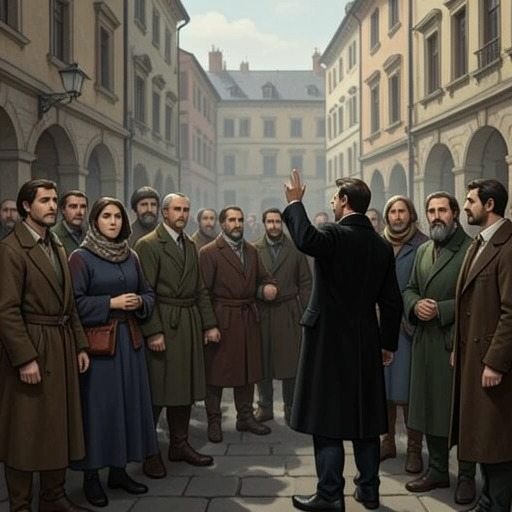
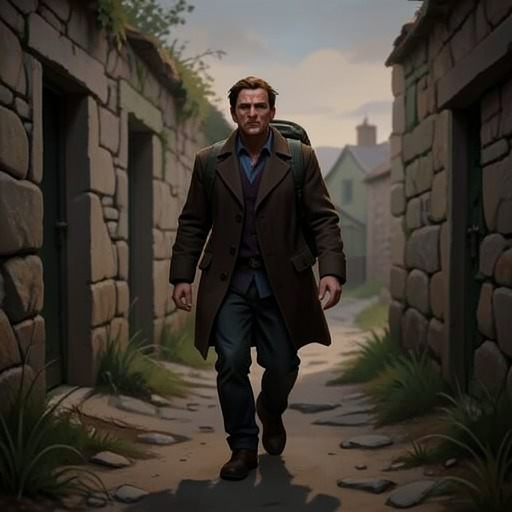
Prentisstown’s all-male society
The Knife of Never Letting GoPrentisstown’s all-male society is both the aftermath of the town’s loss of its women and a social order that continues to define itself through gender and age. Its dwindling population is divided between men and boys, but the passage from one category to the other is not merely a birthday or a change in status: it is governed by a secretive adult culture whose coming-of-age practice makes a boy responsible for killing a man. The town’s apparent social rule is therefore also a mechanism of violence and shared guilt.
Demographic Setting and Origins
Todd Hewitt describes himself as having been born into an already crowded swamp and cemetery, but a town that was not crowded enough. He remembers no world without Noise. His father died of sickness before Todd was born; his mother died afterward, and Ben and Cillian took Todd in and raised him. The account places the all-male society within a history of loss, although it does not establish a cause for the deaths of the women.
The town’s numbers make its decline explicit: its population is 147 and falling, comprising 146 men and one almost-man. That count gives the social structure a stark outline. There is a large adult male population, but Todd stands alone at the edge of its definition of adulthood. His description of the town as still falling suggests a community diminishing as well as one organized around an unusually narrow passage into adult life.
Todd also treats claims about who was the last woman with uncertainty. Ben says Todd’s mother was the last, but Todd notes that people say the same of everyone’s mother; Ben may believe the claim, yet Todd cannot know whether it is true. The uncertainty matters because the town’s history reaches Todd through the accounts of surviving men. Even a basic fact about the last woman is remembered as competing family testimony rather than settled knowledge.
Gender Roles and the Thirteen-Year Threshold
Before learning what the town’s adult men conceal, Todd has absorbed a conventional picture of gender. He has seen girls in the Noise of their fathers and in videos, and describes the expected division as one in which girls are polite, wear dresses, and do work inside the home, while boys do work outside. At thirteen, girls are supposed to become women and wives, just as boys are supposed to become men. Todd presents this as how the New World works, or at least how Prentisstown was meant to work.
That formula survives in his understanding even though the girls and women are gone. Todd says they died in the months after he was born, along with their mothers, sisters, and aunts. The contrast is sharp: the social script still assigns women domestic work and marriage, but no women remain in the town to occupy those roles. The all-male society is not described as having developed a new arrangement; its familiar expectations persist as an inherited framework for a world from which half its population has disappeared.
Age thirteen marks a different and consequential boundary for boys. Once boys become men, they attend meetings restricted to men, while boys are excluded. If a boy is the last one in town, he has to wait by himself. The meetings thus make adulthood visible as a separation from younger boys, while keeping the substance of adult male life out of their reach. For Todd, the gap between being an almost-man and being admitted to the men’s world is also a gap between ignorance and knowledge.
The Secret of Manhood
When Viola asks why boys become men at thirteen, Todd recalls the explanation he has heard: the custom is supposed to be scriptural. Aaron connected it to eating from the Tree of Knowledge and passing from innocence into sin. This interpretation gives the age threshold a moral and religious framing, but Todd’s later understanding reveals a practical rite behind the language of symbolism. The change in status depends on a boy being made to kill a man.
Todd identifies two cases that expose what the adult meetings and the public story of the town have hidden. Mr Royal, the former schoolteacher whom Todd had believed shot himself, was instead shot by Seb Mundy on Seb’s thirteenth birthday, with the men of Prentisstown watching. The correction changes the meaning of Mr Royal’s death: what seemed a private suicide was part of the town’s coming-of-age system, and the watching adults were present at the event that made a boy a man.
Mr Gault’s case shows the same system operating through the town’s treatment of attempted escape. He tried to disappear, was found by Mayor Prentiss while fleeing through the swamp, and was kept until Mr Prentiss Jr’s thirteenth birthday. Mayor Prentiss then made his son kill Mr Gault without assistance. The delay and the birthday tie the execution to the boy’s passage into adulthood; the act is assigned to the boy, but planned and enforced by the adult authority around him.
Complicity and Significance
The two cases clarify why the boys who have become men do not talk to boys who are still boys. The separation is not only a social custom: it protects the secrecy surrounding the rite until a boy is made to undergo it. Todd connects that concealed knowledge to the crimes of Prentisstown. What the men withhold from boys is also what binds the men together as participants in the town’s violence.
The rite isolates the boy at the moment of action, but the surrounding community is not absent. The men watch Seb Mundy’s initiation, and Mayor Prentiss arranges Mr Gault’s death as his son’s thirteenth-birthday act. Todd’s account makes this tension central: one boy is left to perform the killing alone, while adult authority and the assembled men make the act possible. Individual responsibility is imposed within a collective system, not outside it.
Todd’s conclusion is uncompromising: everyone is complicit, everyone guilty. In this way, Prentisstown’s all-male society is more than a demographic condition. Its boundaries between boys and men organize who may know, who must act, and who bears responsibility for what the town calls adulthood. The apparent promise of inclusion in the adult male community is revealed as entry into a shared crime, while the meetings that define that community help keep the crime hidden until each boy’s turn arrives.