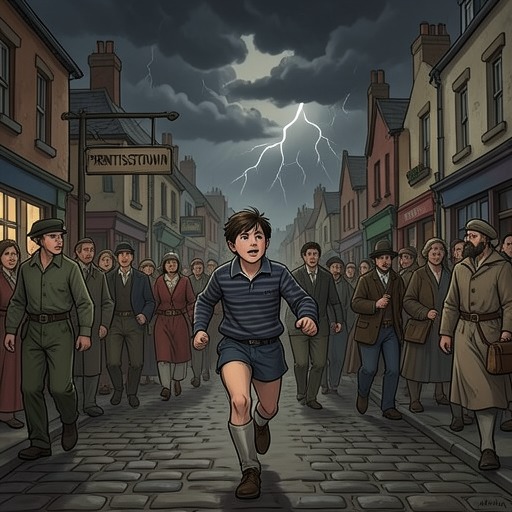
Prentisstown’s manhood rite and complicity
The Knife of Never Letting GoPrentisstown’s manhood rite and complicity is the system by which the town turns boys into men through a concealed history and an assigned killing. The rite binds adulthood to violence: boys are eventually told a version of what has happened, then made complicit in the crimes that sustain the town’s order. Its political purpose is especially clear in the Mayor’s pursuit of Todd Hewitt, the last boy not yet incorporated into that system. Todd’s discovery of the truth exposes not only individual killings but a community organized around shared responsibility and concealment.
A coming-of-age rule built on concealment
Ben explains that he and Cillian waited in Prentisstown, which he describes as a town-sized prison, trying to keep Todd as innocent as they could until he was old enough to leave on his own. The Mayor was waiting too. In Ben’s account, a boy’s transition into manhood is not an open passage into adult knowledge: boys are told the truth, or only a version of it, and are then made complicit. The delay matters. The boy first grows up among the town’s explanations for its missing men; only when he reaches the threshold of adulthood is he initiated into the violence those explanations conceal.
That arrangement makes complicity part of the rite rather than a consequence that follows it by chance. A boy is not simply informed that the adults have committed crimes. He is made to take part in the system that commits them, and the resulting silence separates boys from men. The division protects the practice from younger boys’ knowledge while preparing those same boys to enter it in turn. Adulthood is thus defined by participation in a lie and a crime, not merely by age or social status.
The killings hidden as disappearances
Todd’s disclosure gives specific meaning to the men said to have disappeared. Mr Royal, Todd’s former schoolteacher, was not the person who ended his own life, as the town’s story held. Seb Mundy shot him on his thirteenth birthday, after being made to stand alone and pull the trigger while Prentisstown’s men watched. The town’s account of Mr Royal’s death therefore concealed both the actual killer and the rite that had assigned him the act.
Mr Gault’s fate reveals another route by which the same system operated. After he tried to escape through the swamp, the Mayor found him and carried out the punishment required under New World law. Rather than acting openly, the Mayor waited until Mr Prentiss Jr’s thirteenth birthday and had his son kill Mr Gault without help from anyone else. The circumstances differ from Mr Royal’s case, but both deaths make a boy’s birthday the occasion for an adult’s killing and make the boy responsible for carrying it out.
Todd understands these cases as examples of a repeated practice, not isolated crimes. Men he knew were killed by boys he knew, who were being made into men in their turn. If the Mayor’s men had captured someone attempting to escape, they could keep that person hidden for a boy’s birthday. If they had no such captive, they could choose someone in Prentisstown they disliked and say that he had disappeared. The false account did more than hide a death: it supplied a cover story that could be used to protect the rite and select its victim.
The Mayor’s claim to control
The Mayor’s interest in Todd gives the rite a larger political aim. Ben describes Todd as the last innocent boy in Prentisstown and explains that, if the Mayor could make every boy a man according to his own definition, he could claim complete control over them. The image of the Mayor as a creator is presented as Ben’s explanation of the Mayor’s ambition: the last boy’s initiation would complete an army made in the Mayor’s image and under his authority.
Todd’s position is therefore unlike that of the boys whose birthdays had already been used to bind them to the system. He is both a person the Mayor wants to control and a symbol of the possibility that the process might not be complete. Ben tells him that failure to bring him into the Mayor’s order would mean the Mayor would kill him instead. The alternative is not a peaceful place outside the system; it is death rather than incorporation. That threat clarifies the coercive logic beneath the rite’s claim to make boys into men.
Disclosure and the limits of complicity
The truth comes into view when Todd names the sacrifice as the person before him and opens his Noise so that the other witnesses can see he is telling the truth. He then explains the pattern he had been shown before leaving the farm: the separation between boys and men, the men’s complicity, and the supposed disappearances. His account replaces the town’s scattered explanations with a connected system, linking birthdays, chosen victims, adult spectators, and the Mayor’s concealment.
The disclosure ends in a stark judgment: the men are complicit and guilty, except Todd. That distinction does not mean Todd has been untouched by the town’s history; Ben has already told him that the Mayor has been waiting for him, and Todd wonders whether he has already fallen. Rather, the exception marks his refusal—or, at this point, his not-yet-completed initiation—into the Mayor’s definition of manhood. His question about whether he was going to be different registers the cost of learning that innocence was something others had tried to preserve for him, while the town’s rite was designed to make it impossible to keep. The concept’s significance lies in that reversal: the town calls its practice adulthood, but Todd’s revelation shows that its measure is participation in an organized wrong.