Purification Through Sacrifice
The Knife of Never Letting GoPurification Through Sacrifice is Aaron’s doctrine that killing can serve as a test, a cleansing act, and the foundation for a remade community. It joins religious language about purity to a politics of hatred and collective discipline: supposed evil must be exposed and destroyed, while the killer is promised transformation. The doctrine’s claimed renewal is shadowed by the people it makes expendable, from the Spackle to Prentisstown’s women and dissenters, and finally to the boy Aaron wants to turn into a murderer.
Religious language and social order
The doctrine grows out of the settlers’ stated hope for a pure new beginning on New World. The Church’s sermons recall the departure from the corruption and sin of Old World and the aspiration to build a new Eden through purity and brotherhood. In Prentisstown, Aaron preaches that men must bind themselves into a single community because they have only one another. The religious promise of shared life thus supplies a vocabulary for unity, but the novel sets that promise against the town’s coercive social reality.
Mayor Prentiss’s project offers a political parallel. At his house, he and his closest men practise exercises intended to sort and harness Noise; their counting and orderly chants present discipline as a way to master a disorderly world. That effort is understood as threatening, and the repeated creed that the community stands or falls together gives collective order an absolute force. Aaron’s preaching and the Mayor’s drills are not identical projects, but both make unity and control central, creating a context in which violence can be represented as service to the whole rather than as harm done to particular people.
Blame becomes persecution
Ben explains how hardship across New World—failing crops, sickness, and the absence of the promised prosperity—was followed by preaching that assigned blame. The Spackle became the target of that accusation; preaching became a movement, and the movement became war. Humans had guns and the Spackle did not, and Ben describes the result as the end of the Spackle, while acknowledging that not all were killed and that survivors learned to avoid men. The account shows how the language of a threatened or failed community can redirect attention from its troubles toward an excluded group, then make violence appear to resolve the crisis.
The same pattern reaches into Prentisstown. Todd names the killing of the town’s women after the war against the Spackle. Ben confirms that many men were swayed by Mayor Prentiss and Aaron’s preaching, including the claim that what was hidden must be evil; women and the men who tried to protect them were killed. The doctrine’s logic does not stop at an outside enemy. Once concealed difference is treated as proof of evil, people within the community can also be made into sacrificial targets.
The coming-of-age system
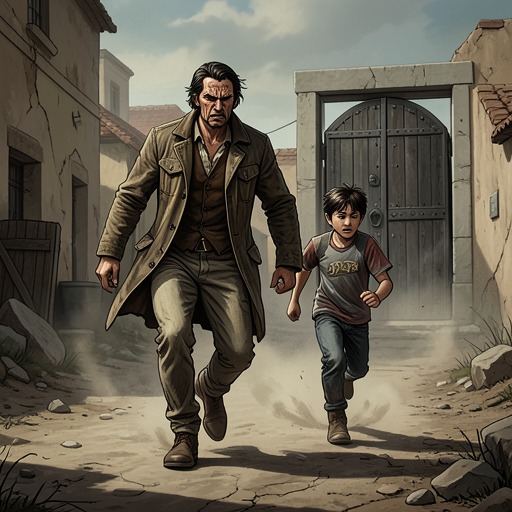
The town’s killings are sustained through a system that turns a boy’s thirteenth birthday into a test of manhood. Todd learns that Mr Royal, remembered as having shot himself, was instead killed by Seb Mundy on Mundy’s birthday, with the men of Prentisstown watching. Mr Gault, who had tried to escape, was captured by Mayor Prentiss and killed on Mr Prentiss Jr’s thirteenth birthday, with the Mayor arranging for his son to carry out the act. If the Mayor’s men had no captured escapee for a boy’s birthday, they could choose someone disliked in town and claim he had disappeared.
This arrangement makes an individual victim serve a boy’s passage into adult status, while the town’s men participate as witnesses or accomplices. Its recurring formula joins a man’s death to a boy’s supposed birth as a man. Todd’s recognition that the town’s members are complicit, and that he alone has not taken part, makes the rite’s social function plain: the violence is not an isolated act but a collective institution that distributes guilt while teaching boys to accept killing as the price of belonging.
Aaron’s final test for Todd
In the church behind the waterfall, Aaron presents Todd as the last boy needed to complete his army. He invokes the creed of mutual dependence to claim that Todd’s participation would leave no weak link, then couples the group’s supposed rebirth to the destruction of the existing world. Todd answers that he would not have killed anyone. Aaron turns that refusal into evidence of Todd’s special role: the boy who cannot kill, he argues, must be made to choose whom he will protect.
Aaron also recasts Viola’s silence as pollution and her arrival as a divinely provided sacrifice. He says that he once believed he had been sent a victim to destroy, but now sees Todd’s purpose as protecting the helpless. This interpretation converts Todd’s care for Viola into a stage in Aaron’s religious design. It does not describe Todd’s own understanding of his actions; instead, Aaron tries to claim those actions as proof that the boy is moving toward the destiny Aaron has assigned him.
Aaron’s demand is explicitly more than a request to be killed: he wants Todd to murder him and become a man through the act. When Todd falls and drops the knife, Aaron says Todd has robbed him of his sacrifice and threatens Viola. Aaron continues to call himself a saint even as he turns his violence against her. The contrast exposes the gap between the purity he claims and the harm through which he pursues it. With the knife resting in water and Aaron holding his arms open, the proposed act of purification remains a coercive test, not a redemption established by the evidence.
Meaning and political aftermath
Across these episodes, sacrifice is less an offering that heals a community than a mechanism for selecting victims and binding observers to violence. The targets change—from the Spackle, to women and their defenders, to men labelled as escapees, to Todd and Viola—but the legitimizing pattern persists: blame is assigned, destruction is called necessary, and participation is presented as proof of unity or maturity. The doctrine’s promise of a purified community is therefore inseparable from the exclusions and killings on which that promise depends.
At the end of the supplied narrative, Mayor Prentiss announces that he has been appointed President and welcomes Todd to the planet’s new capital. This political announcement follows Aaron’s attempt to make sacrifice the gateway to a new order, but the passage does not equate the two men’s projects or explain the appointment’s full history. It does leave the doctrine’s language of remaking the world beside an emerging regime: the promise of a fresh beginning has not disappeared, but neither has the question of what violence its claim to purity will authorize.