Spackle
The Knife of Never Letting GoThe Spackle are the native people of New World, a species whose history is bound to the planet’s living communication, the human Noise germ, and a war that settlers remember as their extinction. For Todd Hewitt, encountering one alive overturns what he has been taught; his immediate attack then makes the cost of that inherited certainty personal and enduring.
Identity and the inherited name
Todd’s first understanding of the Spackle comes through the language and assumptions of Prentisstown. People commonly call them “spacks,” a shortened, contemptuous name. In the swamp, Todd finds writing on an old structure and learns from Ben that its letters sound like es’Paqili, meaning “The People.” The contrast is stark: the name the Spackle give themselves is a collective humanizing one, while the settlers’ familiar label reduces them to an alien enemy.
The writing matters because Todd has been told that no one has seen words in the Spackle language before. The inscription is evidence of a culture that humans do not understand, not proof that its people lacked culture or purpose. The old buildings nearby deepen that uncertainty. They lean out of the swamp’s shadow, their function forgotten by the settlers; Ben guesses that they may have been connected with burial, perhaps serving a role something like a church. He also notes that the Spackle had no religion Prentisstown could recognize. The limits of that recognition belong to the observers, not necessarily to the Spackle themselves.
The swamp and the dead
The swamp preserves a history that human memory turns into smell and fear. According to Ben, the Spackle placed their dead in its water. Their bodies and the swamp were compatible, and the remains enriched the wetland rather than poisoning it. This burial practice makes the landscape more than a backdrop to Todd’s flight: it holds evidence of how the Spackle lived and how their dead were treated.
That balance was overwhelmed during the war. Todd understands that far more Spackle died than the swamp could absorb. Bodies accumulated, and the wetland became a place of decay before, over time, it became a swamp again. The burden was environmental as well as human: the aftermath persisted in the landscape, while settlers carried memories of the mass death into their perception of the place. Todd suspects that the dead may have left germs behind, but this is his uncertain fear, not a confirmed explanation for the Noise germ.
The swamp’s older buildings and burial landscape also stand against the settlers’ claim that the Spackle simply vanished. Even before Todd sees a survivor, the terrain contains traces of a people whose lives and practices are only partly legible to the humans who occupy their former world.
Noise, blame, and war
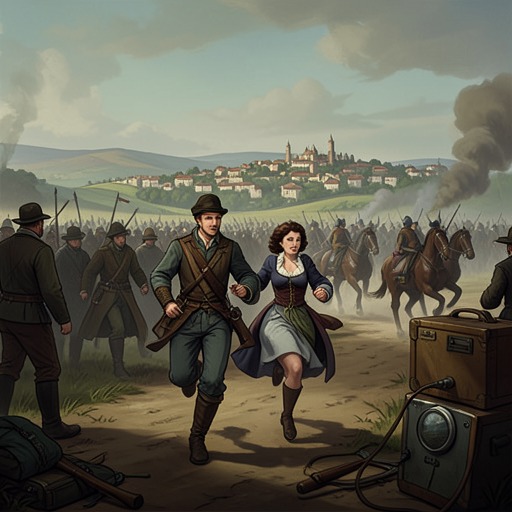
Prentisstown teaches Todd that the Spackle released the Noise germ during the war. In the account he inherits, the germ killed half the men and every woman, including his mother, and drove surviving men mad; that madness, in turn, ended the Spackle once humans took up guns. The explanation offers a simple sequence of injury and retaliation, with the Spackle positioned as the original cause and human violence as its consequence.
Ben later corrects that account. The germ was already present in the planet’s air when the settlers arrived. Within a day of landing, people could hear one another’s thoughts, though no one knew why women were not affected. Ben describes New World as a place where everything communicates: the Spackle had evolved to live with that constant exchange, while humans were not equipped to manage so much information. For people unable to escape or make sense of it, the overload became Noise and could lead to madness.
The distinction changes the moral history of the war. As hardship deepened and hopes of prosperity failed, preaching began to blame the aliens. That blame became a movement, then war. The Spackle faced human guns without comparable weapons, and Ben says they did not stand a chance. Their supposed responsibility for the germ was not established fact but a story that made an existing crisis politically usable. Ben nevertheless warns against treating the settlers’ account of total extinction as true: some Spackle survived, but learned to keep away from humans.
The survivor Todd encounters
Years of separation make the living Spackle at a campsite seem impossible to Todd. He sees a tall, thin figure with pale skin, long limbs and fingers, dark eyes, and lichen and moss where clothing would ordinarily be. These details mark the figure as unfamiliar to him, but the encounter does not confirm the image of a monster that Prentisstown’s stories have prepared him to see. Todd recognizes that the person before him is a Spackle before he reaches for his knife.
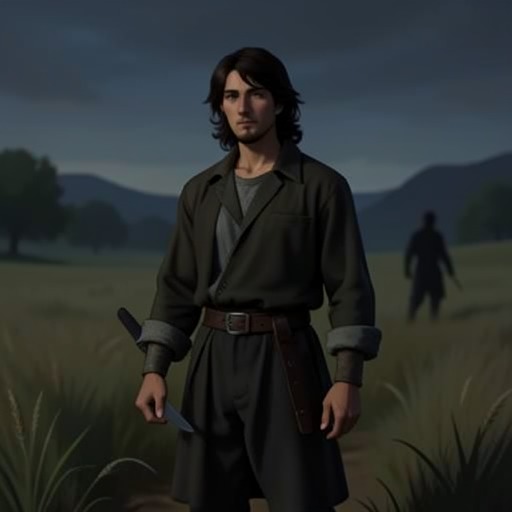
The Spackle’s Noise reaches Todd as pictures rather than clear words. The images show Todd and Viola standing in front of him, shocked, and the knife extended in Todd’s hand. Communication is taking place, but Todd cannot readily interpret it. The pictures give him a glimpse of the Spackle’s perspective at the very moment his inherited fear is turning the encounter into a threat.
Todd attacks. Viola objects that he has no basis for assuming the Spackle intended to harm them: the figure’s reaching for a spear follows Todd’s advance with the knife. She challenges him with the contradiction between his certainty that all Spackle died and the living person in front of them. Todd’s assertion that the Spackle killed everyone on New World thus collapses under the evidence of the encounter itself. His belief is not merely mistaken; it has shaped his action before he has understood the other person’s intentions.
Consequences and significance
Todd later remembers the killing as a lasting moral wound. He recalls the Spackle’s pain and bafflement, and the sense of the knife and the two beings’ blood together stays with him after the encounter. When he tells Viola about the memory, her distress makes clear that the act has consequences beyond the moment of violence. Todd does not treat what happened as an abstract victory over an enemy: he continues to remember the person he killed and the fear and confusion he had failed to recognize.
The surviving Spackle’s fate is not resolved in these episodes, and neither is the question of how many others remain. What is established is enough to overturn the certainty of extinction: the Spackle were not all killed, and at least one has continued to live apart from humans. Their distance is not evidence that they never existed or that they are inherently hostile; Ben presents it as a lesson learned after war.
Through the Spackle, the story exposes the gap between a people and the story told about them. Human settlers mistake a planetary phenomenon for an enemy’s weapon, turn hardship into blame, and then read the survival of the people they attacked through the same hostile assumptions. Todd’s encounter makes that history immediate. The Spackle’s pictures, the old writing, and the swamp’s burial ground each offer partial evidence of lives that human certainty has obscured. His remorse cannot undo the killing, but it marks a break from the inherited account: the Spackle are people, not a vanished enemy or a permissible target.