Spackle Structures in the Swamp
The Knife of Never Letting GoThe Spackle Structures in the Swamp are the first striking sign of the old Spackle presence that Todd Hewitt encounters as he crosses into the darker part of the swamp. Their melting, hut-sized forms seem to offer evidence of a vanished people, but they disclose no settled account of what they were for. In the search for an impossible hole in the Noise, their shadowed exteriors, empty interiors, and lone inscription make the structures more than ruins: they are material traces that prompt human guesses while resisting certainty.
Setting and Appearance
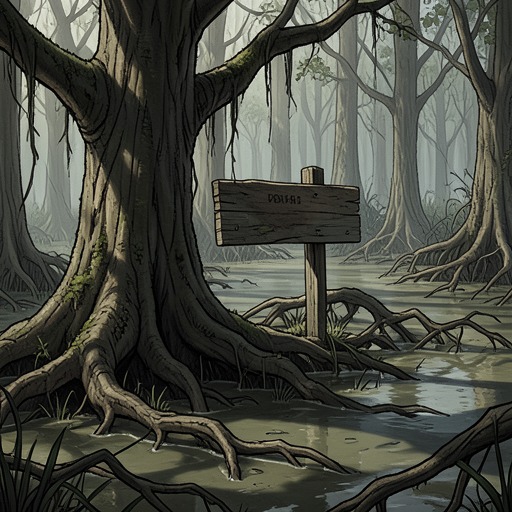
The structures appear just beyond a log that marks the point where the swamp’s darkness begins. They lean out of the shadows in shapes Todd Hewitt compares to enormous blobs of melting tan ice cream. The image makes them vivid but not legible: they are recognizably buildings, yet their unfamiliar, softened outlines do not tell him how they were meant to be used. Their scale is substantial enough for people to enter, but their appearance supplies no reassuring sense of domestic or public purpose.
Todd Hewitt initially keeps a wide distance from them and goes instead to a nearby grove of wild apple trees. The contrast is practical as well as atmospheric. The apples can be picked and tasted, even if they are only nearly edible; the buildings offer no such immediate familiarity. When Manchee begins sniffing toward the structures, however, Todd Hewitt follows. He approaches the largest cautiously, keeping clear of its bent triangular doorway and looking inside only after taking a deep breath. The sequence turns the buildings from distant silhouettes into spaces that must be approached and inspected.
Uncertain Purpose and Empty Interiors
No one in Prentisstown knows, or can remember, what the buildings were intended to be. Ben’s best guess is that they had something to do with burying the dead, perhaps serving as a kind of church. That suggestion remains explicitly provisional: it is an interpretation imposed on unfamiliar architecture, not a recovered Spackle explanation. The possibility of a church is especially uncertain because the people of Prentisstown could not recognize any religion among the Spackle. A burial place and a religious building are human categories offered in the absence of reliable knowledge.
The largest building does not confirm either guess. Its ceiling rises to a point well above Todd Hewitt’s head, while its dirt floor has been overtaken by swamp plants and vines. There is nothing else inside, and no hole. The emptiness does not resolve the structure’s purpose; instead, it leaves open what may once have occupied the space and what, if anything, was removed or lost. When Todd Hewitt checks a second building, that one is empty too. The repeated absence frustrates the search without making the buildings irrelevant: they become places where he tests what he can hear, and where the expected answer fails to appear.
The Inscription and the People
The second structure bears writing on its exterior, making it exceptional among the traces of Spackle culture known to the people of Prentisstown. The letters are identified as Spackle letters; Ben offers a tentative account of their sound as es’Paqili. He says this means The People, the name for the Spackle themselves. The inscription is therefore a rare surviving act of self-naming, in contrast to the hostile shorthand spacks that people use after what happened to the Spackle.
Yet even this written trace is limited. The letters can be seen, but the structures provide no broader account of the people who made them, their customs, or the buildings’ specific uses. The sign names a people without explaining their architecture. Its placement on the exterior also makes the structure a surface for communication as well as an interior space: a mark left where another visitor might encounter it, though Todd Hewitt and Ben can only interpret it from what they know. The buildings preserve evidence, but not a complete history.
The Noise and the Structures’ Narrative Role
Todd Hewitt’s attention to the buildings is bound to his search for a hole in the Noise, an absence he regards as impossible. He listens inside the first structure and then outside, using what he calls the hearing parts of his brain; the second interior also yields no hole. The search makes the buildings part of a sensory investigation, not simply an archaeological curiosity. Their emptiness is measured against the possibility that something essential has gone quiet.
Later, as Manchee runs from building to building and Todd Hewitt tries to calm his Noise, Todd hears a vast rip in the Noise behind the Spackle Structures in the Swamp and some bushes. The buildings thus help orient the discovery without explaining it: the rupture lies beyond them, not inside either empty room he has searched. Their role shifts from places examined for an answer to landmarks behind which something is concealed. In the subsequent swamp encounter, the girl stops when Todd Hewitt calls for her to hold up; the stillness of that moment contrasts with the earlier, overwhelming rupture in the Noise. Across these scenes, the structures frame the limits of what can be known. Their form invites speculation, their inscription offers a fragment of identity, and their silence cannot itself tell Todd Hewitt what is waiting beyond them.