The Knife as a Choice
The Knife of Never Letting GoThe Knife as a Choice gives a physical object the burden of a decision in the confrontation between Todd Hewitt, Aaron, and Viola. The knife first appears to summon Todd toward the act Aaron demands, but the scene does not end with Todd wielding it. Viola picks it up and makes the decisive move; when Aaron goes over the edge, the knife goes with him. Its significance lies in that reversal: the object seems to offer one course of action, yet the choice belongs to the person who takes it and acts.
The Knife as an Apparent Invitation
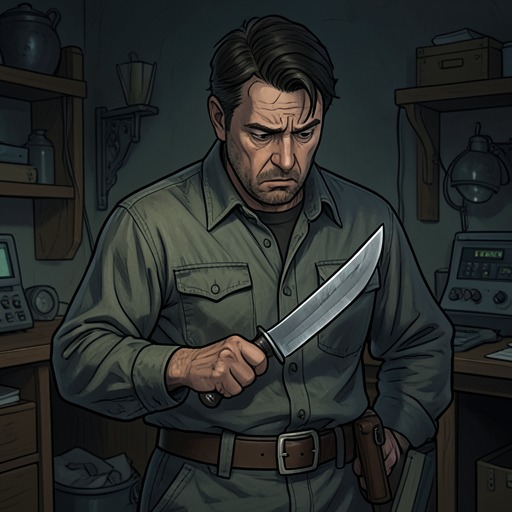
The knife rests in a puddle near the ledge beside the pulpit, behind Aaron. Todd has dropped it there. Its position matters: it is close enough to be taken, but it is not already in either person’s hand. The scene makes the distance between possession and action visible, holding open a possibility without making it inevitable.
Todd’s attention returns to the knife as his hatred fills the cavern. Aaron urges him to purify himself and holds out his arms, inviting Todd to kill him and become a man. The demand gives the knife a meaning beyond its practical use: in Aaron’s terms, taking it would enact a passage into manhood. But that definition comes from Aaron, whose invitation turns violence into a test. The object is therefore caught between the act it can enable and the meaning another person imposes on that act.
The knife’s apparent call to Todd is rendered as a repeated insistence that he take and use it. That language makes the object feel like an active voice, but its force is bound to the pressure of the moment: Aaron is waiting, the knife is within reach, and Todd is being asked to answer violence with violence. The scene presents temptation as something tangible and immediate, not as an abstract debate detached from action.
A Decision That Changes Hands
The sequence emphasizes that Todd’s response is not settled at once. The knife calls again, and then Todd recognizes that he is going to use it. The recognition marks a turn in intention, but it does not complete the act. Before Todd can take the knife, another hand reaches it first. The distinction between deciding and acting becomes the scene’s hinge: Todd has moved toward a choice, yet the object remains available to someone else.
That someone is Viola. Todd says her name as she picks up the knife. The moment interrupts the path Aaron has set out for him. Aaron had framed the knife as Todd’s means of proving himself through killing; Viola’s intervention means Todd does not carry out that demand. The action is not simply the removal of a weapon from Todd’s reach. It transfers the scene’s decisive agency to Viola, whose choice determines what happens next.
The change is sharpened by the contrast between Todd’s momentum and Viola’s deliberate action. Todd is falling toward the ledge and trying to catch himself; he cannot stop her as she steps toward Aaron. The scene thus separates his earlier readiness from the act itself. His intention matters, but it does not make him the person who uses the knife. The weapon’s meaning shifts with its holder.
The Act and Its Consequence
Viola strikes Aaron with the knife, and Aaron goes over the edge, disappearing beneath the waterfall. The account makes the consequence unmistakable without treating the knife as an independent cause: it is Viola who takes it and acts, and the resulting fall carries Aaron out of the scene. The knife has been the focus of Aaron’s challenge and Todd’s wavering response, but the outcome comes from Viola’s intervention rather than the ritual Aaron tried to impose.
The weapon also leaves with Aaron. It does not remain beside the pulpit as an available object for Todd to claim after the confrontation; it is taken over the edge with him. That final movement closes the knife’s immediate role in the scene. It began as something Todd had dropped, became an apparent invitation to violence, passed into Viola’s hand, and disappeared with the consequence of her action.
Moral and Narrative Significance
The scene complicates the idea that a knife dictates what its holder must do. Aaron presents its use as a route to manhood and purification, but those meanings are his demand, not an unavoidable property of the object. Todd’s decision to use it begins to form, then is overtaken by Viola’s action. The difference between an offered test and a freely chosen response remains central: Aaron tries to define what the act would mean, while the change of hands breaks his control over the scene.
The knife also gives the confrontation a clear sequence of reversals. It is dropped, noticed, imagined as calling, approached in intention, taken by Viola, used against Aaron, and carried away. Each change in its position marks a change in who can act and whose purpose shapes the moment. The scene’s force comes not from the knife alone but from the gap between Aaron’s command, Todd’s emerging decision, and Viola’s intervention.
As a symbol, the knife is therefore neither a simple emblem of violence nor a guarantee that violence will follow. It concentrates a choice under pressure and exposes the competing meanings attached to it. Aaron tries to make its use proof of a prescribed manhood; Todd reaches the threshold of acting; Viola takes the object and makes the decisive choice. When the knife disappears with Aaron, the scene ends not with Todd’s acceptance of Aaron’s test, but with that test disrupted and its outcome carried beyond reach.