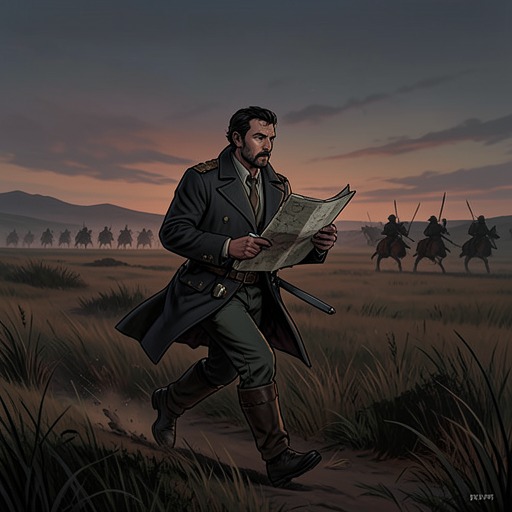
Todd Finds Viola in the Swamp
The Knife of Never Letting GoTodd Finds Viola in the Swamp begins with a mystery that overturns Todd Hewitt’s expectations: a gap in the Noise leads him to a girl, not a Spackle. The encounter makes his accustomed way of reading the world unreliable, and turns an armed search for an enemy into a cautious meeting with someone equally alone and wary.
The Silence in the Swamp
Todd first senses a hole in the Noise: not simply a quieter patch of swamp, but an absence he can recognize by the way surrounding sounds seem to meet it. The distinction matters because the swamp itself is never truly quiet. This is something different, a space where Noise appears to stop altogether. Todd cannot see its source, and the strange absence becomes an object of pursuit precisely because he has no ordinary evidence to explain it.
Manchee reacts to the same phenomenon, barking about quiet and running toward it. Todd follows, but the approach overwhelms him. The silence brings on a grief-like pressure, and he stops long enough for the gap to move away. His distress is not just fear of what may be hidden there: the silence feels like the loss of something valuable, though he does not yet know what that something is. The first pursuit therefore ends in frustration and makes the anomaly more compelling rather than resolving it.
Later, Todd and Manchee run back toward the Spackle buildings. Todd carries a knife and, in his anger and fear, has decided that the hidden Spackle must die for what has happened that day. The plan depends on his treating the unexplained silence as evidence of a familiar enemy. When the tear in the Noise appears behind the buildings and moves through the bushes, Manchee again leads the way. Todd follows without stopping this time, controlling his distress as he runs. At the tree, however, he halts. The expected target is not what he imagined.
The Expected Enemy and the Girl
Todd’s sudden stop marks the decisive reversal. The silent presence is not a Spackle; it is a girl. He remains frightened and keeps the knife extended, but the discovery breaks the simple logic that had driven his pursuit. The silence he had treated as a sign of danger belongs to a person, and his readiness to kill an unseen enemy now confronts him with someone standing directly before him.
The meeting is not immediately peaceful. While Todd examines a map Ben left in his book, the girl approaches without his hearing her and strikes him with a stick. Todd swings his knife in response, and both are left hurt and startled. The encounter gives Todd a practical lesson in the danger of a presence that makes no Noise: someone can come close without his usual warning. It also shows that the girl is not merely a passive mystery. She acts to defend herself, and Todd’s weapon and his assumptions make him dangerous to her as well.
Their first attempt at communication remains tentative. Todd tells her he will not hurt her, while making that promise conditional on her not hitting him again. She looks from his eyes to the knife, a small gesture that keeps the threat of the weapon present even as he tries to reassure her. The scene does not offer instant trust or a clear understanding between them. Instead, it lets caution and the possibility of cooperation occupy the same moment.
The Wreck and the Cost of Being Alone
The crashed ship gives Todd a context for the girl’s presence. Looking over the wreckage, he concludes that she arrived with her parents and that they died while she survived. He cannot tell whether she came from somewhere else on New World or from beyond it, and recognizes that her origin does not change the immediate facts: she is alive, her parents are not, and she has been alone. The wreck turns an apparently impossible silence into part of a concrete human loss without explaining every question surrounding her arrival.
Todd also realizes that Aaron found her. The girl’s slight reaction when Todd mentions Aaron’s name suggests that the name carries meaning for her, though she says nothing to confirm what she knows. Todd apologizes for her parents and later for the situation more generally, even as he admits to himself that he cannot identify exactly what he is apologizing for. His response is awkward, but it marks a change from his earlier certainty that he had found a target to kill: he now sees a bereaved person whose danger is connected to the pursuit around them.
A Cautious Offer to Leave
Todd tells the girl that they cannot stay because others may come after them, even if Aaron is dead. He thanks her for the food and asks whether she will come with him. The invitation does not erase the hazards between them: he still has the knife, she has already defended herself, and neither has established full trust. But Todd now frames their next step around getting away together rather than attacking the person concealed by the Noise.
The girl answers through action rather than speech. She uses the tip of her boot to knock burning sticks from a small green box, presses its button, and picks it up without burning herself. Todd notices the device and wants one, but its place in the scene is also practical: it belongs to the supplies she has and the food she has shared. The evidence does not make her acceptance of his offer explicit. It leaves the meeting at the threshold of companionship, with Todd asking and the girl continuing to act on her own terms.
The discovery’s significance lies in the gap between what Todd hears and what he thinks he knows. His Noise-guided world encourages him to treat silence as an alarming absence and, in his anger, to fill that absence with an enemy. Finding Viola exposes the limits of that assumption. Their encounter begins not with easy recognition but with pursuit, a mistaken expectation, a defensive clash, and the first incomplete steps toward mutual reliance.