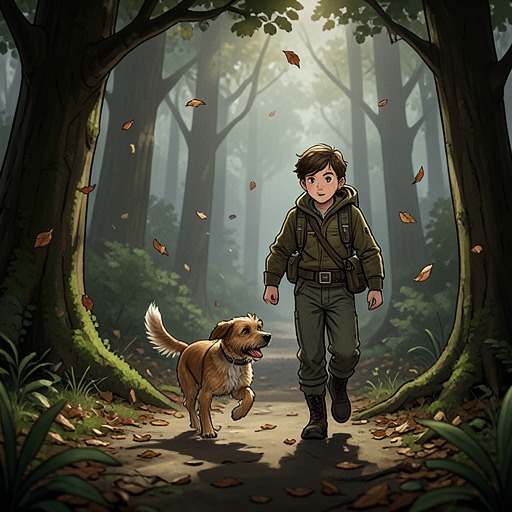
Todd Hewitt and Manchee: from reluctant owner to loyal companions
The Knife of Never Letting GoTodd Hewitt and Manchee move from reluctant owner and unwanted pet to companions whose loyalty is tested in the swamp. Their relationship turns on a reversal: Todd begins by treating the dog as an imposed burden, but when danger comes, Manchee repeatedly acts to protect him, and Todd responds with tenderness.
An Unwanted Birthday Gift
Todd’s first account of Manchee is colored by resentment. The previous year, for his birthday, Todd had wanted Cillian Boyd to repair the fissionbike so he would not have to walk everywhere in Prentisstown. Instead, Cillian Boyd gave him a puppy. Todd believes the dog had been bought to keep Mayor Prentiss in favor, and emphasizes that he had never asked for a pet.
The gift also becomes a daily responsibility. Todd says he has to feed, train, wash, and walk Manchee; now that the dog has grown old enough for the talking germ to make him speak, Todd must also listen to his repeated chatter. When Ben sends Todd to gather swamp apples in the fields southeast of town, he insists that Manchee go along. The errand makes visible the mismatch between Todd’s wish to be left alone and the care that has already become part of his routine.
Irritation and Unequal Power
At the start, Manchee’s speech does not create understanding between them. He repeats words and alerts Todd to a squirrel; Todd, already overwhelmed by his own Noise, responds by striking the dog’s back leg more than once. Manchee’s bewildered repetition of Todd’s name and question about being hurt exposes the imbalance in their relationship: Todd controls the outing and reacts to the dog’s behavior with force, while Manchee cannot understand why his warning has provoked it.
This moment matters because the loyalty that follows is not presented as the result of consistently gentle treatment. Todd’s irritation and Manchee’s attachment coexist. The scene establishes a relationship in which Manchee continues to attend to Todd even when Todd has just hurt him, making the dog’s later acts of protection more than a simple extension of a harmonious partnership.
The Swamp Reverses Their Roles
The danger in the swamp first brings the pair into a shared moment of relief. After Todd survives an attack by a crocodile, he and Manchee are both making enough noise that Todd realizes they have failed to hear someone approaching. Aaron appears and attacks Todd. Manchee barks at Aaron and goes for his legs; Aaron knocks him out of the way without looking at him.
When Aaron later has Todd by the throat, Manchee intervenes again. He bites Aaron’s calf, forcing Aaron to release Todd. The action is immediate and protective: the dog whom Todd had treated as a nuisance places himself between Todd and an attacker. Aaron flings Manchee into the bushes, but the interruption has given Todd the chance to breathe and recover. The scene changes the practical meaning of their companionship; Manchee is no longer merely someone Todd must take along, but someone whose presence can save him.
Care Becomes Reciprocal
After the attack, Manchee comes back to Todd, repeatedly calling his name and licking and barking like a puppy. Todd cannot yet speak, so he scratches Manchee between the ears. The gesture is small, but it answers the dog’s earlier intervention with care rather than irritation. Todd’s silence here is not rejection: his touch communicates the gratitude and affection he cannot put into words at that moment.
Their physical closeness also contrasts with Todd’s earlier treatment of Manchee. At first, Todd’s account dwells on the unwanted gift and the chores attached to it; after danger, he welcomes the dog’s approach and comforts him. The relationship has not been shown to become free of strain, but the swamp makes mutual dependence unmistakable: Manchee protects Todd, and Todd turns toward Manchee with tenderness when the immediate danger has passed.
Narrative Significance
Manchee’s talking makes him a companion who can address Todd, but speech alone does not resolve their difference in power or temperament. Their bond is expressed more decisively through action: Todd lashes out when annoyed, Manchee warns and defends him, and Todd answers the dog’s return with a familiar, gentle touch. The contrast between repeated barking and the quiet scratch between the ears marks the change without requiring a declaration of affection.
The relationship’s early arc is therefore a movement from imposed responsibility toward reciprocal attachment. Manchee’s loyalty is established not by what Todd wanted when he received the puppy, but by what the dog does when Todd is in danger; Todd’s response, in turn, reveals that the burden he resented has become a bond he values.