Todd Hewitt and his mother: love carried through a diary and songs
The Knife of Never Letting GoTodd Hewitt’s relationship with his mother is defined by a separation imposed first by political violence and then by her death, but it does not end there: Ben’s account and the book she left allow her to speak to Todd long after she is gone. Her history explains both why Todd was entrusted to Ben and why the record of his earliest day becomes more than a keepsake. Through its account of love, fear, and a song carried across generations, it offers him a bond that can still guide what he gives to others.
A family history shaped by violence
Todd learns the circumstances of his mother’s death while Ben explains what happened in Prentisstown. After the men killed the Spackle, many of the town’s men, influenced by Mayor Prentiss and Aaron’s preaching, killed the women and the men who tried to protect them. Todd connects that account directly to his mother, and Ben confirms that she was among the dead. The revelation turns the violence from a history of a town into the loss of a particular person whom Todd has never had the chance to know through his own memories.
Ben’s explanation also places her death within the destruction of New Elizabeth. Jessica Elizabeth, its mayor, recognized the danger and organized girls and younger boys to flee across the swamp. She and the women and men who had not joined the violence were attacked before they could leave. Todd understands the political transformation in stark terms: New Elizabeth became Prentisstown. His mother’s fate belongs to that rupture, in which a community’s attempt to escape was overtaken by the forces that made the new town possible.
Todd’s mother had not believed the catastrophe would happen. Ben remembers her as loving and hopeful in other people’s goodness, and says that by the time it became clear that flight was necessary, Todd was too young to be sent away. She therefore gave him to Ben and the others, telling them to keep him safe. This act is not presented as a rejection of her child: it is a decision made when the remaining choices had narrowed, and it places Todd’s survival in the hands of the people who raised him.
Separation and the question of safety
The account leaves Todd with an immediate contradiction. He asks how remaining in Prentisstown could have kept him safe, while Ben looks at him with sadness and does not, in this moment, give a simple explanation. The gap matters: the mother’s instruction to protect her son is clear, but the circumstances and consequences of that protection are bound up with a town formed through violence. Her decision can be understood as an effort to secure care for a child too young to flee, without turning the painful outcome into a claim that she foresaw or controlled everything that followed.
The relation is therefore disclosed in two stages. First comes the knowledge that Todd’s mother was killed; then comes the knowledge that, before the violence closed in, she had entrusted him to Ben and the others. The sequence changes the meaning of his upbringing: the people who cared for him were not simply the adults around him, but the recipients of his mother’s explicit request. Ben’s sadness gives that history emotional weight, while his confirmation connects the absent mother to the family Todd has actually known.
The book as a surviving voice
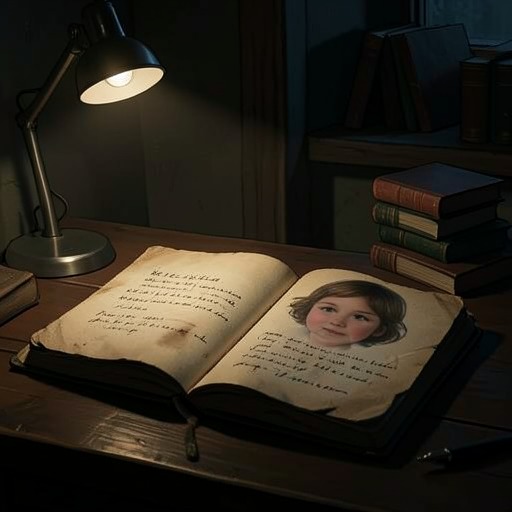
Later, Todd takes out his mother’s book and asks Viola to read in a Prentisstown voice. Viola imitates Ben’s accent, and the written address to Todd sounds to him like his mother speaking. The scene makes the book a form of mediated presence: Viola supplies the living voice, the written words belong to his mother, and Todd receives them as a message addressed to him rather than as distant historical information. He folds his arms and looks down at the wheat scattered on the ground, unable to look at her as she reads.
In the entry, his mother describes the settlement’s difficulties with food and sickness, the loss of Todd’s father, and her own approach to despair. She says she did not give up because of Todd and imagines that her beautiful son might help make the world better. She recalls holding and feeding him for the first time that morning, when the force of her love felt nearly painful. These details establish the relationship at its beginning: before Todd could answer her, she was already imagining his future as a reason to persist and as a possibility for a better world.
The book also records Todd’s first response to life. His mother remembers singing to him after his first waking from sleep in his cot, when he cried out for the world to come to him. The contrast between that infant cry and the older Todd listening to the account gives the reading its movement: the book returns him to a beginning he cannot remember, while making him the witness to his mother’s memory of it. His hands go to his head as the entry reaches its promise, and the scene acknowledges his grief without supplying a conversation between them that can no longer happen.
Inherited song and continuing promise
The song in the book has passed from Todd’s maternal grandmother to his mother and then to Todd. Its significance is not only that it survives across generations, but that his mother explains what she wants it to mean: a promise not to deceive or abandon him, which he may one day pass on to others. Viola sings the song while reading, turning a private written memory into a shared act of transmission. The mother’s voice is absent in the present, but the song carries her words through another person and reaches her son.
This promise gives the relation a future-facing dimension. Todd’s mother does not merely describe the love she felt when he was born; she asks that the assurance he received become something he can offer in turn. Her hope that he might make the world better and her wish that he pass the promise to others are presented together, linking care within a family to conduct beyond it. The evidence does not show what Todd later makes of that instruction, but his close attention to the reading and his visible emotional response establish that the message reaches him.
Narrative significance
Todd’s mother is characterized through two forms of testimony: Ben’s account of the political violence and the first-person record in her book. Ben explains the circumstances of her decision and confirms her death; the book gives her a distinct voice, recounting her fear, hope, and love in her own words. The contrast matters because Todd’s knowledge of her is necessarily assembled after her death, yet neither account reduces her to the fact of her loss. She appears as a person who tried to protect her child and who imagined a future for him amid hardship.
The book also changes the shape of Todd’s grief. The earlier revelation identifies what was taken from him; the later reading gives that absence a history of care and a message that continues beyond it. The mother’s love reaches him through Ben’s guardianship, the written account of his birth, and a song Viola can carry aloud. Their relationship cannot resume as a living exchange, but it remains active in the story as an inheritance: Todd is given both an explanation of how he survived and a promise meant to travel onward.