Todd and Aaron’s Final Fight
The Knife of Never Letting GoTodd and Aaron’s Final Fight brings the history of violence that has shaped the New World to a personal confrontation: Aaron presses Todd toward a vision of manhood founded on killing, while Todd’s choices challenge that demand.
Background and Stakes
The confrontation follows revelations about how violence became embedded in the societies Todd knows. Ben explains that hardship across the New World—failing crops, sickness, and the absence of prosperity—gave force to preaching that blamed the Spackle. That blame grew into a movement and then a war, fought with weapons the Spackle did not have; although some survived, they learned to keep away from humans. The account establishes scapegoating as a cause of collective violence, not merely a prejudice held by one person. Todd then identifies another consequence of that pattern: after the Spackle were killed, men in Prentisstown killed women and the men who tried to protect them. Ben confirms that Mayor Prentiss and Aaron’s preaching helped sway many of the killers. These disclosures connect Aaron’s private insistence on sacrifice to a broader history in which violence is given a moral or communal justification. Todd also learns that disappearances in Prentisstown often concealed executions staged as boys’ coming-of-age tests: Mr Royal was killed on Seb Mundy’s thirteenth birthday, and Mr Gault was executed after Mayor Prentiss captured him trying to flee. The town’s men watched or enabled the killings, leaving Todd to recognize the scale of shared complicity. Against that history, the fight is a struggle over whether manhood must be proven through another person’s death.
The Fight and Its Reversal
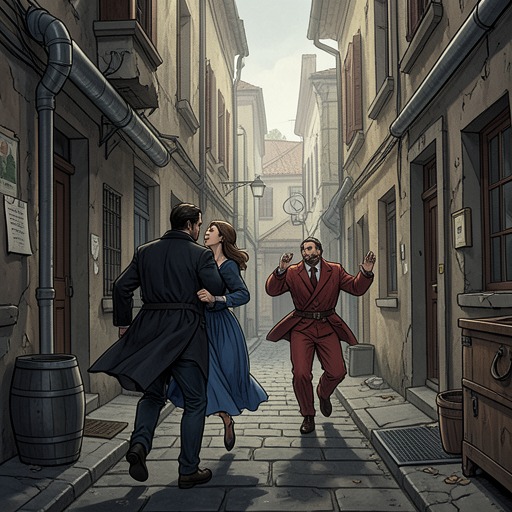
Aaron initiates the fight by leaping at Todd. Todd holds his ground, then evades the charge, sending Aaron into a wall. He slashes at Aaron with the knife, but Aaron presses on and strikes him; in the struggle, the knife falls out of Todd’s reach. The exchange turns the confrontation against Todd: he is left injured and unarmed while Aaron stands over him.
Aaron makes the struggle a judgment on Todd’s identity. He says Todd’s Noise exposes him and insists he will never be a man. Todd answers that he already is one, even as he lies hurt with the knife gone from his hand. Aaron then threatens Viola and claims Todd is depriving him of the sacrifice he wants. His language recasts violence as purification, making Todd’s refusal to accept Aaron’s definition of manhood the fight’s central moral conflict.
Viola interrupts Aaron by striking him with a rock she can barely lift, giving Todd a chance to move. Todd lays her down gently, stands to face Aaron, and, as Aaron urges him to purify himself, leaps at him instead. Aaron does not move to avoid the charge. Todd then reaches for the fallen knife. The action leaves the choice unresolved at this point: Todd has attacked Aaron, but the next decisive movement is toward the weapon Aaron’s demands have made the emblem of manhood and sacrifice.
The Knife and the Unresolved Choice
Aaron’s open-armed stance makes the attack resemble an invitation to the sacrifice he has been urging, but Todd meets him with his shoulder rather than immediately using the knife. The distinction matters: Todd acts against Aaron, yet the weapon remains a separate choice. When Todd turns back toward it, his reaching hand brings the confrontation to its sharpest moral point. Aaron has tried to make killing the proof of manhood; the sequence instead holds Todd between an act of resistance and the possibility of taking up the instrument Aaron’s demand has made central.
Narrative Significance and Endpoint
The scene’s endpoint preserves the difference between opposing Aaron and accepting the identity he demands. Todd apologizes, leaps, and drives his shoulder into Aaron, whose open arms make the encounter resemble the sacrifice he has been urging; the next movement is toward the fallen knife. As Todd reaches for it, his Noise is so red that he can barely see. The narration stops at that suspended choice, without establishing here whether Todd takes up the knife or what follows. The fight thus brings its challenge to Aaron’s creed to a point of maximum pressure but withholds an answer: Todd has resisted Aaron’s account of manhood, yet the weapon remains within reach.