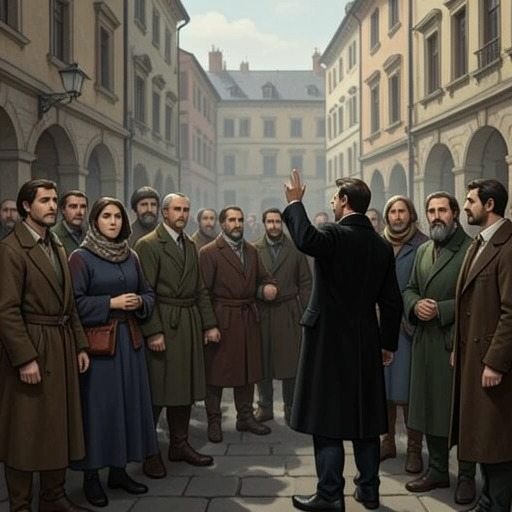
Todd and Viola Meet Hildy
The Knife of Never Letting GoTodd and Viola Meet Hildy is the encounter that turns a dangerous flight into a possible place of shelter. After escaping across and destroying a bridge, Todd and Viola are stopped at gunpoint by Hildy, who has heard the explosion and wants to know what the two young fugitives are doing to her bridge. She does not simply dismiss the damage or their danger: she questions them, lowers her weapon, and offers food and rest before they continue toward the settlement. The scene moves from threat to guarded hospitality without making the uncertainty disappear.
The armed encounter
Todd has just urged Viola and Manchee to get moving when a loud mechanical click announces a rifle being cocked. A person stands on a rock above them, aiming down the sight. Manchee barks and jumps about as the armed stranger accuses the pair of burning down the bridge. Todd does not know whether the person serves Mayor Prentiss, or whether telling the truth about their flight from Prentisstown will make matters worse. Asked what they were doing, he can only say they were being chased.
The exchange is shaped by an imbalance of power: Hildy has the rifle, while Todd and Viola have their hands raised. Todd tells her he will become a man in twenty-nine days. Hildy answers that this is not something to be proud of where he comes from, then lowers the gun from her face. Todd registers the sudden quiet and realizes that the person holding the rifle is a woman. That discovery unsettles his expectations of the society he has left, where women have been absent from his daily experience.
From suspicion to an invitation
Hildy keeps the rifle pointed at them as she asks whether they ran from Prentisstown. Todd lets her see what happened: their flight, the bridge, and the people pursuing them. She does not immediately declare them safe. Instead, she acknowledges that the bridge’s destruction has angered her, explaining that its sound reached her farm, and that she had kept the crossing in place in hope, even though the destination beyond it had not been worth reaching for a decade or more. The bridge is therefore both the damage at the center of the confrontation and a sign that Hildy had continued to leave a way open.
She lifts the rifle again and asks whether she will need it. Todd exchanges a glance with Viola and answers no. When she asks their names, they hesitate: giving them up feels like a price, but perhaps one worth paying to have the weapon lowered. Todd identifies himself and Viola. Hildy, meanwhile, has Manchee on his back for a belly rub; the dog responds warmly to her. She introduces herself as Mathilde but says they may call her Hildy, adding that earning the right to shake her hand will take time. Her manner combines an unmistakable boundary with a willingness to engage: she has not forgotten the bridge, but she is no longer treating the fugitives only as threats.
Todd asks whether there is another way across the river because the men pursuing them are still a danger. Hildy says that shallow crossings lie a couple of days upstream, but there are no bridges for a considerable distance in either direction. The answer makes clear that there is no easy immediate route around the damaged crossing. She then calls to them as though their next step is already settled. Viola says they are supposed to be heading for the settlement, whether or not they are welcome; Hildy replies that they will get there, but first they need sleep and food.
Conditional refuge and continued fear
The offer does not instantly overcome the pair’s suspicion. Viola privately admits that she does not know where they are going, and Todd can only invoke what Ben said. Hildy makes the proposal concrete: they can come to her farm, eat, sleep in beds that are not soft, and set out for the settlement in the morning. She emphasizes that she has a gun but is asking them to come. The distinction matters. She could hold them at gunpoint, yet presents shelter as an invitation rather than an order.
Todd remains concerned about infection. When Viola seems ready to answer his challenge about whether Hildy would leave them, Hildy offers a practical arrangement: Viola can walk ahead with her, while Todd stays farther back with Manchee. The suggestion allows the group to proceed while respecting the distance Todd fears may be necessary. Viola turns and starts up the rocks; Todd follows, feeling he has little choice. Their route runs along a narrower path through rocks and scrub. Hildy and Viola keep close together when they can, while Todd and Manchee travel far behind. Todd continues to look back, expecting Mayor Prentiss, Mr Prentiss Jr, and Aaron to appear. Shelter has become possible, but pursuit still governs how safe it feels.
The encounter in the wider story
Todd’s recognition that Hildy is a grown woman who has survived the Noise germ leads him to question the isolation of Prentisstown. Her friendly attention, combined with her caution and the rifle she keeps ready, gives him evidence of a world beyond the assumptions he was raised with. She is not proof that the danger he fears is imaginary: Hildy herself proposes keeping Todd at a distance from Viola. Rather, the encounter allows welcome and precaution to coexist.
Later revelations make the scene’s movement from suspicion to hospitality stand against a broader history of communal blame and violence. Ben explains that hardship on New World—failing crops, sickness, and lack of prosperity—was redirected into a movement blaming the Spackle, which became a war in which humans had guns and the Spackle did not. Todd later voices the truth that the men of Prentisstown killed its women; Ben confirms that many men were swayed by Mayor Prentiss and Aaron, and that women and men who tried to protect them were killed. Ben’s account also exposes the town’s coming-of-age killings: men were made to die at boys’ thirteenth birthdays, sometimes under false claims that they had disappeared. Todd concludes that the town’s men were complicit, while insisting that he was not. These disclosures do not make Hildy responsible for, or directly involved in, those events. They deepen the contrast surrounding her meeting with Todd and Viola: at a moment when violence has taught Todd to expect danger from strangers, Hildy answers the destruction of her bridge with a wary but real offer of shelter.