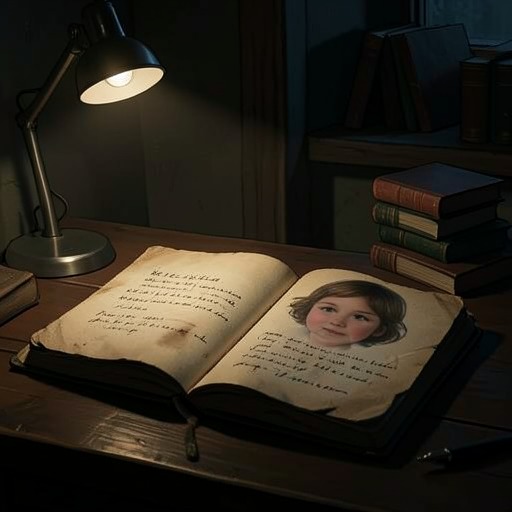
Todd's Mother's Birth-and-Colony Diary
The Knife of Never Letting GoTodd's Mother's Birth-and-Colony Diary is both a record of Todd's first day and a surviving voice from the family life he cannot remember. When Todd takes out the book and asks Viola to perform a Prentisstown voice, she reads its opening in an approximation of Ben's accent. The performance brings his mother's words into the present: the diary is no longer only a written record, but the means by which Todd hears her addressing him, and by which her promises reach him through another person's voice.
The book and its reading
The book enters the scene as a physical object Todd takes out while he and Viola are together, with spilled wheat on the ground and the sun still low. He asks whether she can do a Prentisstown voice; she answers quietly, then copies Ben's accent as best she can. Todd recognizes the voice the reading evokes as his mother's. The sequence is spare but decisive: his request sets the performance in motion, Viola supplies the voice, and the written page makes that voice possible without making the absent mother present in person.
The diary's effect is registered in Todd's body as well as in his recognition. He looks down at the wheat, feels his face redden, and later cannot look at Viola and puts his hands to his head. His reaction does not require the entry to explain his grief in abstract terms. The words addressed to him, and the fact that someone else is speaking them aloud, make the old record an immediate encounter. Viola's reading is also an act of care: she lends her voice to the text at Todd's request, while the words and the intimate address remain his mother's.
The birth entry and its world
The opening entry begins on Todd's birth day, when his mother first holds him in her arms rather than carrying him in her belly. Its details make the address intimate and particular: she remembers his kicking, calls him beautiful, and writes that she wishes his father could have seen him. His father had died of sickness five months earlier. The diary therefore begins with joy already marked by bereavement, joining the child's arrival to a loss that preceded it.
The entry also records the conditions into which Todd is born. His mother describes hardship and sickness on New World and in New Elizabeth, and explains that the planet's Noise has troubled men since the settlers landed. Todd, she observes, will grow up among boys who have never known a different condition, so the earlier world and the difficulty of the present may be hard for him to understand. The diary gives its reader this account through a mother's attempt to explain the settlement to her newborn son, not through an impersonal history of the colony.
In that explanation, the entry mentions a man with a son slightly older than Todd, describing him as one of the settlement's better organizers and recalling that he may have been a caretaker aboard the ship. The detail places the new community's leadership and its shipboard past inside the mother's account, while her uncertainty about the man's earlier role keeps the recollection personal rather than authoritative. Elsewhere she reflects on the attractiveness of power and warns that it separates men from boys in a way most men fail to understand. She immediately withholds further explanation, invoking prying eyes. The diary thus records both her desire to teach Todd and the limits she places on what she can safely write.
Hardship, hope, and maternal promise
The entry refuses to disguise how close its writer came to despair. Food difficulties, sickness, and the death of Todd's father had made life hard even before his birth. Yet the entry turns from that accumulated pressure to the decision not to give up: Todd is the reason his mother continued, and the child becomes the focus of her hope that the world might improve. She promises to raise him with love and hope and imagines that he may help make the world better. Those intentions are especially meaningful because the entry does not present them as easy optimism; it places them after an admission of hardship and near-despair.
The promise becomes personal rather than merely hopeful when his mother says she will never deceive or leave him, so that he may one day make the same promise to others and know it to be true. The diary preserves a maternal ethic meant to travel beyond the page: love is not only something she feels for Todd, but something she hopes he will be able to offer in turn. When Viola reads these words, Todd's response makes the promise's emotional force visible without turning it into a spoken conversation between mother and son.
Form and significance
The birth-day entry has the immediacy of a record begun at the moment it describes. Its writer addresses Todd before he can understand her, setting down the circumstances of his arrival and the hopes she attaches to his future. At the entry's end, she hears him crying from his cot, waking from his first sleep and asking the world to come to him, and says she must put the writing aside for the day. That interruption gives the journal a small but concrete measure of its purpose: the newborn's need takes precedence over the act of recording him.
The book's later reading creates a layered transmission. The mother wrote to Todd; Todd asks Viola to read; Viola adopts Ben's accent; and Todd hears his mother's voice through that performance. The diary remains an object in his hands, but it changes what can be present in the scene: a lost parent's account, her memory of his birth, and her commitment to honesty and care become audible again. Its significance lies not in resolving the hardships it records, but in preserving a promise that Todd can receive and, as his mother hoped, carry onward.