Todd's Mother's Book
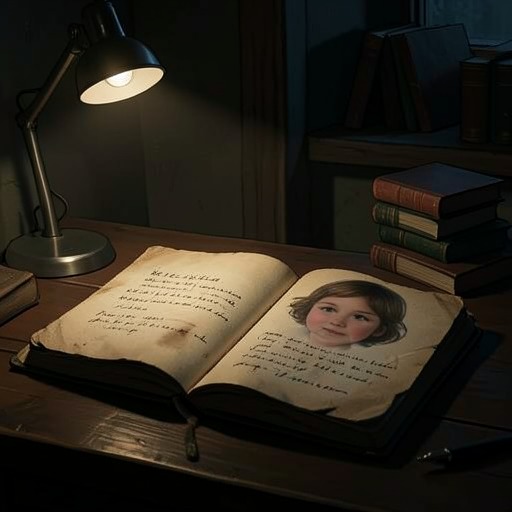
The Knife of Never Letting GoTodd's Mother's Book is at once a practical guide, a message about hidden history, and an object whose physical presence changes the course of a dangerous encounter. Todd first studies its map and an underlined instruction to warn others, without knowing what danger the warning concerns. Later, Viola reads the message aloud: the book connects the route to Farbranch with a threat that reaches beyond the settlement. It also becomes an accidental shield when Aaron attacks Todd, surviving with a slit through its pages and remaining legible. Its significance lies in these joined roles: it points toward a destination, carries knowledge Todd does not yet possess, and physically intervenes between him and harm.
Map and Warning
In his room, Todd checks that nobody has followed him before taking the book from his rucksack. He opens it to a map whose arrows lead down through the swamp toward a river and a settlement on the other side. The map shows no bridge, though the directions written elsewhere refer to crossing one. Beneath the settlement’s name is a phrase Todd reads as Fayre braw nk; he guesses that it means Farbranch. The book therefore offers a route, but not one Todd can interpret with complete certainty. Its markings make the settlement a concrete destination while leaving questions about the route and the words themselves unresolved.
The back of the map carries a written warning, underlined at the bottom: others must be warned. Todd recognizes the instruction but cannot identify its intended audience or explain what they need to know. He considers Farbranch and Hildy as possible recipients, then turns through pages of writing that he cannot make sense of. To him, the accumulation of words resembles Noise put onto paper: abundant, but not yet usable as knowledge. The book holds an urgent instruction and a larger body of information, while Todd’s inability to read that information leaves him responsible for a warning he cannot yet clarify.
The Message Read Aloud
The book’s contents become more intelligible when Viola asks to read the note on the map. Todd is tired and initially prepares to resist, but accepts that she is right to ask. He takes the book from his rucksack, unfolds the map from inside its front cover, and gives it to her. Using her torch, she turns the paper to the message on its reverse and reads it aloud. The act changes the note from private, difficult writing into shared information: Todd hears the words through Viola’s voice, yet experiences them as carrying Ben’s presence and reaching back to Prentisstown.
The message directs Todd to the settlement downriver and across the bridge, identifies it as Farbranch, and says its people should welcome him. Todd answers that some of them did. The note then explains that there is history Todd does not know and that learning it would put him in great danger; for the moment, his innocence offers his only chance of being welcomed. It points him toward his mother’s book for further explanation, making the volume itself a promised source of knowledge even though Todd has not yet been able to understand its pages.
The warning also widens the book’s reach beyond Todd’s immediate journey. The message says the wider world must be warned because Prentisstown is on the move. It describes the plan as having been in preparation for years and waiting for the last boy in Prentisstown to become a man. Viola asks whether Todd is that boy; he confirms that he was the youngest and says he will turn thirteen in twenty-seven days, when Prentisstown law will officially make him a man. The map and its note thus join a geographical direction to a deadline and a political danger. What began for Todd as an uncertain instruction now has a stated target, a long preparation, and a connection to his own approaching adulthood.
The Book as Protection
During Aaron’s attack, the book is in Todd’s rucksack. The knife passes through the pack and into the book, but something inside the rucksack prevents it from going all the way through Todd’s body. Todd identifies the book as what stopped the blade. Its protective role is accidental: the evidence does not suggest that it was carried or used as armor. Instead, an object he has been carrying for its map and message becomes a physical barrier at the moment he is attacked.
Afterward, Todd takes the book out and examines the damage. A knife-shaped hole runs through it and out the other side, leaving a slit through the pages. Blood from Todd and from the Spackle marks the edges, but the book is hardly ruined and remains readable. The contrast is central to its importance: the attack has physically marked the volume without destroying the information it carries. Todd recognizes that he could still read it, or have it read, but doubts whether he deserves to do so. The book’s survival therefore does not resolve his uncertainty about its knowledge; it preserves the possibility of understanding it.
Knowledge, Access, and Meaning
The book repeatedly separates possession from comprehension. Todd can carry it, open it, follow the map’s arrows, and recognize the underlined warning, yet he cannot make sense of its pages or explain what the wider world must be told. Viola’s reading supplies information that Todd cannot extract alone, while the note itself directs him back to the book for more. Its knowledge is neither wholly inaccessible nor immediately available: it can be shared through another reader, but the evidence leaves much of its contents undisclosed.
Its physical and informational roles also converge without becoming interchangeable. The map gives the journey direction; the message gives that journey political stakes; and the book’s presence in the rucksack helps prevent the knife from passing fully through Todd. Its pages are damaged but remain legible, just as Todd’s access to their meaning remains incomplete rather than ended. By the time he takes the volume from the pack, the book has become more than a container for directions or a message from the past: it is both a surviving record of what he needs to learn and an object that has helped keep him alive.