“Have I done my duty”
The Last Duel“Have I done my duty?” is the question Jean de Carrouges shouted after his judicial duel with Jacques Le Gris. It gives the victory a second, public form: Carrouges turns from the defeated man to the king and spectators, asks whether he has fulfilled his obligation, and receives an answer from the crowd. The words do not establish what happened in the disputed case by themselves. Instead, they make the duel’s outcome audible as a communal judgment, after a contest whose ceremonies had demanded silence.
The Question at the Duel’s Close
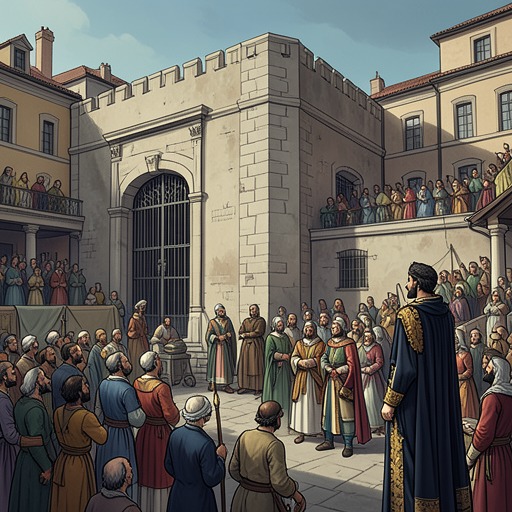
The expression comes at the climax of the duel at Saint-Martin’s dueling ground. Carrouges had stayed beside Le Gris until he was sure his opponent was dead, then rose and looked toward his wife, Marguerite de Carrouges. Their long exchanged look preceded his address to the public. He turned first toward the royal stand and bowed to the king; nodding to either side, he acknowledged the gathered spectators. Only then did he cry, “Have I done my duty?”
The question is brief, but its placement matters. Carrouges has prevailed in the combat, yet he does not simply announce himself the winner. He puts the significance of his action to those watching, in a form that asks them to recognize whether he has met his duty. The scene thereby shifts from the physical contest to its public interpretation: the victor’s question seeks an answer that the duel itself, for all its procedure, cannot speak aloud.
A Voice After Enforced Silence
The crowd’s response gains force from the rules that had governed its behavior. Before the fight, a herald announced prohibitions on carrying weapons and remaining on horseback, and ordered spectators not to obstruct others’ view. Most severely, the assembled people were forbidden to speak, gesture, cough, spit, or cry out during the battle, under threat of death and loss of property. The account stresses that judicial duels were not noisy entertainments: spectators watched in near-total silence, scarcely daring to breathe.
That silence was part of the event’s order, not an incidental absence of sound. The field had been prepared for thousands, from commoners watching around the enclosure to nobles and royal courtiers seated in stands arranged by rank. Officials were positioned in towers to supervise the combat, while guards were assigned to control the crowd. The question breaks this carefully maintained quiet at the moment when the fight is over. The crowd’s answer is thus more than ordinary applause: it is the first permitted collective voice after a contest in which even involuntary noise had been forbidden.
The Answer and Its Public Reach
The account gives the crowd’s reply as “Oui! Oui!” and describes ten thousand voices answering as one. That response supplies the affirmation the question solicits. The movement from a single, hoarse voice to a multitude’s shouted answer makes duty a matter of public recognition, not merely Carrouges’s private claim about himself. In the scene’s terms, the crowd confirms his victory and joins the resolution of the celebrated quarrel.
The sound also carries beyond the duel’s immediate audience. It rises over the monastery walls and reaches the bourg Saint-Martin and streets of Paris, where people pause at the shout. They can guess that the famous quarrel has been resolved, though they do not yet know which man won. The answer therefore announces an ending at a distance before it communicates its details. The words and reply become a public signal: the combat has concluded, and the result has been acclaimed.
Meaning and Limits
The question’s force rests on a tension between uncertainty and acclaim. Grammatically, Carrouges asks rather than declares; dramatically, the crowd answers without hesitation. The exchange turns a personal challenge into a communal verdict on the combatant’s performance. Yet it should not be mistaken for independent proof of the underlying accusation. What the passage establishes is that Carrouges won, that he asked whether he had done his duty, and that the crowd affirmed him. The scene presents the duel’s visible outcome and its public reception, not a separate examination of the disputed events.
After the shout, the guards open the gate and Carrouges leaves the field. He must still pay his respects to Charles VI, who presided as judge, before he can return to Marguerite and celebrate with her. The question therefore falls between two forms of recognition: the crowd’s immediate affirmation and the formal deference owed to the king. Its enduring significance lies in this compact staging. A question asks for judgment, a disciplined audience answers together, and a private claim of duty becomes the audible conclusion of a public ordeal.