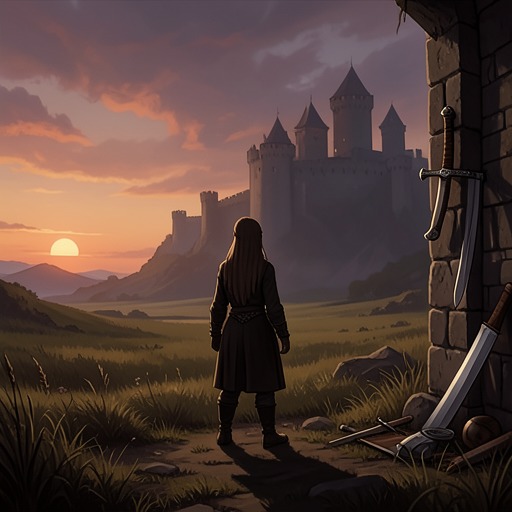
29 December 1386
The Last Duel29 December 1386 was the day Jean de Carrouges and Jacques Le Gris met in a judicial duel at Saint-Martin’s dueling ground in Paris. Postponed so that Charles VI could attend, the combat made a disputed accusation into a public test of honor and justice. Its significance lay not only in the violence between the two men but in the thousands who watched—and in the final exchange between Carrouges and the crowd, which turned his question of duty into a collective answer.
From accusation to royal spectacle
The duel grew out of Marguerite de Carrouges’s accusation that Le Gris had attacked her while her husband was away. The allegation followed events at Capomesnil on 18 January 1386: Nicole de Carrouges had been summoned to Saint-Pierre-sur-Dives as a witness and left with most of the household, including the maidservant Jean had instructed to remain with Marguerite. Only one maid reportedly stayed behind, and she made herself scarce. Le Gris later gave an account placing himself in Argentan that day, arguing that the winter journey to Capomesnil—nine leagues over bad roads—would have required at least a full day. The distance and the timing became part of the dispute over his alibi; the account does not resolve the uncertainty.
Count Pierre of Alençon heard the accusation and convened a hearing before prelates, knights, council members, and other experienced men. Although he offered the couple a hearing as part of his responsibility for disputes among his vassals, Le Gris was his favorite, leaving the count with a personal stake in the matter. Carrouges later brought the case to the Parlement of Paris. The proceedings widened the circle of participants: each man named six noble pledges to guarantee his appearance, and the affair became a subject of heated discussion at the royal court rather than a local quarrel alone.
The duel was first scheduled for 27 November. Charles VI, eager to witness it, sent orders postponing the combat until 29 December, after his return to Paris. The Parlement accepted the change on 24 November, just three days before the original date, even though the field was nearly ready and both combatants were preparing to fight. The delay gave Carrouges, Le Gris, and Marguerite another month under the strain of the pending judgment. Marguerite faced the possibility of death by burning if her husband lost.
A winter morning of preparation
The appointed day fell on a Saturday during Christmas week and on the feast day of Saint Thomas Becket. Paris’s shops were largely closed for the holy day, but the duel drew spectators from distant parts of France. People began arriving soon after first light; by mid-morning, many thousands crowded the priory grounds. Guards armed with spears and maces tried to keep the spectators back from the walled field and its gates. In the bitter cold and gusting wind, people without reserved seats competed for places, while some climbed onto walls or trees to see.
The two men began the day separately, at lodgings on opposite sides of Paris. They bathed, heard mass, and ate after fasting overnight; prayers had also been said for each of them in Parisian churches on the eve of combat. Attendants dressed them in layers of linen and padding before fastening on their armor piece by piece. Each brought provisions as well as weapons: a leather bottle of wine, bread wrapped in cloth, silver for use of the field, and fodder for his horse in case the fight continued into a second day. The preparations joined religious observance and practical readiness in a ceremony watched by a city already gathering to see its outcome.
The charge and the public answer
Carrouges, as the accuser, began the mounted combat. More than seventy yards separated the men as they lowered their lances and rode toward one another. At a modest trot, the combined speed of the horses would close that distance in a little over five seconds. There was no tilt-fence dividing the field, as there would be in a sporting joust; the riders advanced directly toward each other, carrying the force of horse, rider, armor, and lance into the collision.
Marguerite watched from a scaffold beside the field. Later, weak from exhaustion and blood loss, Carrouges loosened his visor and turned toward her. She clung to the rail, wiping away tears, and the two held a long look as the crowd watched. He then turned to the royal stand and bowed to the king before acknowledging the spectators. Hoarse with thirst and fatigue, he called out, “Ai-je fait mon devoir?”—“Have I done my duty?” Ten thousand voices, silent through the combat under threat of severe penalties, answered together: “Oui! Oui!”
The meaning of the date
The day brought a prolonged legal dispute into a space where judgment was made visible through ritual, armed bodies, and public witness. The proceedings had begun with a seigneurial hearing and expanded through appeal into a matter entangling nobles, the Parlement, and the king. On 29 December, the vast crowd’s presence gave the duel a reach far beyond its two combatants, while Marguerite’s place beside the field kept the accusation at the center of the spectacle.
The final exchange does not itself establish what happened at Capomesnil; it shows how the combat’s public meaning was framed. Carrouges asked whether he had discharged his duty, and the crowd answered as one. On this date, a question about an individual knight’s obligation became a collective declaration before the king, the accused, the accuser, and the woman whose testimony had set the case in motion.