Battle of Nicopolis
The Last DuelThe Battle of Nicopolis was the decisive defeat of a European crusading army by Sultan Bayezid’s Ottoman forces in September 1396. A campaign marked by divided leadership and uncertain plans ended in disaster when the French and Burgundian vanguard attacked before the allied lines were ready. The battle’s consequences reached beyond the loss of an army: it probably cost Jean de Carrouges his life, though the surviving account cannot establish how he died.
The Crusade and Its Route
Jean de Carrouges joined a crusade that drew nobles and knights from across Europe. The Burgundian contingent was led by Jean of Nevers, son of Duke Philip. Among the French commanders were Marshal Boucicaut, who had previously traveled with Carrouges in Turkey and Greece; Philip of Artois, Count of Eu, who had served as one of Jacques Le Gris’s pledges; and Admiral Jean de Vienne, Carrouges’s former commander. Carrouges had fought alongside de Vienne against the English in Normandy nearly twenty years earlier and had joined him on the ill-fated Scottish expedition of 1385. Nicopolis was their third campaign together.
Some leaders entertained the prospect of marching as far as Jerusalem, but the coalition never settled on a clear common plan. The French and Burgundian forces assembled at Dijon in late April 1396 and received four months’ wages in advance. They marched east through Switzerland, Bavaria, Austria, and Hungary, joining other crusaders at Budapest, including King Sigismund of Germany and Hungary. From there, the army divided: some proceeded south through the Balkans along the Danube, with supply ships following the river, while others took a more direct overland route north of it, passing Belgrade and Orsova.
The forces met again at Vidin in early September, besieged the town, and captured it. Its entire garrison was put to the sword. Short of supplies as they continued east, the crusaders attacked and plundered other towns. On September 12 they reached Nicopolis, a strongly defended city on a high bluff above the Danube. Their first attempt to take it, using mines and scaling ladders, failed because they lacked siege engines.
Bayezid’s Approach and the Crusader Advance
Bayezid had been besieging Constantinople, about three hundred miles away. On learning of the Christian attack, he abandoned that siege and marched north at speed. His army joined its Serbian allies at Kazanlak around September 20 and reached Nicopolis four days later. By night, messengers were sent to the city to urge its defenders to hold out, since relief had arrived.
Bayezid did not rush to attack. He selected ground on a ridge a few miles south of Nicopolis, behind a narrow wooded ravine, and ordered his troops to plant dense rows of sharp wooden stakes. The crusaders were caught between the city and the approaching Ottoman army. Having taken thousands of prisoners during their raids, and fearing an effort by the city’s defenders to free them, the crusaders massacred their captives and left the bodies unburied as they prepared to fight.
On Monday morning, September 25, the crusaders rode out to meet Bayezid. The French and Burgundians refused to march behind Sigismund’s forces, whom they considered peasants, and insisted on leading the attack. Sigismund yielded but warned them not to get too far ahead or abandon a sound defensive position in their haste. As the lines were still forming, the Count of Eu seized a banner and urged the troops forward. When Jean de Vienne and other French commanders asked him to wait until the army was ready, the count accused them of cowardice. The premature attack began.
The Battle and Its Reversal
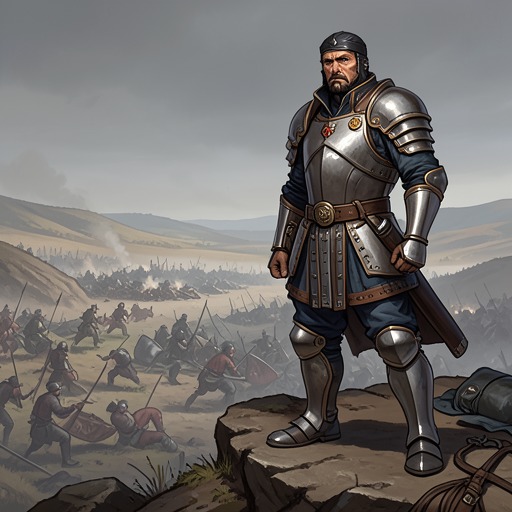
The French heavy cavalry charged downhill into the wooded ravine as mounted Ottoman archers sent a hail of arrows from the ridge above. At the dry streambed, the crusaders had to climb the opposite slope; some did so on foot after being unhorsed, while others dismounted where the incline was too steep for their horses. Many nevertheless reached the top. Their plate armor turned aside most arrows, but the withdrawing archers revealed the rows of stakes protecting the Ottoman infantry.
The crusaders pulled up stakes to open a way through. Once they broke the defenses, the knights killed or routed most of the lightly armed infantry. They were preparing to pursue when Ottoman cavalry swept in. In the fighting that followed, French knights fought on foot and used daggers against enemy horses. Both sides suffered losses, and the Ottoman cavalry eventually withdrew. Believing they had prevailed, the crusaders rested, exhausted by the climb, the fighting, and the effort to breach the stakes.
That pause proved fatal. A reserve cavalry force, hidden behind trees, charged into the weary crusaders. Some were killed in the first assault; others retreated down the slope they had just climbed and fled toward the city, with some crossing the Danube to escape. Those who remained continued fighting amid mounting losses. Jean de Vienne fell with the banner of the Virgin still in his hand. Sigismund’s forces, which had followed the Franco-Burgundian charge, were cut to pieces.
Defeat, Captivity, and Carrouges’s Fate
Overwhelmed, many crusaders who had held their ground surrendered. The captives included Boucicaut and the Count of Eu, the leader whose premature advance had started the French attack. The Ottomans took as many as three thousand prisoners. Some high-ranking and wealthy captives were later ransomed, including Boucicaut and Jean of Nevers. But on the day after the battle, the Ottomans beheaded several hundred crusaders in retaliation for the massacre of their prisoners. Bayezid, sickened by the slaughter, eventually ordered it stopped.
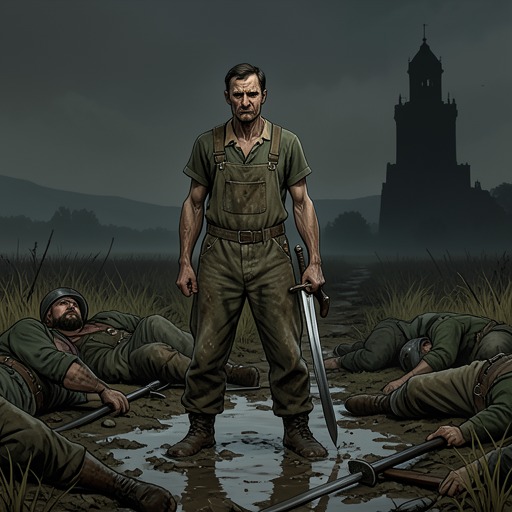
The record does not say what happened to Carrouges. The account considers it likely that he died fighting near Jean de Vienne and was buried with him in a mass grave. It also leaves open the possibility that he was among the prisoners executed the next day. His bravery, ferocity, and loyalty to his comrades make it unlikely that he fled, but these qualities cannot establish his precise end. A later note adds that his three reported companions at Nicopolis also died, as did his old commander de Vienne, lending weight to the likelihood that Carrouges perished there without resolving the uncertainty.
The defeat is presented as one of the great military disasters of its age and as the end of three centuries of European military adventures in the East. For the history of Carrouges, the battle also marks a final separation: his departure on crusade left Marguerite without her defender, and news of his death, when it reached her, would leave her permanently without a champion. The account gives no certainty about the manner or date of his death; the campaign’s ending is known, but Carrouges’s individual fate remains unresolved.