Capomesnil Castle
The Last DuelCapomesnil Castle was a remote manor on the south bank of the river Vie, best known in the book as the place where Marguerite de Carrouges was left nearly alone and attacked in January 1386. Its modest domestic scale and lack of substantial defenses stand in sharp contrast to the violence that unfolded inside it: a hall, stairway, and upstairs room became the successive spaces through which Marguerite was confronted, pursued, and overpowered.
Setting and Approach
The castle stood apart from the small hamlet of Capomesnil, a cluster of ten or twelve thatched houses inhabited mainly by farmers and tenants working the surrounding land. Jean de Carrouges and Marguerite reached the area after passing through Lisieux and turning from the old Roman highway onto a country road southwest toward Saint-Pierre-sur-Dives. At Saint-Julien-le-Faucon they crossed the river Vie, then followed a narrow track west along its south bank to the bluff above the hamlet.
The château stood by itself farther up the riverbank. The nearest other inhabited place, beyond Capomesnil’s houses, was Saint-Crespin, across the river and nearly a mile north on a hillcrest. Nicole’s summons to Saint-Pierre-sur-Dives would later make the castle’s isolation matter in practical terms: the abbey town was about six miles away, and the journey there and back took her away for part of the day. Capomesnil was not simply outside a town; it was a household set apart from nearby communities by the river, the countryside, and the distance between settlements.
Architecture and Occupants
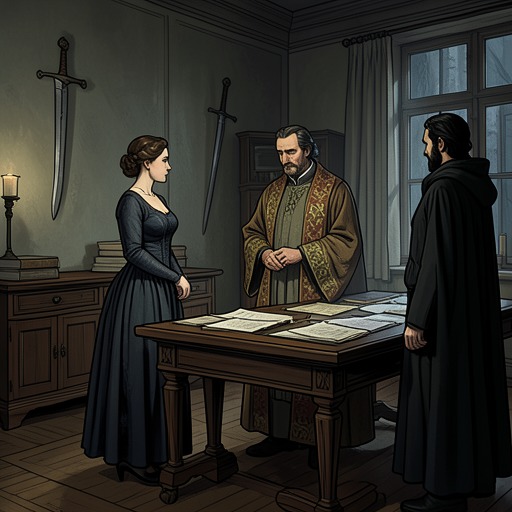
Capomesnil Castle was small, with a ground-floor main hall, a kitchen and servants’ quarters behind it, and several upstairs living rooms reached by an internal stairway. A sturdy keep, or donjon, offered protection, but the château had no high encircling walls or defensive towers. It stood in open country, far from any fortified place. Its layout was that of a lived-in residence rather than a heavily defended stronghold: rooms and household spaces were gathered within a compact building, connected by the hall and stair.
Nicole de Carrouges lived there quietly with a few servants and received very few visitors. The book contrasts this retirement with the attention she had once received at Bêlleme, where she had been treated as Sir Jean’s lady-wife. Now, she believed her exile at Capomesnil owed in part to her son’s angering the count by marrying Marguerite. She also resented Marguerite’s position as mistress of the larger and finer Château de Carrouges. That contrast gives the residence a family and social history: Capomesnil was Nicole’s modest home, but also a place where marriage, rank, and estrangement shaped how its occupants regarded one another.
The château no longer survives. It was demolished soon after the French Revolution, though its form was said to resemble the small châteaux and manor houses that still dot the Normandy landscape. Its historical importance therefore rests less on architectural grandeur than on the precise domestic setting preserved in the account: a hall with a barred window in its heavy door, an interior stair, and rooms above.
The Household on January 18, 1386
Jean de Carrouges left Marguerite at his mother’s château when he went to Paris in January 1386. On January 18, Nicole was summoned to appear as a witness in a legal case before Guillaume de Mauvinet, the bailiff of Caen. She departed early that morning for Saint-Pierre-sur-Dives, taking an entourage that included nearly all the household servants. She also took the maidservant Jean had instructed to remain with Marguerite throughout his absence. Only one maid reportedly stayed behind, and she made herself scarce.
The departure emptied the residence of most of its ordinary household presence for much of the day. Marguerite was upstairs warming herself by the fire when pounding began at the heavy front door. She put a fur-lined mantle over her gown, went down to the hall, and cautiously slid back the panel behind the small barred window. The visitor was Adam Louvel, whom she recognized. The door and its small viewing aperture briefly made the entrance a point of caution and control, but that protection did not last: after Louvel solicited her on Jacques Le Gris’s behalf and she refused, the unbarred door was suddenly pushed open and Le Gris entered.
The Castle as the Scene of the Assault
Le Gris stepped into the hall in a mud-spattered cape, which he tossed onto a bench, revealing the dagger at his belt. Marguerite backed away in alarm. The confrontation then moved through the building: Louvel and Le Gris dragged her toward the stairs; she briefly broke free and threw herself onto the stone floor, declaring that she would tell her husband and that he and his friends would avenge her. The men forced her up the stone steps and into the nearest room, where Louvel shut the door, leaving her with Le Gris.
The upstairs room offered Marguerite two possible exits, and she tried both. While Le Gris bent to untie his boots, she ran to the window and shouted for help, but could not open it. She then fled toward the door at the other end of the room, hoping to barricade herself beyond it. Later, even after she had been lashed to the bed, she continued to cry out; Le Gris used his leather cap to gag her. Louvel remained present as Marguerite resisted, and Le Gris raped her against her will.
The castle’s rooms and passages do not explain or excuse the assault; they record its physical course. The empty household left Marguerite with little immediate help, while the hall, stair, and upstairs room mark the progression from an unexpected visitor at the threshold to violence behind a closed door. Capomesnil Castle thus becomes central not for its size or military power, but as the specific domestic setting of the accusation that drove the legal conflict into the public arena.