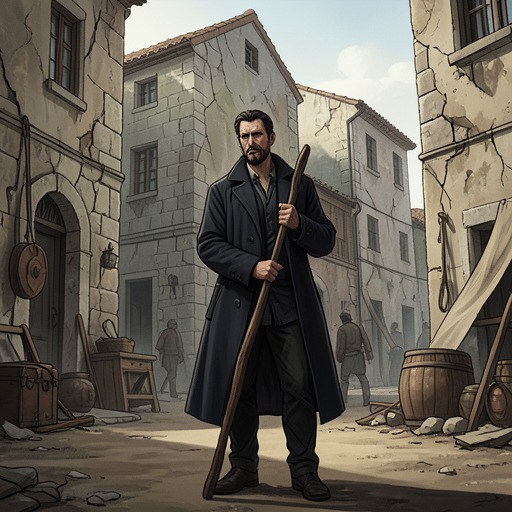
Charles VI’s first episode of insanity
The Last DuelCharles VI’s first episode of insanity occurred on August 8, 1392, during a military expedition near Le Mans. A stranger’s warning, an accidental noise, and the king’s sudden misrecognition of those around him turned a royal procession into a crisis: Charles attacked members of his own entourage and pursued his brother. The episode was the first public sign of an illness that would repeatedly interrupt his rule, and it swiftly shifted power back to the relatives from whose control he had only recently emerged.
Setting and Warning
The king’s army was passing through a large forest near Le Mans in hot, dry weather when a bare-headed man in a smock ran into the road and seized Charles’s horse by the bridle. The stranger warned him not to go farther and urged him to turn back because, he claimed, the king had been betrayed. Charles’s attendants treated the man as mad and beat him; once he let go of the reins, the procession continued. The warning thus entered the episode as an unresolved alarm: it did not stop the army, but it remained in the account as part of the circumstances surrounding what followed.
Around noon, the army left the forest and crossed a broad sandy plain. The great lords rode in separate companies. Charles kept to one side to avoid the dust, while his uncles, the dukes of Berry and Burgundy, rode about a hundred yards to his left. The king wore a black velvet jerkin and a plain scarlet hat, while pages followed behind him: one wore a polished steel helmet, and another carried a lance with a broad steel head. These details establish the close order of the royal party and the immediate setting for the accident that precipitated the crisis.
The Episode
At some point on the plain, the second page accidentally dropped his lance, which struck the helmet of the page ahead. The sudden clang startled Charles. The account links his reaction to the stranger’s warning in the forest: his thoughts were still occupied by the possibility of betrayal, and he imagined that enemies were approaching to kill him. The narrative presents the lance’s impact not as an attack but as an accidental event interpreted through the king’s growing delusion.
Charles spurred his horse forward, drew his sword, and wheeled toward the pages. He no longer recognized them or the other people around him, and acted as though he were surrounded by enemies in battle. The pages turned their horses aside to escape him. In the confusion, Charles killed several men in his entourage. The episode therefore moved from a sudden misreading of a sound to a direct danger to the people accompanying the king, although the account does not describe the individual victims or the precise circumstances of their deaths.
The king then saw his brother, Louis of Valois, and rode after him with his sword raised. Louis escaped by galloping away. The dukes of Burgundy and Berry, alerted by the commotion, recognized the gravity of what was happening and called for the king to be caught. Their response brought the royal party’s leaders into the crisis: the uncles who had recently lost control of Charles now had to manage a king who could not recognize even his own family.
Restraint and Immediate Consequences
Louis eventually outdistanced Charles, and men-at-arms caught up with the king and formed a circle around him. They parried his blows while taking care not to injure him, allowing him to tire. When he had exhausted himself, a knight quietly approached from behind and pinned him. The others took away his sword, lifted him from his horse, and laid him on the ground. Charles did not speak and failed to recognize his uncles or his brother. The account describes his eyes as moving strangely, but gives no further explanation of his condition at that moment.
The king was carried back to Le Mans in a litter, and the military expedition was immediately called off. The decision marked the practical consequence of the episode: the campaign could not continue once the ruler at its center was incapacitated. The narrative’s sequence also gives the crisis a clear reversal. The army had proceeded despite the warning; after the king’s attack on his own entourage, the expedition ended and the king himself had to be transported back.
Significance for the Reign
This was the first public display of the madness that would affect Charles for the remainder of his long reign, which lasted until his death in 1422. He alternated between periods of lucidity, when he seemed normal, and bouts of debilitating insanity. The account also notes his sensitivity to bright light and loud noises and his recurring fear that he was so brittle he might break like glass. Those later characteristics place the Le Mans episode within a longer pattern, but do not establish a simple medical explanation for its immediate trigger.
Its political consequence was immediate. Charles had only recently shaken off the control of his uncles and declared himself sole ruler of France. After the episode, he was unable to govern himself, much less the kingdom, and power passed back to his uncles and Louis of Valois—the brother who had just escaped the king’s pursuit. The event thus turned a personal crisis into a reversal in government: the king’s claim to rule independently could not be sustained when his capacity to act as ruler became uncertain. The opening warning, the accidental clang, and the mistaken identification of companions as enemies make the episode a stark account of how quickly the authority concentrated in the king could be disrupted.