Count of Alençon’s Palace
The Last DuelThe Count of Alençon’s Palace at Argentan was the residence and principal court of Count Pierre of Alençon, a fortified seat from which he administered his domain and received his vassals. Rebuilt after Pierre bought Argentan in 1372, the palace joined conspicuous architecture to practical authority: its great hall served for tribunals, commands, visits, and meals, and became the setting for Jean de Carrouges’s return to court in January 1386, when his presence unsettled a household that may have expected him not to come back.
Acquisition and Reconstruction
Argentan was a fortified hilltop town about twenty-five miles north of Alençon. Count Pierre set his sights on the town, its château, and surrounding lands, and in 1372 purchased them for 6,000 livres in gold. The acquisition enlarged a domain already built through inheritance, marriage, and further landholding. Argentan’s strategic location and its past as a favored residence of King Henry II also made it a prestigious seat for the count.
Pierre immediately rebuilt the old palace and moved his entire court from Alençon to Argentan. The resulting building was an imposing four-story structure with Romanesque windows and three square towers capped by sharply angled roofs. The palace still stood at the time of the book’s account. Its scale and prominent towers presented the count’s wealth in architectural form, while the relocation of his court made the building an administrative center as well as a private residence.
The Great Hall and the Count’s Court
The palace’s second-floor great hall was the focus of its formal life. Count Pierre sat there in an ornately carved chair, with rich tapestries covering the walls, as he issued commands, presided over tribunals, and received visitors. These activities brought the governing work of the domain into a single room: the count’s authority was exercised before the people who served, petitioned, or attended him.
The same hall also accommodated the rhythms of the household. Toward noon, trestle tables were set up, and Pierre dined with knights, squires, clerics, and guests. The room therefore joined official business with the social life of the court. The book also reports a rumor that Pierre entertained mistresses at the palace, including Jeanne de Maugastel, the wife of one of his vassals, with whom he fathered a son. In contrast to that reported liaison, Pierre and his wife Marie had eight children during the first fourteen years of their marriage.
Vassals, Officers, and Courtly Access
The palace’s importance extended beyond its walls through the relationships organized around the count. Jean III de Carrouges and his son Jean IV visited Argentan to attend Pierre, participate in his seigneurial court, and answer military call-ups. Jean III was based at Bellême, where he served as captain of the fortress, while Jean IV, whose estate at Carrouges lay much closer to Argentan, spent more time at the count’s court.
Jean IV became Pierre’s chamberlain soon after entering his service in 1377. Although the office had become more honorary than its original role of attending a lord in private, it still marked a place within the count’s circle and could bring a summons for a special errand or important occasion. Another chamberlain was Jacques Le Gris. He and Carrouges had been friends and fellow vassals of Count Robert of Perche; after Robert’s death in 1377, both entered Pierre’s service. The palace thus brought together men whose earlier connections and shared service would later be shadowed by conflict.
Carrouges’s Return in 1386
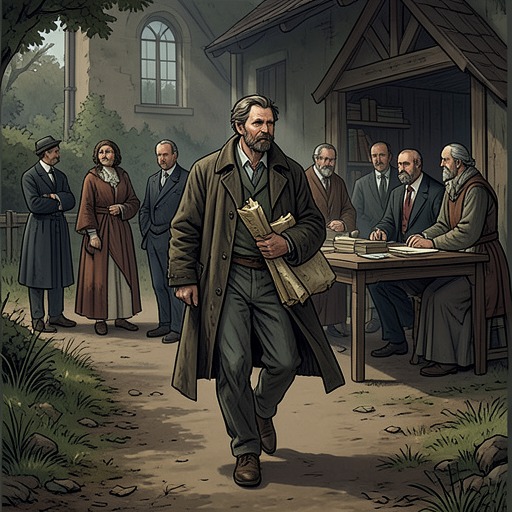
In January 1386, after many hours on winter roads, Carrouges rode to Argentan and was admitted through its guarded gate as one of Pierre’s men. He went to the palace, left his horse with a stable-hand, and prepared to enter the hall where the count held court and dined with his companions. The account suggests that the exhausted, mud-spattered traveler may have washed before presenting himself, but the precise details of his arrival are not recorded.
Carrouges’s appearance surprised the court. News of the disastrous Scottish expedition had reached Argentan: some nobles had died, and survivors had returned impoverished and ill. Since Carrouges had been absent and no word of him had arrived, Pierre may have believed him dead; some of the count’s men may already have been dividing up his lands. Carrouges entered the hall weak with fever but alive, to the surprise and, perhaps, displeasure of those present.
The documented account of that day is sparse. It records that Carrouges encountered Le Gris and other men of Pierre’s household and told them of his plan to go to Paris. He may also have disclosed, or allowed the courtiers to infer, that his wife was staying nearby at Capomesnil with his mother. The palace scene is significant partly for what its uncertain record conveys: a court that was at once a place of service and proximity, a venue for the old friendship between the two squires, and the setting for their renewed encounter as Carrouges pursued his affairs beyond Argentan.