Danube
The Last DuelThe Danube shaped the crusaders’ approach to Nicopolis in 1396, serving as a corridor for movement and supplies before becoming part of the geography of their defeat. In the account of Jean de Carrouges’s final campaign, the river links the long eastward march to the battle’s scattered retreat and uncertain human cost.
The River as a Route of Advance
After gathering at Dijon and joining other crusaders at Budapest, the army divided its route eastward. Some continued south through the Balkans along the Danube, accompanied by a fleet of supply ships; others took a more direct overland route north, past Belgrade and Orsova. The river was therefore not merely a landmark on the campaign’s map: it carried provisions alongside part of the advancing force. The crusaders reunited at Vidin in early September, besieged the town, and captured it. They continued east along the Danube, but supplies were running short. The army attacked and plundered several more towns before reaching Nicopolis on September 12. In this sequence, the river marks the direction of advance while the shortage of provisions helps explain the violence and foraging that accompanied it.
Nicopolis and the River’s Military Setting
Nicopolis stood on a high bluff overlooking the Danube and was strongly defended by the Ottomans. The crusaders’ first attempt to take the city, using mines and scaling ladders, failed for want of siege engines. Sultan Bayezid abandoned his siege of Constantinople and marched north; his army and Serbian allies reached the area on September 24. The city and the approaching Ottoman force left the crusaders caught between two threats. Bayezid chose the ground for the battle a few miles south of Nicopolis, on a ridge behind a narrow, wooded ravine. His troops planted thick rows of sharpened stakes there. The river belonged to the wider setting of the confrontation, but the account locates the prepared battlefield on the ridge and ravine, not on the riverbank. The crusaders’ position between the defended city and Bayezid’s army, together with the obstacles on the chosen approach, framed the danger of their assault.
Retreat and Significance
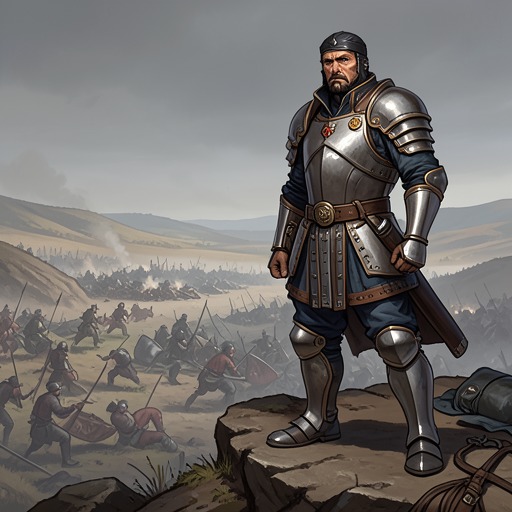
On September 25, the French and Burgundians insisted on leading the attack rather than following the forces of King Sigismund of Germany and Hungary. After an initial advance and fighting against Ottoman forces, the crusaders were struck by cavalry held in reserve. Some survivors retreated down the slope toward the city; others scrambled across the Danube to safety. The river thus appears at the end of the campaign as a desperate route away from the battlefield, sharply contrasting with its earlier role as a line of advance and supply. The defeat at Nicopolis was catastrophic. Jean de Vienne fell with the banner of the Virgin in his hand, while many crusaders surrendered and thousands were taken prisoner. The account does not establish whether Carrouges died fighting, was captured, or escaped; it says only that his fate is unknown and considers flight unlikely. The Danube’s place in his story is therefore geographical rather than biographical: it anchors the campaign’s route and the retreat, while the river’s presence cannot resolve the uncertainty surrounding the knight’s end.