Decline of judicial combat in France
The Last DuelThe decline of judicial combat in France was a long, uneven retreat from a public legal procedure, not an abrupt disappearance. The duel between Jean de Carrouges and Jacques Le Gris in 1386 was the last one authorized by the Parlement of Paris. Its exceptional approval, and the controversy that followed its outcome, marked a turning point: the practice persisted beyond the court’s jurisdiction and elsewhere in Europe, but increasingly ceased to belong to the formal administration of justice.
A rare remedy in a contested case
By 1386, the Parlement had not authorized a duel in a rape case since 1354. Over the preceding half-century it had rejected appeals for judicial combat in 1330, 1341, 1342, 1343, 1372, 1377, and 1383. The request by Jean de Carrouges was therefore made against a clear pattern of refusals. His appeal followed an adverse judgment by Count Pierre, whose court was responsible for disputes between his vassals but whose favorite, Jacques Le Gris, was the accused party. A vassal who believed his lord had delivered an unfair judgment could appeal to that lord’s overlord; because Count Pierre was a vassal of the French king, Carrouges could take the case to the royal court in Paris.
The proceedings also exposed how legal options depended on status and jurisdiction. Le Gris, a cleric in minor orders as well as a squire, could seek to have his case transferred from the secular Parlement to a church court by claiming benefit of clergy. His lawyer, Jean Le Coq, urged him to use that avenue because a church court would not require a duel. Le Gris refused. Meanwhile, the allegation rested on testimony that lacked corroboration, and the case divided people at court: both men were known in Paris, both had served the king, and powerful supporters had pledged themselves to one side or the other. The Parlement’s decision to authorize combat was unusual not only because of the rape accusation but because judicial duels were already rare.
Authorization and public ceremony
The court’s decision may have reflected political pressures as much as legal reasoning. With the king and his uncles away in Flanders, planning an invasion of England, the Parlement may have wished to avoid appearing to choose between two prominent royal servants and the factions behind them. By granting Carrouges’s request, it left the case’s resolution to the duel rather than issuing a judgment that might deepen the controversy. The king later postponed the combat so he could attend, and the event proceeded under royal authority.
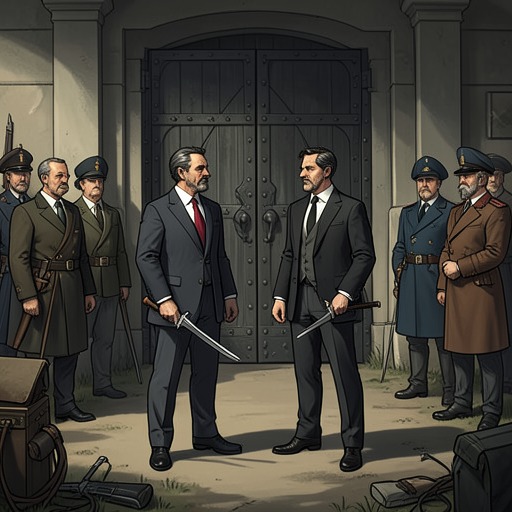
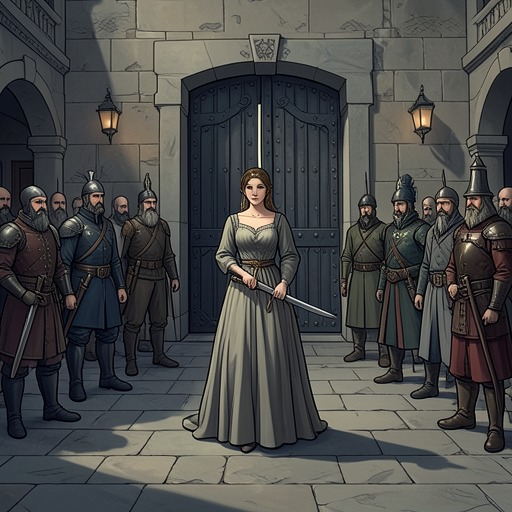
The scale and regulation of the spectacle show what was at stake in this older form of justice. Thousands of spectators were expected at Saint-Martin’s field, from commoners gathered around the enclosure to foreign nobles and members of the royal court seated according to rank. Carrouges arrived with pledges and attendants, prepared for combat; Marguerite de Carrouges arrived in a black-draped carriage after recently giving birth. Before the fighting began, officials inspected the weapons, and a herald proclaimed rules backed by severe penalties. The audience was required to remain seated and silent. The procedure made a disputed case visible to the king and a large public, but the outcome of the contest could not independently establish what had happened in private. The crowd’s eventual approval of Carrouges’s victory showed how the duel could produce collective certainty even where the underlying allegation had been difficult to corroborate.
The Parlement’s final authorization
Carrouges killed Le Gris, and the crowd answered the knight’s question about whether he had done his duty with a unified shout of approval. The result settled the immediate contest under the rules of the wager, but it did not end disagreement over the case. The account stresses that the truth of the alleged crime cannot now be known for certain: some chroniclers doubted Marguerite’s testimony, while others accepted her repeated sworn account. Le Gris’s descendants were still protesting the duel’s outcome five centuries later.
The Parlement’s authorization was the last of its kind. Later appeals for trial by combat reached the court, but none resulted in an order permitting a duel. The controversial verdict has been credited with hastening the decline of a practice that many regarded, then and in later centuries, as barbarous. That interpretation does not make the 1386 decision the sole cause of the change: the evidence instead shows a court already reluctant to authorize combat, followed by a sharp institutional boundary between this final sanctioned duel and subsequent unsuccessful appeals.
Survival beyond the court and transformation
Judicial duels nevertheless continued for roughly another century in areas outside the Parlement’s jurisdiction. They took place in parts of Brittany and in parts of Flanders under Burgundian control. Examples included a duel between two nobles at Arras in 1430, a public fight with clubs between two burghers at Valenciennes in 1455, and a duel at Nancy in 1482. The practice also survived elsewhere in Europe, especially in Britain, where nobles and commoners continued to claim the privilege. A duel to the death was fought in Ireland in 1583 with Queen Elizabeth’s approval, and trial by combat was not abolished in England until 1819, after a murder case produced a challenge to a duel.
Over the longer term, the duel’s legal and social character changed. Its earlier purpose had been to settle quarrels before they escalated into feuds; in the Middle Ages, it became a formal procedure shaped by religious ceremony and chivalric display, staged before courts and crowds. In most European countries and in the newly independent United States, the later duel instead became private and illegal, usually fought with pistols over matters of personal honor rather than criminal complaints. A victor who killed an opponent could face a murder charge, a sign that combat had moved outside the legal system. The contrast is stark: the medieval contest placed bodies, oaths, rank, and royal authority on a public field, while its later counterpart retreated to secrecy and carried the risk of prosecution. The 1386 duel stands at the hinge between those forms, both the last judicial combat sanctioned by the Parlement and a spectacle whose solemn public grandeur was not to return.