French royal court
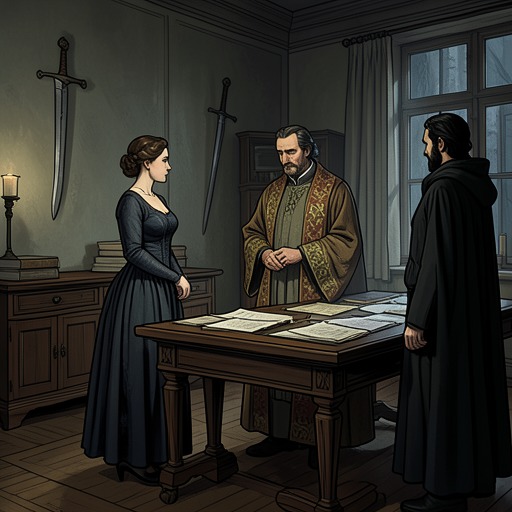
The Last DuelThe French royal court became the national stage on which the Carrouges–Le Gris affair moved beyond a local quarrel and into royal justice. Its role joined political authority to legal procedure: the Parlement of Paris considered the appeal, the king’s court became a place of accusation and public attention, and Charles VI presided over the judicial duel whose outcome was understood as a divine judgment. The court could organize and authorize the test, but it could not make the truth the duel purported to reveal independently verifiable.
Royal Authority and Judicial Combat
The French royal court’s involvement rested on a changing relationship between trial by combat and royal jurisdiction. Judicial duels had long served as a form of legal proof and appeal, but their use narrowed as kings sought to strengthen their authority against powerful lords. In 1258, Louis IX replaced duels in French civil cases with the enquête, a formal inquiry based on evidence and testimony. Criminal appeals by noblemen nevertheless continued to leave room for combat.
The restrictions imposed by Philip IV show the tension between the custom and the Crown’s interests. He first outlawed judicial combat in wartime in 1296, judging that duels among nobles depleted the manpower needed for defense, and banned it in peacetime in 1303. After noble resistance, Philip IV’s 1306 decree on judicial combat restored it as an appeal in certain criminal cases, including rape, but placed such proceedings under the king’s direct jurisdiction. The royal court thus inherited a procedure that preserved a noble privilege while bringing its exercise within the king’s authority.
From a Seigneurial Dispute to the Royal Stage
The case first passed through a different jurisdiction. In late January 1386, Count Pierre of Alençon investigated the report that Jean de Carrouges accused Jacques Le Gris of attacking Marguerite de Carrouges. The count questioned Jean’s brother-in-law, Sir Bernard de La Tour, and Jean Crespin, a squire who had known the parties. They reported that Jean and Marguerite had repeatedly made the accusation known and wished to seek justice from the count. Count Pierre convened his own court to hear them. That hearing was not a session of the French royal court: it was the seigneurial proceeding whose verdict the later royal appeal would contest.
When Jean brought his case to Paris, he invoked the right of a nobleman appealing to the king to challenge his opponent to judicial combat. The appeal therefore raised more than the allegation itself. It asked the king’s institutions to review a lord’s judgment and to decide whether an increasingly rare and controversial procedure could be used. The Parlement of Paris held the inquiry, while the royal court supplied the political setting in which the quarrel became a subject of wider debate.
The affair widened further when Thomin du Bois, Marguerite’s cousin, confronted Adam Louvel at the Château de Vincennes before Charles VI, the king’s uncles, and courtiers. Thomin accused Louvel of attacking Marguerite and threw down his gage of battle to challenge him. Louvel requested time to consult counsel. A later record indicates that the two wagers of battle may have been combined into one case. The royal setting made the dispute visible to an audience far beyond the original parties and their local lord’s court.
The Court as a Network of Participants
The appeal drew other nobles into the case through the system of pledges. When the Parlement allowed Jean and Le Gris to remain at liberty within Paris during the enquête, each had to promise to appear when summoned and name six noblemen responsible for producing him, by force if necessary. The record for July 9 lists twelve pledges. Among them, Jean’s chief pledge was Count Waleran de Saint-Pol, a celebrated veteran and a figure close to the king; one of Le Gris’s leading pledges was Philip of Artois, Count of Eu, recently returned from campaigning in Gascony.
These obligations turned a dispute between two men into a matter involving an extensive circle of families, followers, and court connections. The pledges were not merely procedural names: each had his own associates, multiplying the number of people with an interest in the outcome. The controversy became a subject of gossip and heated discussion at the French royal court even before the official inquiry had run its course, and the affair’s reach soon extended throughout France and beyond. The court functioned not only as a seat of judgment but also as a social network through which the case acquired national prominence.
Charles VI and the Duel’s Public Ritual
The king’s role became explicit when the Parlement authorized a duel in his name. By law Charles VI was its presiding judge, not simply its most exalted spectator. He had ordered the combat postponed for a month so that he could attend after returning from Flanders, and insisted that nothing begin until he arrived. Once seated on a cushioned throne warmed by coals and draped in royal blue embroidered with golden fleurs-de-lis, he marked the point at which the ceremonies could proceed.
The royal procession made authority visible before the combatants fought. Trumpeters announced the king; officials and heralds followed, along with a squire carrying the unsheathed Sword of Justice. Charles arrived on horseback with four knights appointed as witnesses, while his uncles and other high-ranking nobles took places in the viewing stand. The marshal, heralds, guards, and witnesses gave the event a formal public order, presenting the duel as a proceeding conducted under royal supervision rather than a private settling of accounts.
Religious ceremony gave that royal proceeding another source of authority. Priests placed an altar at the field’s center with a silver crucifix and an open prayer book bearing an image of Christ’s Passion. The combatants swore three formal oaths, and a priest warned that the guilty man risked damnation in both soul and body. The duel was thus framed as the judgment of God, but its timing, venue, rules, and supervision belonged to the king’s legal and political order. Royal authority and sacred sanction reinforced one another, even as the claim that combat disclosed divine truth remained impossible for the court to verify apart from its result.
Consequences for the Court and the Institution
The fight between Jean de Carrouges and Jacques Le Gris was the last judicial duel sanctioned by the Parlement of Paris. Later appeals for trial by combat came before the Parlement, but none produced an authorization for another duel. The contested outcome has been credited with hastening the decline of an institution already criticized as a barbarous form of justice.
Judicial combat did persist beyond the Parlement’s jurisdiction, including in Brittany and parts of Flanders under Burgundian control, and it continued elsewhere in Europe. That survival underscores the importance of jurisdiction: the French royal court did not immediately extinguish the custom everywhere, but its refusal to authorize later duels marked a decisive limit on the practice within its own sphere. In the Carrouges–Le Gris affair, the court gave a local accusation national consequence and invested a lethal contest with royal and religious authority; the controversy that followed also exposed the limits of that authority to settle what had happened.