Jean de Carrouges–Jacques Le Gris quarrel
The Last DuelThe Jean de Carrouges–Jacques Le Gris quarrel transformed a relationship of trust into a public contest over accusation, honor, and proof. After Marguerite de Carrouges accused Le Gris of assault, her husband pursued the charge through the Parlement of Paris; when the court authorized judicial combat, the former friends became opponents in a duel that ended with Le Gris’s death. The verdict resolved the proceedings, but conflicting accounts and later legends ensured that the dispute’s central question remained contested.
Friendship, marriage, and the grounds of conflict
Jean de Carrouges described Le Gris as one of his closest and most loyal friends, someone he had trusted and confided in for years. The relationship had been marked by an especially intimate bond: Jean chose Le Gris as godfather to his firstborn son. At the baptism, Le Gris held the child at the font as the priest dipped him in the sacred water. In Jean’s account, the episode made the accusation that followed a betrayal not merely of friendship but of a relationship bound up with family and religious ceremony.
The men’s earlier dealings with Marguerite also carried the language of reconciliation. At the house of Jean Crespin, where Le Gris first met her, Jean instructed his wife to kiss Le Gris as a sign of peace and friendship between the two men. This remembered gesture later stood in stark contrast to the proceedings in which Jean charged his former friend with a grave crime.
The marriage itself existed within strict expectations about women’s conduct and inheritance. Marguerite was much younger than Jean, and a well-born wife was expected to be loyal and chaste; legitimate heirs mattered to the continuity of aristocratic bloodlines and estates. Such norms shaped the public stakes of the accusation. The charge threatened Le Gris’s standing, while the scandal placed Marguerite’s reputation and the honor of the Carrouges household under scrutiny. This social context helps explain the conflict’s intensity without determining the truth of the accusation.
The accusation and its risks
The alleged assault took place at Capomesnil on 18 January 1386. Le Gris warned Marguerite not to tell her husband, claiming that Jean might kill her. The warning exploited a genuine danger within the circumstances described: Jean was known to be jealous and suspicious, and an accusation of adultery could expose a wife to severe consequences. Le Gris may have expected that fear to keep Marguerite silent, although the evidence cannot establish his intention with certainty.
Marguerite did not remain silent. While waiting for Jean to return from Paris, she committed the day and time of Le Gris’s arrival to memory, anticipating the questions she would face from her family and the public ordeal that might follow. She disclosed the accusation after Jean returned, probably on 21 or 22 January. Her case faced formidable obstacles. She would have to establish what had happened without supportive witnesses, while Le Gris was Count Pierre of Alençon’s favorite and a well-liked figure at the royal court. As a cleric in minor orders, he could also seek the privilege of being tried in a church court. Marguerite’s family history added another burden: her father’s treason had left the Thibouville name under a cloud, and Jean was regarded as one of the count’s troublesome vassals.
Jean’s pursuit of the case therefore joined personal grievance to the demand that a public accusation be answered. The charge also reopened the contradiction at the heart of the former friendship: a man once trusted with the Carrouges family’s child was now accused by Jean’s wife and pursued by Jean as an enemy. The legal process could test sworn accounts, but the former closeness of the men could neither prove nor disprove what Marguerite said had happened.
Testimony, inquiry, and uncertainty
The Parlement of Paris required the evidence to be put in writing. Although women could not bring criminal charges on their own, Marguerite testified as the chief witness and was closely and repeatedly questioned. By the time the inquiry began in mid-July, she was six months pregnant and appeared before the assembled court. The three principal participants gave their testimony in Norman French, but no transcript of their spoken words survives. Instead, a professional scribe summarized the case in Latin in a surviving manuscript of nearly ten densely written folio pages.
Jean’s written charges emphasized the former intimacy between himself and Le Gris, then recounted Le Gris’s first meeting with Marguerite at Jean Crespin’s house. Le Gris offered a lengthy defense. The surviving record therefore preserves not the participants’ exact spoken testimony but a formal account shaped by the court’s written process. That distinction matters: the document is detailed, yet it is not a verbatim record of everything said.
The lawyer Jean Le Coq’s private diary adds another perspective. He listed arguments for and against his client, including the fact that Marguerite never relented in affirming that the crime had occurred. He also recorded that knights claimed to have seen Le Gris with Count Pierre throughout the day in question. Some people reportedly suggested that Le Gris refused to confess because of the scandal a confession would bring upon his sons and friends, particularly after Count Pierre had declared him innocent. These remarks reveal the pressures surrounding the defense, not a definitive resolution of the evidence.
Le Coq’s conclusion was that no one really knew the truth of the matter. The lawyer’s position is significant precisely because he had access to the proceedings and opportunities to question his client, yet did not claim certainty. The surviving evidence thus holds together determined testimony, a contested alibi, political and personal loyalties, and the limits of what the court could establish.
Judicial combat and the rupture made physical
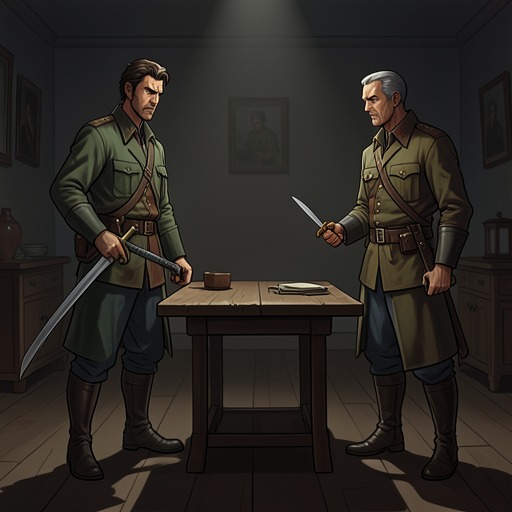
After the inquiry, the Parlement authorized a judicial duel. Its decision converted the unresolved dispute into a test of combat: under the rules described in the book, killing an opponent, forcing him to confess perjury, or driving him from the field could establish guilt. The duel was not simply a continuation of the men’s earlier rivalry. It made their opposing claims a matter of bodily risk and placed the legal judgment in the hands of a fight whose outcome could not be predicted.
The ceremonies sought to put the combatants on equal terms. Jean was already a knight, whereas Le Gris was a squire, so Le Gris was knighted before entering the field. The formal equality concealed real differences. Jean had survived numerous campaigns, most recently in Scotland, and had greater experience of military combat. Le Gris was larger and stronger, wealthier, and able to equip himself with a better horse, armor, and weapons. He appeared in good health, while Jean was weak from a long-running fever that had flared again that day. These differences made the result uncertain even before the fighting began.
The sources also disagree about the form of the encounter. Some accounts describe a joust with lances, while others report that the men fought on foot with swords or give few details. What the evidence does establish is that the judicial duel was not a friendly tournament: once combat began, its conventions did not guarantee chivalrous restraint. Jean killed Le Gris, and the outcome was widely interpreted as either vindication or an unjust death. The duel ended the immediate legal contest, but it could not make its physical result a conclusive account of the events at Capomesnil.
Aftermath and the quarrel’s unresolved legacy
Reactions to the duel were divided. Jean Froissart, writing within a few years, reported that the king, court, and crowd rejoiced at the outcome; Le Coq recorded mixed responses, with some considering Jean vindicated and others believing Le Gris had been unjustly slain. Later chronicles introduced the story that Marguerite had accused Le Gris mistakenly and that another man eventually confessed. The version changed over time, including whether the supposed confessor was a condemned felon or a dying man, but the theme of a false accusation revealed too late persisted.
The book challenges both that account and the opposing theory that Marguerite knowingly fabricated the charge. Her identification of two alleged attackers, including Adam Louvel, made a deliberate lie more difficult to sustain: adding a second accused man increased the burden of proof and exposed her story to further challenge. The author likewise considers mistaken identity unlikely, while acknowledging that the case cannot be resolved to everyone’s satisfaction. This assessment does not erase the uncertainty recorded by Le Coq; it distinguishes the weaknesses of later explanations from proof of what happened.
The legend was later used to criticize judicial combat. Enlightenment writers treated the affair as evidence of the folly of allowing a duel to decide a legal case, and later popular histories repeated the story of Le Gris’s wrongful death and Marguerite’s belated regret. Yet the duel’s place in legal history was specific: it was the last judicial combat authorized by the Parlement of Paris, not the end of every later duel. The quarrel endured because its decisive public ending—the death of one man and the apparent vindication of another—could settle the court’s procedure without settling the truth.